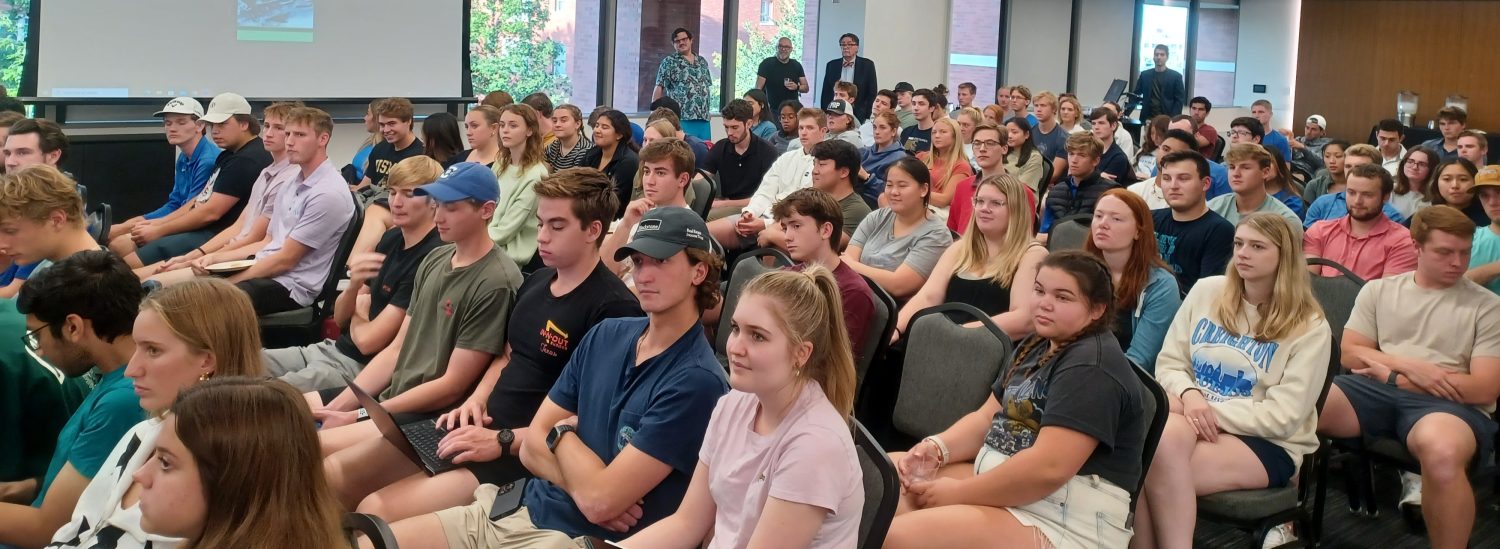
The 2016 Business, Faith and Common Good Symposium was an event to highlight the ways faith and a concern for the common good can motivate business practices. We brought in 9 businesses and organizations, and had Michael Naughton as our keynote speaker.







Companies represented included Complete Nutrition, Thrasher, Thrivent, Chick-fil-A, Habitat for Humanity, Prairie Plains Resource Institute, Data Systems, Verdis, and Landmark Group. Five of those nine were new– Thrivent had actually heard about the symposium and asked if they might participate– and it was great to bring in new perspectives which were inspirational to the students. It was also great to bring back companies who have such a strong story that we wanted them back again. The format was that each of these companies had their own session. There were three breakout sessions at three different times, for a total of 9 presentations. Typically they were 30-35 minutes with 10-15 minutes for Q&A.
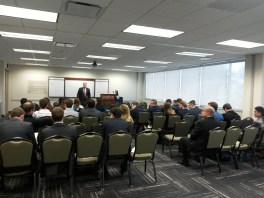
Professor Michael Naughton, director of the Center for Catholic Studies at St. Thomas University was this year’s keynote speaker. Naughton is really a preeminent scholar at the intersection of Catholic Social Thought and business, with 5 books and 40 articles, mostly related to that topic. He also helped coordinate and write the Vocation of the Business Leader issued by the Pontifical Council for Justice and Peace (2012) which is a key document for thinking about business practices from a faith perspective.
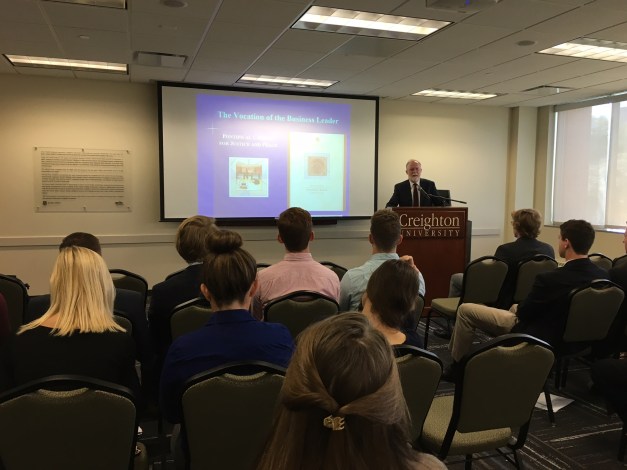 Naughton’s keynote drew on the ” Vocation of the Business Leader” document, which he helped write as a summary of some of the key teachings of Caritas En Veritate. He contrasted three notions of work, each paired with a distinct notion of leisure. First, one might think of their work as just a job, and be fairly disengaged from work, seeing it merely as something which must be done for money. If you view work as a job, then you view leisure as an escape from your job’s drudgery– so an unhealthy detached view of work leads to an equally unhealthy view of leisure. Leisure on this view is a-musement. Atheist means literally without-God, and sine muse means “to consider thoughtfully”, “amusement” means “without thought”– when we amuse ourselves we are trying to escape thinking and consideration of our situation. And ironically to escape more often requires more money, so you have to work more, which leads you to need to escape more, in a vicious cycle! On the other hand, if you are all too engaged in work, it may lead to a careerism where work is everything and it consumes you. Leisure, on this careerist view, is simply time to recharge so you can do more work– sharpening your saw– and so leisure’s sole purpose is for the utility of working more. The better view of work, according to Naughton, is a view of work as a vocation– a calling. With such a view of your work, you see that God has called you to a particular task in a community of persons. All people have dignity, and each has a vocation of their own to help serve the common good. Leisure linked to this vocation view of work is sabbath, where one rests to reflect on one’s place in the world, on things beyond work which actually give meaning to the work, and on one’s relationships to others. This thoughtful consideration is literally the opposite of a-musement!
The symposium has definitely developed over time. In 2013 we invited a speaker, internationally known Christian philosopher Robert Audi of Notre Dame, to give a talk on “business and the common good” here at Heider. It was a nice event, and well attended. For 2014 Tom Kelly and I worked to develop the first symposium, coming up with the idea to invite and we had as keynote Daniel Finn, a very well known Theologian who is also an economist. For 2015 we had a reknown Catholic business ethicist Ken Goodpaster, and this year we had Michael Naughton. Really, these are three of the greats in the field, so we have an outstanding track record and legacy. So we are very proud of that. The students who went to the sessions gave me some great feedback on the sessions– even the lesser-attended sessions were generally well-liked by students. Students were moved by many of the presentations, but I got significant outstanding feedback on Naughton. One student said that his talk helped her to see where she is at, and where she wants to be. That is exactly the kind of transformational learning we are hoping for through the symposium speakers and events.
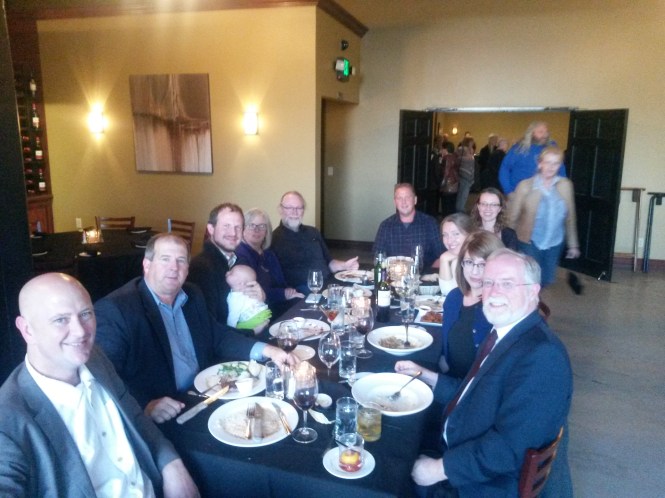
 Business, Faith, and the Common Good Institute