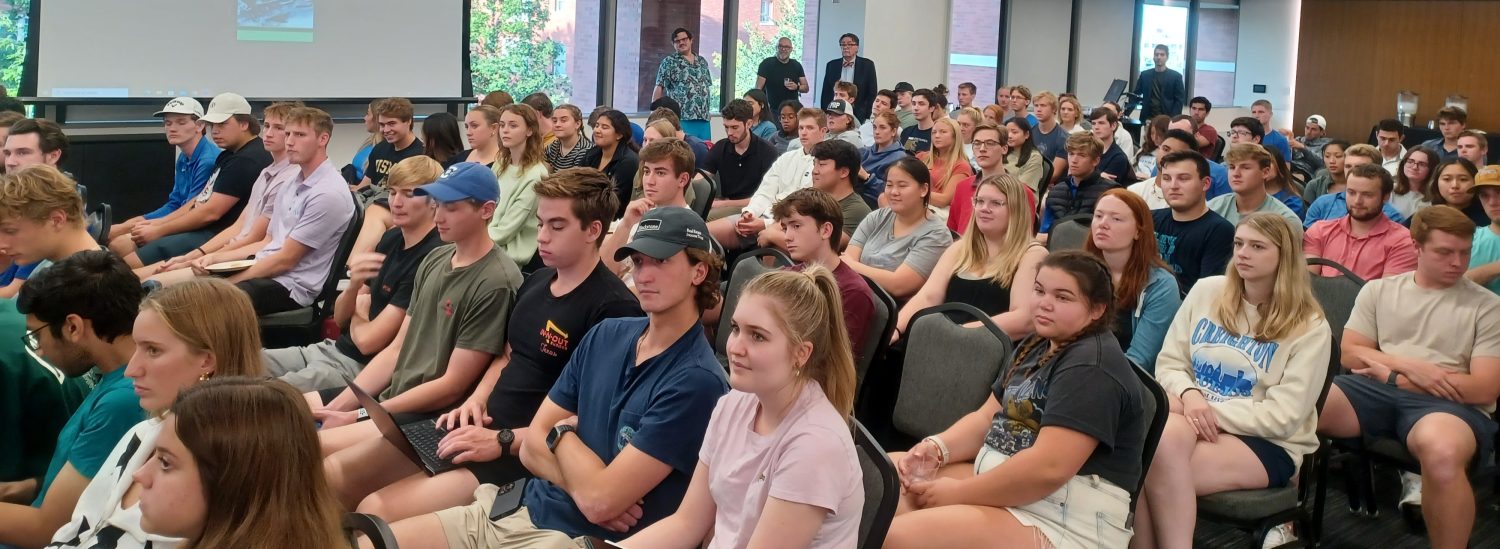


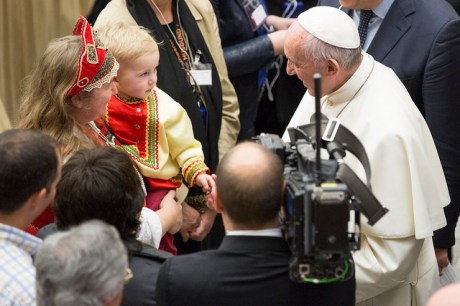
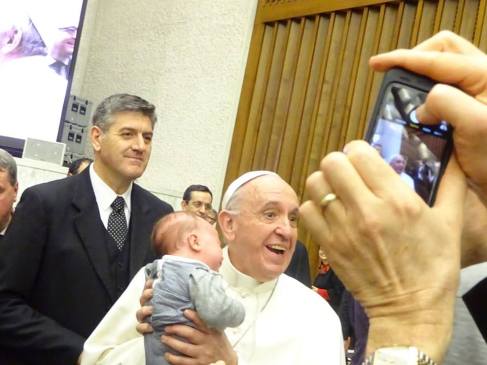
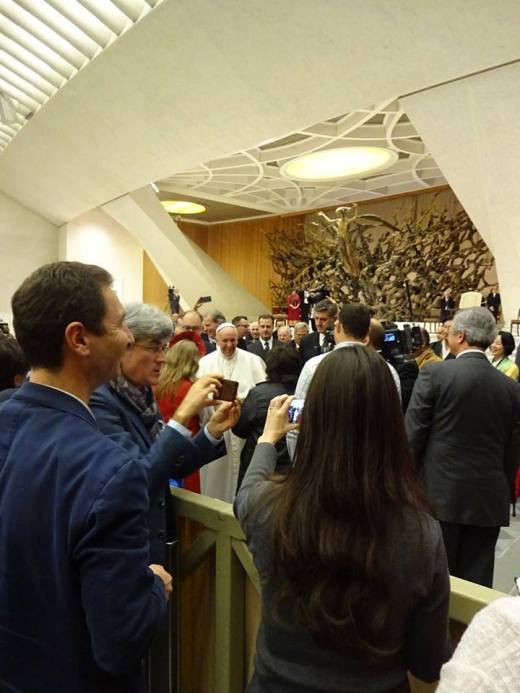
As a business-member of the Economy of Communion, I was invited to join a worldwide conference on EOC in Rome, culminating in a meeting with Pope Francis where he spoke to our group. Pope Francis had asked that we come to meet with him and hear from him at the Vatican.
In his talk to the Economy of Communion group, Pope Francis put his finger on a key point: “Capitalism knows philanthropy, not communion. It is simple to give a part of the profits, without embracing and touching the people who receive those ‘crumbs’.” This is ultimately what is so different about the economy of communion—it is a vision to live out our lives and practice our faith through our business activities in a way which is truly novel and transformative. Economy of Communion is not a philosophy of sharing money, it is a vision of using business to help build community and to help people through our private enterprise. Through business we help bring about communion.
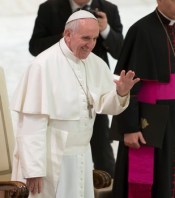
In this vision, Pope Francis pointed out, “You see the entrepreneur as an agent of communion. By introducing into the economy the good seed of communion, you have begun a profound change in the way of seeing and living business.” This has significant affects on how and why one participates in business practices—and bringing even our business practices into our way of forming communion impacts our communion as well:
Certainly the economy becomes more beautiful, but communion is also more beautiful, because the spiritual communion of hearts is even fuller when it becomes the communion of goods, of talents, of profits. .
While Pope Francis has in various contexts brought up criticisms of aspects of the current capitalist system, he is not against capitalism. He, as most Popes, agree with St. Thomas Aquinas that private property and private ownership is important. That is why, when one of my fellow parishioners at church asked if Pope Francis is a Marxist, I could say without hesitation, “certainly not, nor a socialist”. But he does think we as business owners can use our business to bring about communion in society.
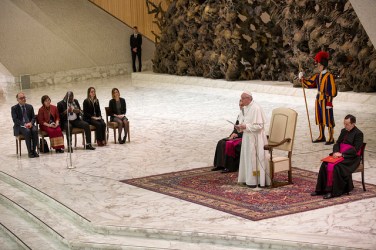
In speaking to us, Pope Francis said he had three things he wanted to talk about. First, money. “Money is important, especially when there is none, and food, school, and the children’s future depend on it. But it becomes an idol when it becomes the aim.” When the accumulation of money for ourselves per se becomes the aim, it becomes idolatrous, and “When capitalism makes the seeking of profit its only purpose, it runs the risk of becoming an idolatrous framework, a form of worship.” Pope Francis pointed out that the pursuit of security in money is a deluded quest for immortality.
His advice for not making money an idol is hard but simple:
The best and most practical way to avoid making an idol of money is to share it with others, above all with the poor, or to enable young people to study and work, overcoming the idolatrous temptation with communion. When you share and donate your profits, you are performing an act of lofty spirituality, saying to money through deeds: you are not God, you are not a lord, you are not a master!
We overcome the temptation to let money become our idol by giving it, giving ourselves, and spending ourselves and our money for purposes beyond ourselves—for God’s purposes. This practice is essential.
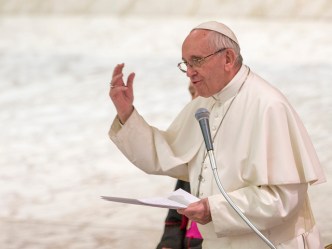
Second, Pope Francis spoke about poverty, pointing out that since Biblical times, the poor have always been with us, and they are often considered by society to be ‘discarded lives’. Though we have some new ways to help some of the poor, “The principal ethical dilemma of this capitalism is the creation of discarded people, then trying to hide them or make sure they are no longer seen.” And eventually we can become blind to this discarding, and to the discarded. Francis said, “A serious form of poverty in a civilization is when it is no longer able to see its poor, who are first discarded and then hidden.” Insofar as we shield ourselves from the poor, we become poor as well.
He then spoke about the ironic hypocrisy of a system which cares for the poor which it itself helps to create:
Aircraft pollute the atmosphere, but, with a small part of the cost of the ticket, they will plant trees to compensate for part of the damage created. Gambling companies finance campaigns to care for the pathological gamblers that they create. And the day that the weapons industry finances hospitals to care for the children mutilated by their bombs, the system will have reached its pinnacle. This is hypocrisy!
Rather than try to give aid to the poor, “The economy of communion, if it wants to be faithful to its charism, must not only care for the victims, but build a system where there are ever fewer victims, where, possibly, there may no longer be any.” Charity is not enough, we must work towards “changing the rules of the game of the socio-economic system.” The Good Samaritan helps the victim, but we must work to change the system to help reduce the amount of victims to begin with. This is done by us in the way that we conduct our own business- the values which guide our decision-making, our conduct towards employees and other businesses, our customers, and how we envision the purpose of our business itself. It especially will affect the way we treat others. Often it is said that Economy of Communion is about gratuity and reciprocity—meaning that we act with grace towards others through business, and that we act in faith that there will be reciprocity of kindness and goodwill. That is a radical departure from the dog-eat-dog world of business where people treat others poorly, then excuse it by saying, “sorry, nothing personal, its just business”. Those with a vision of business informed by the Economy of Communion will act quite differently, living out gratuity and reciprocity as we pursue communion through business:
For communion one must imitate the merciful Father of the parable of the Prodigal Son and wait at home for the children, workers and coworkers who have done wrong, and there embrace them and celebrate with and for them — and not be impeded by the meritocracy invoked by the older son and by many who deny mercy in the name of merit. An entrepreneur of communion is called to do everything possible so that even those who do wrong and leave home can hope for work and for dignified earnings, and not wind up eating with the swine. No son, no man, not even the most rebellious, deserves acorns.
Third, Pope Francis spoke about the future. The EOC has existed for 25 years (since 1981), but what should our future hold? He encouraged us that though we are a very small group of businesses with this vision of communion guiding us, we can be salt and light and leaven in the world. The key is, “What do we do so as not to lose the active ingredient, the ‘enzyme’ of communion?” His answer is that we must share it: “The economy of communion will have a future if you give it to everyone and it does not remain only inside your ‘house’. Give it to everyone, firstly to the poor and the young, who are those who need it most and know how to make the gift received bear fruit!” And this giving is not just giving of the profits of our business, but of ourselves—the gift of ourselves to others. He says, “Today’s economy, the poor, the young, need first of all your spirit, your respectful and humble fraternity, your will to live and, only then, your money.” Money is important of course, but it comes last. This is why EOC is so much more than charity or aid.
Finally, Pope Francis concluded his remarks with a challenge to all of us:
You already do these things. But you can share more profits in order to combat idolatry, change the structures in order to prevent the creation of victims and discarded people, give more of your leaven so as to leaven the bread of many. May the ‘no’ to an economy that kills become a ‘yes’ to an economy that lets live, because it shares, includes the poor, uses profits to create communion.
I hope you continue on your path, with courage, humility and joy. “God loves a cheerful giver” (2 Cor 9,7). God loves your joyfully given profits and talents. You already do this; you can do so even more.
I hope you continue to be the seed, salt and leaven of another economy: the economy of the Kingdom, where the rich know how to share their wealth, and the poor are called ‘blessed’. Thank you.
It was a powerful message to us. At times he was literally preaching to us—admonishing us and encouraging us to rise to the challenge. It was a pastoral message we will not forget, I am quite sure, and it is clear that Pope Francis understands what the Economy of Communion movement is about, and wants it to spread like leaven throughout the economies of the world.
 Business, Faith, and the Common Good Institute