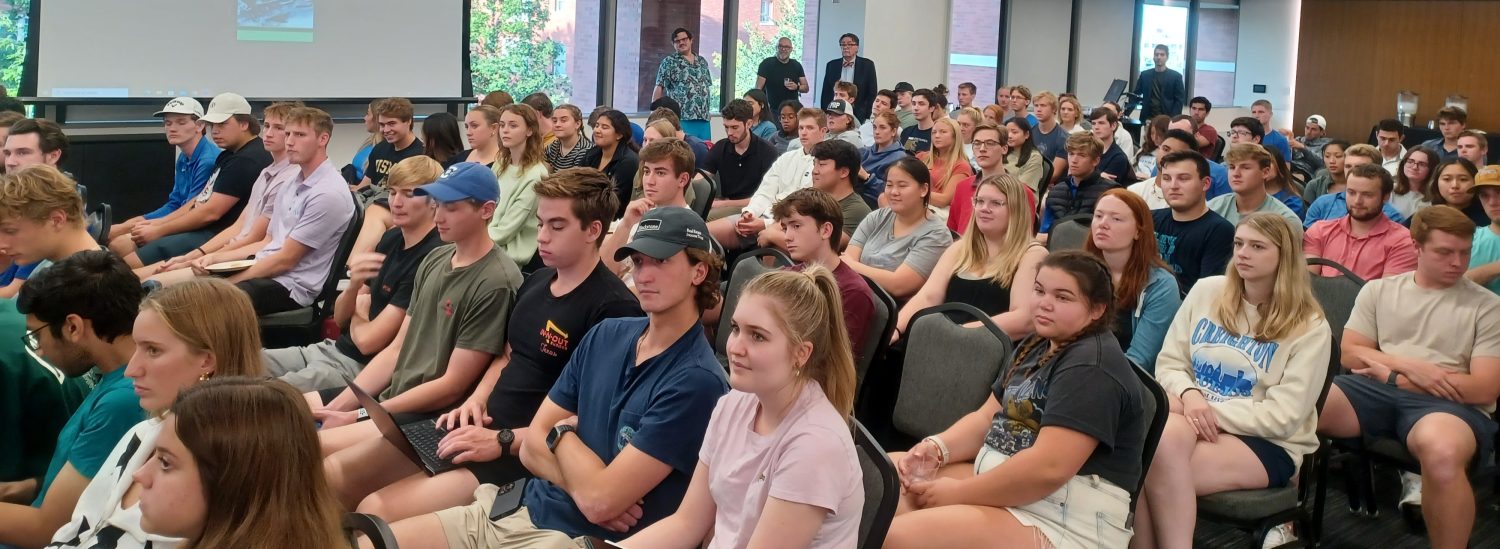

Mary Hirschfeld, economist and theologian from Villanova, spoke to a crowded room about Christian concerns in economics, particularly economic exclusion on Thursday night at Heider College of Business. Dr. Hirschfeld has an interesting story. A Harvard-trained economist, she had a tenured position in Los Angeles for 15 years before going through a dramatic conversion to become a Catholic. Shortly after, she left her tenured position as an economist and began studies in theology at Notre Dame, where she achieved her second Ph.D, this time in theology. Eventually she landed at Villanova, where she combines her concern for faith issues with her knowledge of economics.
Dr. Hirschfeld’s talk focused on the concept of inequality, and particularly, what a Christian theologian should bring to the discussion which is unique. While a lot of concern is focused on inequality, Dr. Hirschfeld challenged us to consider to think as Christians about economics and focus instead on how we use money to protect ourselves and exclude others and to define our status in society. She pointed out that Aristotle said money should be considered like medicine– a certain amount is needed to fulfill a particular end. But many times, she said, the debate about inequality is like having a debate about who has more aspirins– “I really only need two aspirins to deal with my headache, but we get into debates about I only have 10 aspirin and you have 12, or 20!”
What is it that we really need? The quest to maximize, and to earn more and more and spend more and more is part of what undermines our happiness. If we consider wealth as “having what we need” we make ourselves poorer by expanding our financial obligations by aquiring more and more, which then requires more of our efforts towards maintaining our own created needs, and away from concern for others and the common good. We should instead think about what a reasonable amount is for us to live on, and to try to stay within those parameters. When you do this, Dr. Hirschfeld said, you find a real freedom and a lack of stress because you aren’t trying to maximize your income and purchasing power and acquisitions. But as Christians, we are especially called to own private property so that we can use it for the common good and share with those in need. Profit is good, and making money in the free market is great, but setting limits on one’s own ‘economic requirements’ is a matter of spiritual health for us.
Drawing on Pope Francis’ concerns regarding economic exclusion and exploitation, Dr. Hirschfeld reframed the discussion on inequality, saying that the real problem in society is not so much the 1%, but the top 1/3 of us who want to protect our economic status above the other 2/3 by buying into the right school districts, getting our kids in the right colleges, getting the white collar not blue collar jobs, going to the church where aspiring people like ourselves attend, using services to help set ourselves apart in society and having expectations of retirement, vacationing and other types of behavior all which help separate us from the ‘others’ and exclude them. As Christians, we need to overcome class and socioeconomic differences, but we create lifestyles for ourselves which create a great chasm between us and the ‘working class’ and rest of the others. In some ways we actively want those on the ‘other side of the tracks’ to stay there– because that is how we distinguish ourselves and maintain our social standing securely.
After the public talk, Dr. Hirschfeld met with the business, faith and common good seminar class and we discussed some of these matters further, as well as St. Thomas on private property and concern for the common good. Again, Mary challenged us to think about the human-social dimensions of economics and to seriously consider maintaining finite expectations of the amount of money we think we need to live. It is far to easy to use up whatever we have and feel that we need a little more– no matter how much we earn. She shared that until her conversion, she was always of the opinion that ‘if only I could get a 10% raise, then everything would be great’ (even after multiple 10% raises). But somehow at conversion, she was able to learn to really focus on what she really wanted, and to stop spending on a lot of frivolous things which really did not bring her happiness. This in turn allowed her to tithe more and to share generously with others, without hesitation. An open ended maximization view of what we might earn and spend leads to a lack of definition and ironically, to a lack of satisfaction.
It was fantastic to have Dr. Hirschfeld be with us at Creighton, and we look forward to her book which will be forthcoming from Harvard University Press in 2018! Her talk will be aired on KIOS lunch talks sometime in the winter.
Many thanks to our generous sponsors of the BFCGI talks:



office of mission and ministry
 Business, Faith, and the Common Good Institute