


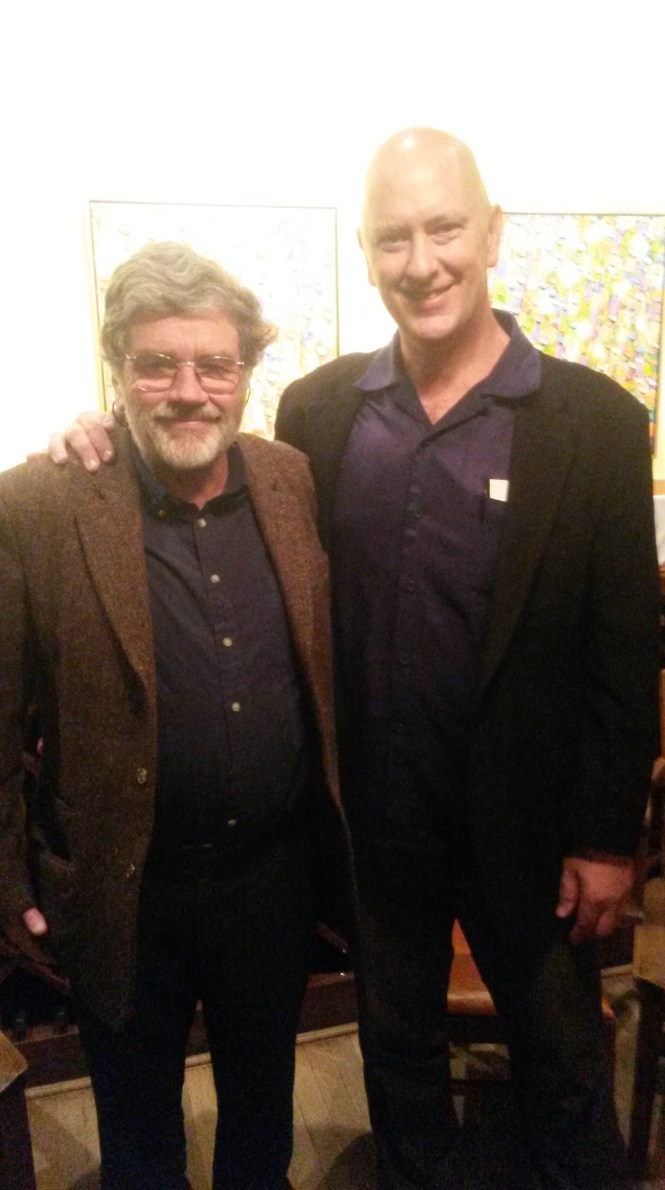
Richard Nielsen came to us from Boston College Thursday evening to help us understand the history of Quaker values, businesses and education, and to make comparisons between the Quakers and Ignatian values.
Some famous Quaker businesses are: Price Waterhouse Coopers, Lloyds, Barclays, Sandy Spring Bank, Chocolate, Cadbury, Fry, Rowntree, Terry, Sony, Lever Brothers (Unilever), Horniman’s Tea, and Wharton of Bethlehem Steel.
Most of these are no longer owned by Quakers. Some distinctive innovations of Quaker Businesses were, Cooperative employee relations, participative decision making, consensus decision making, profit and productivity sharing, continuing innovation with employees, job security with life-time employment with occasional layoffs, eight hour instead of twelve hour shifts, forty hour work weeks, men and women managers promoted from entry level positions, adult education, health care for employees, Home mortgage financing, paid vacations, paid sick days and longer term leaves, subsidized nutritious meals for employees, pensions for employees, unions recognized and supported, and the concept of Servant leadership, created by Quaker Greenleaf.
The Quaker influence was substantial. Nielsen said that this win-win social contract that began with many of the large Quaker family owned/controlled businesses later became the foundation for the 1946-1980 political-economic form often referred to as “managerial capitalism.” Nielsen pointed out that beginning around 1980, managerial capitalism was in large part replaced by the current “finance capitalism” in the U.S. and the U.K. that emphasizes maximization of shareholder wealth rather than a win-win social contract. Many of these influences from the Quakers have been lost in the push for cost savings.


Many Quaker schools are famous: Bryn Mawr College, Cornell University, George Fox University, Haverford College, Johns Hopkins University, Swarthmore College, Wharton School of Finance and Commerce, and Whittier College. The Quaker distinctives have faded over time for most of these schools. Although the Quaker history is there, but its practical affects and influence is muted in most cases. Few Quakers teach at these institutions, and there is little distinctive Quaker influence.
Dr. Nielsen drew a number of comparisons between Quaker and Jesuit values, but he raised a more disturbing concern– are Jesuit schools perhaps losing their identity gradually much like the Quaker schools did?
The history of Quakers, comparison to Jesuits, and possible parallels to decline of the distinctive values were thought provoking and very interesting for the 50+ people who attended (including some local Quakers from the Omaha community).
 Business, Faith, and the Common Good Institute