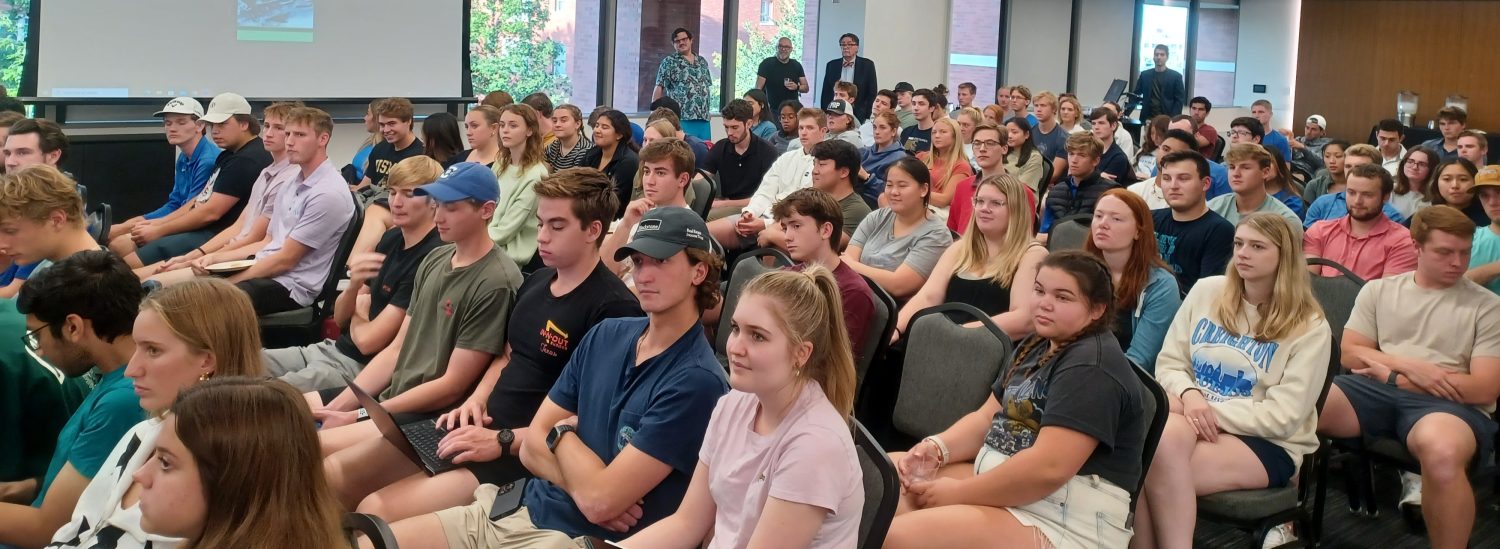
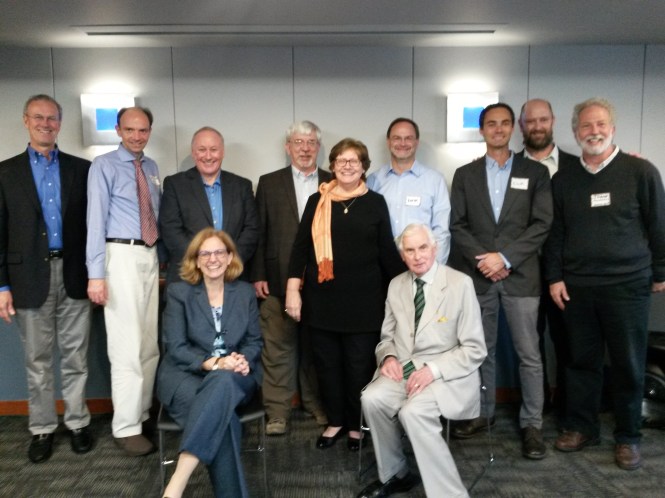



The 2018 BFCGI Symposium was done in tandem with the 2018 annual meeting of the Economy of Communion North America organization, a group of businesspeople, students, faculty and laypeople who pursue a vision of practicing business with a goal of helping human beings and the common good. The symposium brought experts on the topic of business and faith from Paris, Ireland, Washington DC, New York, St Louis, Indianapolis, Minneapolis, and other parts of the country to Creighton University to help our students and community reflect on how business and faith can and should go together. Events started Friday morning at 9 and lasted until Saturday evening.
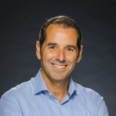 Nick Sanna, COO of RiskLens, serial entrepreneur and longtime member of the Economy of Communion was our first speaker. He gave a brief introduction to EOC, and shared some of his personal experiences of making business decisions with people taking precedence over profit. One of those powerful stories was a time when a recent hire was not working out as a marketing director for his company and Nick told the board he was going to have to let her go. He made an appointment to meet with her, and at the meeting she let him know she had just been diagnosed with breast cancer. Knowing that if he fired her she would be without insurance, he did not bring the matter up and went back to the board and told them he was not going to fire her until she got through her treatment. They did not second guess his decision, and a few months later she was cured of cancer and moved on. In another situation, he had to let some colleagues go during the recession, but felt he should give them double severance pay, since the market was not good for getting anther job. Again, he brought this decision to the board, and he was told “you’d better know what you are doing, or there are going to be more changes” (his job!). When the economic recovery happened, and Nick’s company hired again, some of the interviewees told Nick that through social media they had contacted former employees who had been fired, and those people had such glowing things to say about Nick and his management that the interviewees very much wanted to work at his company. EOC is what helps Nick to ‘stay sane’ and keep focused on what is truly important in work.
 Amy Uelmen Uelman was the founding director of Fordham University’s Institute on Religion, Law & Lawyer’s Work from 2001 to 2011 and is currently at Georgetown Law School. Amy spoke about the apparent ‘opposites’ of economy and faith– one how that the writings of Pope Francis can help us to think about these apparent opposites in unity without compromise. This is at the heart of the Economy of Communion– whose name contains this apparent contradiction– the economy, which is typically considered competitive and cutthroat, and communion, which indicates unity and peace. Rather than an economy of having, the EOC advocates and economy of giving– turning the focus of business around.
 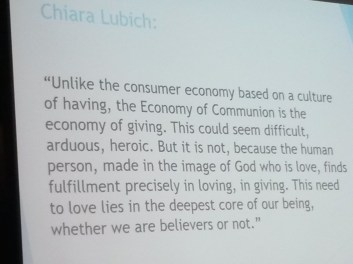 The vision of EOC members is to make profit without compromising concern for human beings– in fact, the focus is to help human beings through business, and keeping that project afloat via profit. Business is seen as a spiritual practice which helps us to become who we are meant to be by helping others fulfill their purpose through meaningful work as well.
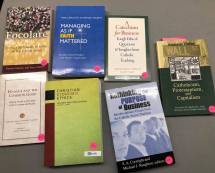
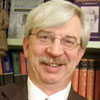 Greg Beabout is professor of philosophy at St. Louis University and has a thorough knowledge of Catholic Social Thought. His books include The Character of the Manager: From Office Executive to Wise Steward. His talk focused on the ethics of ownership– namely, what possible obligations one might have as an owner. Starting with a Christian perspective that all things are God’s to begin with, he drew from the writings of St. Thomas Aquinas, Pope Leo XIII’s Rerum Novarum and other church writings to explain the traditional Christian view that private property is essential for human flourishing, but that a corollary view alongside that view is that if one has enough and anther is in need, you should share. Rerum Novarum, the 1891 encyclical, literally meant “new things” and was dealing with relatively new ‘laissez faire’ economics and the competing ‘socialism’. The pope sought an alternative to both– a humane economy which respects private property as it respects the dignity of humans and concern for the poor. Beabout connected this to the EOC focus on sharing– a concept which was dear to the EOC long before the sharing economy based companies of Uber or AirBnB.
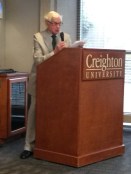 Angus Sibley: Angus Sibley is a retired actuary and former member of the London Stock Exchange. He has written extensively on finance, economics, Catholic theology, and other topics. In 2015 he published Catholic Economics: Alternatives to the Jungle in 2015. and in 2011, The Poisoned Spring of Economic Libertarianism. Angus runs Equilibrium Economicum, a site dedicated to the view that “sound economic policy
means finding and preserving acceptable equilibrium between opposing principles. Between the need for competition and the damage caused by its excesses. Between the need for freedom of enterprise and the abuses of the deregulated jungle.” Mr. Sibley’s talk was a powerful argument for the need for some regulations and ‘brakes’ to help keep the market, itself an inanimate result of human activities, in check– to tame it. The market itself knows economic demand, but not human needs; it knows costs of production, but not human costs. He additionally criticized the tendency towards constant change and innovation in the name of progress, arguing that much of this constant change has diminishing returns.
 Scott Henson International Director, TEAM. Scott holds a Ph.D. in international relations and law from Vanderbilt University. HE was joined by TEAM’s legal counsel, Nick Morgan of Idaho. They presented an overview of evangelical approaches to using business for purposes of faith. Previously, frequently in evangelical missions the purpose of business has generally been used to win souls to Christ or to get entry into countries where missionaries would otherwise have been denied entry, and some people remain in employment they otherwise do not enjoy simply because they have an opportunity to bring Christ to others– such as a biblestudy they run, etc. But there have been some significant shifts in evangelical thinking, modeling a more wholistic approach which sees the gospel to be not only about winning souls for Christ, but to be serving the needs of the needy, as Christ did, because we should give our lives in service to others as Christ who loved the poor, needy, and hungry.
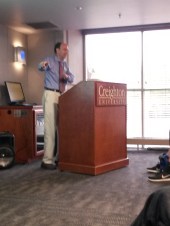 David Cloutier teaches moral theology at Catholic University, and is author of the award-winning The Vice of Luxury: Economic Excess in a Consumer Age, and Walking God’s Earth: The Environment and Catholic Faith, as well as Reading, Praying, Living Pope Francis’s Laudato Si’. His talk was a powerful argument for living our lives with concern for our consumer effects on the common good, and others. He argued that the economy of communion doesn’t accept the typical separation of private and public lives– that I may do whatever I want privately, so long as it doesn’t directly violate others’ freedom. On this pessimistic view of human nature, any desire satisfaction is fine so long as it isn’t illegal and we can pay for it. Cloutier argued that such a view doesn’t take into account the common good. Finally, he argued that EOC businesses should not market futile goods, goods which promise happiness in themselves, or the upscale lifestyle indicative of contemporary consumer culture.
 John McNerney is a researcher in and lecturer in business ethics and philosophy.He has been Head Chaplain/Student Adviser at University College in Dublin, Ireland.He recently published a book, Wealth of Persons: Economics with a Human Face. His talk brought up the centrality of persons in business activity, and the importance of love which is at the root of the vision of business, even drawing on Milton Friedman and Schumpeter for inspiration, along with Zumagni and Chiara Lubich and various encyclicals. Entrepreneurship is personal, creating a space for the human person to creatively contribute, and EOC business should consider the other as me, in a personalistic framework.
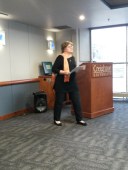 Jean Buckeye is associate professor of ethics and business law are co-authors of the book Structures of Grace, about EOC companies. She is also co-author of Respect in Action: Applying Subsidiarity in Business and she gave a talk explaining the central importance of the Catholic Social Thought concept of subsidiarity for the Economy of Communion practices. Subsidiarity, which essentially encourages that people are empowered to make and speak into decisions which locally affect themselves (rather than decisions being made from a central authority giving little autonomy, power or dignity to those impacted) mirrors the EOC central concern for workers dignity and the human centered focus of business practice.
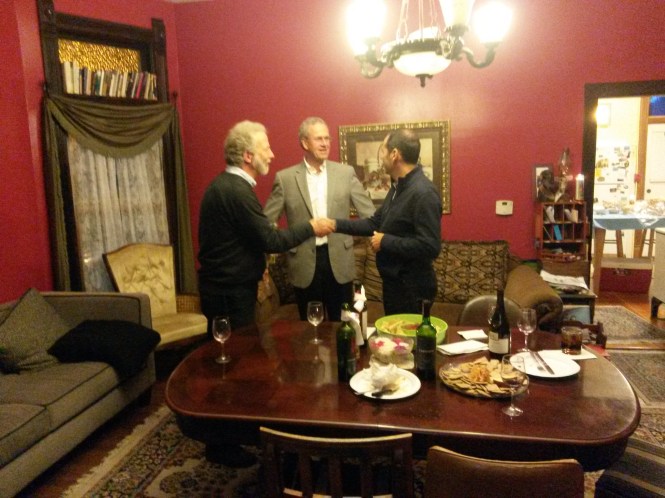
Friday night we had a reception at the Press Club. It was a wonderful evening of discussion and sharing, making new friends and reconnecting with old friends.

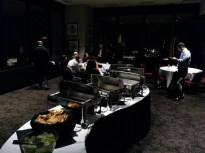
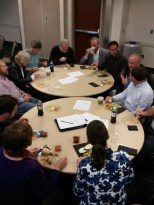
Saturday morning we continued at the Heider College of Business with some EOC workshops and presentations.
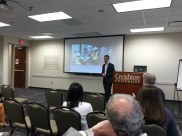 Paul Catipon, president and CTO of NetPro Communications (and EOC company) in New York City shared stories of his worker-focused management practices. He has frequently encouraged clients to hire some of his best employees, because he knows it will be a good career move for his employees. What he didn’t realize is that it means his clients trust him a great deal, and he has previous employees who feel great loyalty to him working for many of his clients, which helps him attract business. He also discussed the importance of being friends with your competition, and how that he will send his competition jobs he cannot do. In one case when he called a competitor to offer them one such opportunity they asked, “what is your cut?” but Paul didn’t want a cut, he just knew his competitor would be able to help his client, so in his mind it was already a win-win. His company has expanded a great deal as he has practiced business in this way.
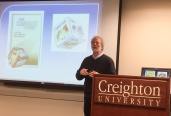 John Mundell is President and Senior Environmental Consultant at Mundell & Associates in Indianapolis, and EOC company. John spoke of our entrepreneurial witness. He has been a tireless leader in the EOC movement for decades, and he shared some of the key elements of the EOC movement in a video, also explaining how they practice it at Mundell and Associates. He also shared about their ongoing internship program, bringing young people to learn about EOC entrepreneurial values for months or a year at a time. Finally, he also shared a video of one of the new exciting projects of EOC, project LIA
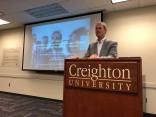 Jim Funk is Global Head of Leadership Transformation at Consulus, Country Director for Consulus USA, and also President, J L Funk & Associates, an EOC company. He shared some of the key management principles involved in aligning your company with your values, both individually and in terms of company policy. He had participants reflect in groups on how EOC principles might make a difference in how businesses are run. It was a productive exercise for all.
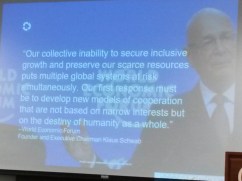
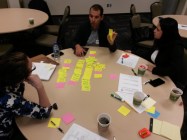 Nick Sanna led a hackathon exercise, bringing out some of the most significant challenges and ways to overcome those challenges for the EOC movement in North America. Some of the takeaways were that it was agreed having a designated staff person rather than volunteer labor to run the organization would likely help propel things forward, that use of social media was essential, and that some more academic development of curriculum and essays for student use would be very useful.
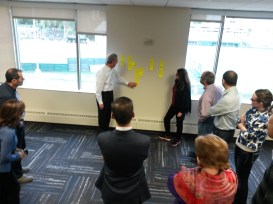
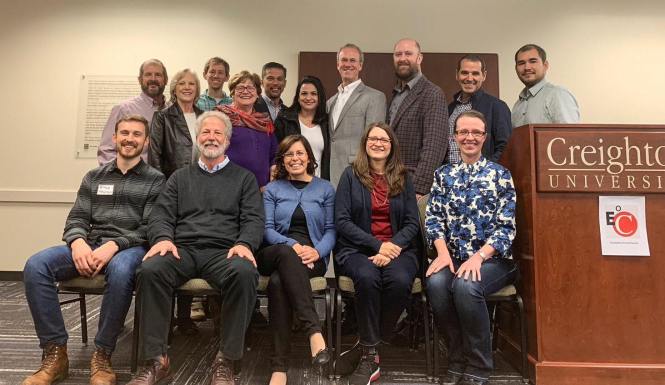
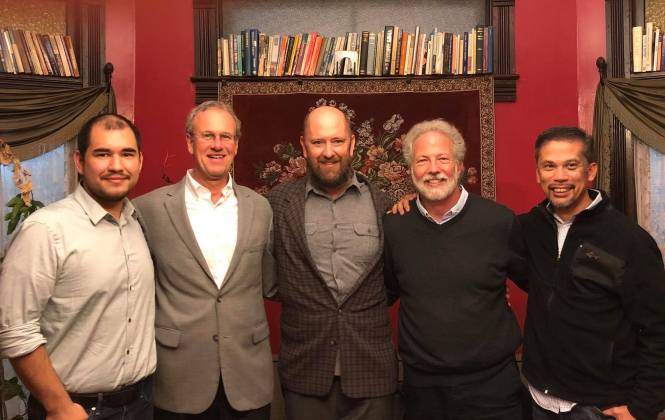
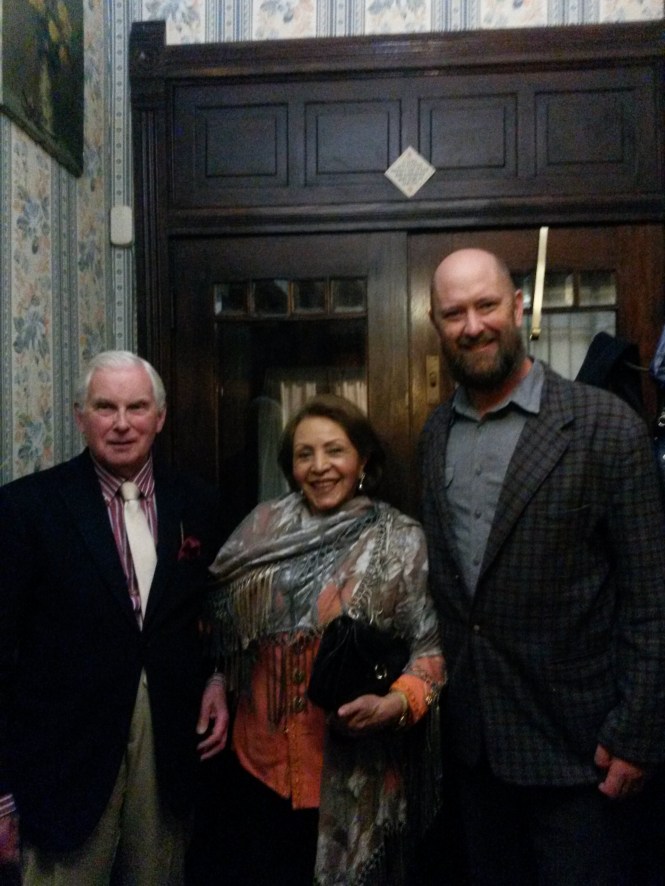
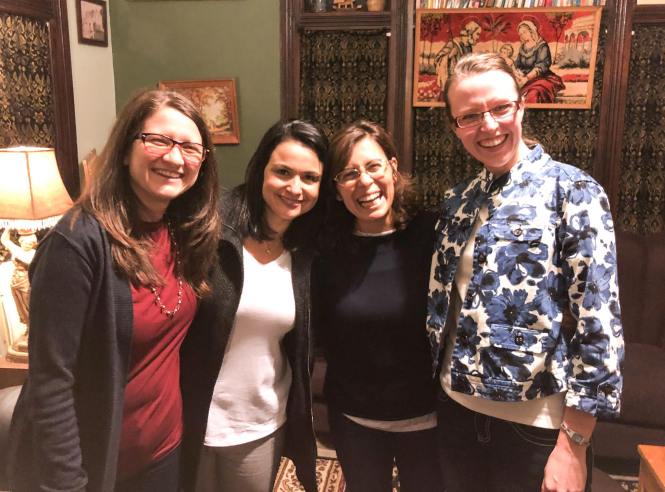
Saturday evening was concluded with a feast at “The Vic”– Andy and Celeste Gustafson’s gathering place near campus. It was a festive and enjoyable night of communion together.

 Business, Faith, and the Common Good Institute