Review of: The Search for God and Guinness

Review of:  The Search for God and Guinness  (by Stephen Mansfield)

Julia Casey

Business as a force for good is not a popular or common notion.  Often, business is seen as a source of social ills and in contradiction to faith.  Stephen Mansfield challenges this notion is his book The Search for God and Guinness: A Biography of the Beer that Changed the World.

Stephen Mansfield is a celebrated historic and biographical writer that explores the role of faith in the lives of his subjects.  Mansfield has a bachelor’s degree in Theology, a master’s in Public Policy, and a Doctorate in History.

Mansfield’s work, The Search for God and Guinness, traces the lives of the generations of the Guinness family most widely known for establishing the Guinness brewing empire.  It is primarily set in Dublin, Ireland where the Guinness brewing business was founded.  Throughout the time this book covers, Ireland was a place of extreme poverty and rampant social, political, and religious unrest.

In The Search for God and Guinness, Mansfield uses the Guinness story to present the idea that business is an act of faith through a calling from God and that this calling is not exclusive to entrepreneurs but can span across generations.  While I think Mansfield succeeded in illustrating this point through The Search for God and Guinness, his treats the Guinness story with rose-colored glasses in not presenting their shortcomings.

The Search for God and Guinness: A Biography of the Beer that Changed the World describes the story and evolution of the Guinness brewing company and the Guinness family.  The author begins by describing the brewing process and its evolution.  The way Mansfield describes brewing makes one fall in love with this art form.  He writes, “He told me he felt closer to God brewing beer than he did in church, because when he is brewing he feels like he is participating in the secret ways of the creator (pg. 14).”  Mansfield then explores Christian attitudes toward beer before starting his description of the patriarch of the Guinness lineage, Arthur Guinness, and the generations that would follow.  Arthur Guinness was a deeply faithful Protestant heavily influenced John Wesley’s Methodist movement (pg. 62).  Arthur saw the heavy consumption of liquor and the resulting drunkenness as one of the foremost social ill of his time.  He felt God was calling him to create a healthy, nutritiously valuable drink for the masses – beer and, thus, stared a brewing company.

After depicting the life of Arthur Guinness and the founding of his brewing company as St. James’s Gates, Mansfield split the resulting generations into three categories: the brewing Guinness’s, the religious/missionary Guinness’s, and the banking Guinness’s.  Mansfield follows the brewing and religious Guinness’s most closely throughout the book and ends the Guinness saga in 1986 when Benjamin Guinness stepped down as chair and effectively ended the Guinness family reign of the Guinness brewing company.  Stephen Mansfield wraps up The Search for God and Guinness with three lessons that one should learn from the Guinness family legacy.  These three lessons include: to “discern the ways of God for life and business”, to “think of generations yet to come”, and “whatever else you do, do one thing very well” (pg. 254-257).

Stephen Mansfield creates an interesting and compelling story through The Search for God and Guinness.  He covers a lot of history while staying true to his theme.  However, the amount of history he covered results in a work that does not look critically at the Guinness’s and their legacy.  For example, he speaks of the missionary Guinness’s as almost heroic in their mission of proselytization without acknowledging or engaging in discussion about the negative externalities that these missions often caused (pgs. 155-200).  Additionally, Mansfield almost exclusively follows the males of the Guinness lineage with barely a nod to the female descendants and their roles within the three categories of the Guinness’s.  Given these critiques, I still found this novel absorbing.  I, particularly, like that the author outlines ways in which the Guinness’s provide relevant lessons to the reader’s life.

The Search for God and Guinness by Stephen Mansfield follows the legacy of the Guinness family from the patriarch’s establishment of the brewery through the generations.  Mansfield’s overarching theme throughout the book is that business combined with faith can have a positive impact that spans through generations.  Mansfield does not look critically at what negative impacts the Guinness family had.  He also fails to follow any of the female descendants of Arthur Guinness.  However, The Search for God and Guinness was a thoroughly entertaining read and made the lessons of history relevant to the present-day reader.


Works Cited

Mansfield, Stephen. The Search for God and Guiness: A Biography of the Beer that   Changed the World. Nashville: Thomas Nelson, Inc., 2009.

Review of The Economy of Desire: Christianity and Capitalism in a Postmodern World

Review of The Economy of Desire: Christianity and Capitalism in a Postmodern World

by Luke Buffington

The Economy of Desire: Christianity and Capitalism in a Postmodern World by Daniel Bell is one installment in a series called The Church and Postmodern Culture, that seeks to engage postmodern thinking and philosophy and explore the ways in which the church should embrace it, challenge it, or interact with it.  In this installment, Daniel M. Bell Jr., builds on Michel Foucault’s and Giles Deleuze’s understandings of desire and its relation to capitalism, and extends their conceptual framework to create what he calls a “Christian economy of desire.”  In doing so he creates a critique of the capitalist system that is based on the way in which it forms and shapes desires contrary to God’s desire for humanity. While his sketch of capitalism and its supporters is, as I will explain later, a bit lacking in nuance and charity, his critique is none the less a powerful call to self-reflection and maybe more importantly a call into community for Christian’s living in a post-modern capitalist world.

In the first section of the book Bell begins by examining the works of Foucault and Deleuze in order to help the reader understand the concept of desire as he uses it throughout the book.  Deleuze in particular focuses on desire as a primal creative force that cannot be contained. In his narrative for centuries the state-form sought to find ways to control and subordinate desire to its purposes, but desire eventually became to much to contain. Next, capitalism came along and as an alternative, trying to direct and harness the creative power of desire to its own ends. In this way, capitalism was more successful than previous state-forms, but Deleuze still sees capitalism as repressive of desire, and urges reformers to, instead of trying to find new state-forms such as socialism, to embrace the anarchaic nature of desire and let it subsume capitalism. Bell later brings to doubt whether desire can properly overcome the capitalist system’s ability to shape and form it towards its own ends, but regardless, Bell at least is interested in painting capitalism as more than a mode of production, but instead an economy of desire.

In the second section of the book, he then proceeds to sketch a capitalist anthropology, based on what are generally considered to be the underlying assumptions of economists. He draws on quotes from scores economists to paint the picture of “homo economicus” or the economic man. It is clear that Bell is well read and has immersed himself in the writings of great economists. However, it is in this section where I feel he is less charitable than he could be in his depiction of various figures. Particularly, Bell characterizes Adam Smith as the consummate individualist and sets him up as a sort of false prophet preaching the gospel of a disinterested deistic god who simply controls and directs sin toward good using the invisible hand. While he may be write that Smith was more a deist than a professing Christian (there is much debate about Smith’s religious views) Smith was not as individualistic as Bell would lead readers to believe. In fact, Smith’s Theory of Moral Sentiments is largely focused on understanding how humans develop moral sentiments and is heavily focused on community and group dynamics as a source of moral understanding.  To be fair to Bell, he may be more critiquing the caricature of Smith that neo-classical economics has created, since economists themselves have not done well at understanding the nuance is Smith until fairly recently. Either way, the capitalist anthropology Bell lays out, one that individualism, utility maximization, freedom of choice, insatiable desire, and competition is broadly accepted to a degree that the specifics of his claims in this section are not of great importance to his argument.

In the next section he explains how the capitalist formation of desire is at odds with a Christian economy of desire. The focus on the individual, for one, is at odds with what Bell seems to put as God’s central goal for humanity, to bring us into community with one another. Indeed, the focus on autonomy and negative freedom in the capitalist order lead to a rejection of the existence of a greater good (sometimes called value subjectivism). For Bell, this sets us up to be in bondage to capital since Christian understanding of freedom is not about non-interference but about being in line with God’s desire for us, and thus free from the bondage of sin.  He also takes objection to capitalism’s assumption that human desire is insatiable and infinite. He claims that we should instead seek to desire God, rather then material things or even such goods as honor or knowledge. Since the perpetuation of capitalism and its focus on growth is contingent on wants never running out, capitalism’s very survival is contingent on forming human desire to never be satisfied and never rest, as God’s design would have it. Before moving on to his vision for a Christian economy of desire he, briefly turns the critical lens back on Foucault and Deleuze, explaining how their alternative view to capitalism, the freeing and unbounded desire is not compatible with Christianity. Their vision is also based on the unbounded and infinite nature of desire. While less centralized than capitalism, it would do nothing to properly turn our desire toward God.

In his final section, Bell explains the alternative vision he sees for a Christian economy of desire. He draws on the monastic tradition to highlight the virtue of poverty, both voluntary and involuntary. He recognizes that a complete transformation of desire before the resurrection is impossible, and instead calls Christian’s to a diaspora of pilgrim economy. Christian’s should embrace their obligations to one another rather than seek autonomy and individual liberty and thus give freely. Additionally, they should recognize that nothing they own is truly theirs, but all should be directed towards God’s ends, which means that it will be redirected toward helping one another. They should trust in God’s providence and abundance rather than fighting to secure their future. All of this will allow them to make progress in reforming their desire to want the things of God rather than the things of this world such as excessive material possessions, honor or status, or even safety and security. He holds up various movements such as the Catholic Workers Movement and the Foculare as examples of how God is moving in the world, and how even if it can never be complete before the end times, there is sufficient hope and possibility that we can reform our desire and seek sanctification even in todays world.

In summary, Bell’s book as dense as it is brief. Bell is incredibly well read in theology, philosophy, and economics (as evidenced by the nearly 400 endnotes in this fairly short book). While his critique of capitalism is at times scathing, it is clear that he recognizes the fundamental creative power of the system. Unlike many other critics, it is not this he challenges. Instead he makes a convincing case for why the very things capitalist society values and promotes may be contrary to God’s values. It is not clear to what extent Bell would be willing to accept the potentially negative material consequences of a widespread adoption of his views, though I presume he would find then acceptable if more people cam closer to God along the way In this sense Bell provides a somewhat unique perceptive that should challenge any reflective Christian to self-examination and hopefully into greater community with God and one another.

Review of: Amish Enterprise: From Plows to Profits

Book Title:       Amish Enterprise: From Plows to Profits

Reviewer:  Ray Anderson

Authored by Donald B. Kraybill & Steven M. Nolt, The Johns Hopkins University Press, 1995, 2004


Have you passed an Amish buggy traveling down the side of a rural Midwest highway? Can you recognize an Amish follower through their black, gray and colorless clothing style? Or recognize an Amish man by his long, untrimmed beard? Do you recall photos of traditional Amish farmers plowing by horse? Have you shopped a modern ‘Amish’ grocery store that appears to be a throwback in time but laden with an excellent selection of homemade pastries, pies and food items?  Have you seen business advertisements for the excellent artisan work of an Amish wood craftsman? Would you like to receive a better understanding of the Amish and their business practices?

Amish Enterprise, From Plows to Profits, by Kraybill and Nolt is an intriguing read about the history, development and current business opportunities of the Amish population in the United States.  The book very successfully overlays the Amish culture and Amish business practices. Kraybill and Nolt are leading experts in both Amish and the Anabaptist movements which lends significant credibility to the literature.

The book tells the story of the Amish, focusing on Lancaster County, Pennsylvania, who have started to transition their traditional agricultural farming and ‘plows’ as a means of living for the pursuit of profit in microenterprises, factories and mobile work crews.  The result of this transformation has been an intriguing growth of some very successful Amish microenterprises and entrepreneurs. Few Amish businesses fail. A fact presented in the book is that greater than 95% of new Amish business ventures succeed.  This success rate is higher than the non-Amish population.

However, with this business success will also come questions as to how this transformation might impact Amish culture in the future.

Kraybill and Nolt seek to answer, and do provide responses, to five major questions in their analysis of Amish business practices:

  • Why did microenterprises arise at this particular juncture in Amish life?
  • In what ways does Amish culture represent entrepreneurial activity?
  • How are these enterprises distinctive?
  • Why are they successful?
  • How will they influence the future of Amish society?

Amish Enterprise, From Plows to Profits, is an excellent complement to our Creighton University Business, Faith and the Common Good course as it engages in topics including cultural resources, cultural constraints, religion, faith, profits, wealth, marketing and management perspectives in relation to the Amish and business enterprise.

KEY ELEMENTS

Amish Enterprise, From Plows to Profits opens with an excellent introduction of Amish history.  Kraybill and Nolt introduce us to the church founding in the 16th Century as part of the Anabaptist movement and the eventual Amish migration to the United States in the 1800’s. You will quickly understand how the Amish, and how the Anabaptist persecution throughout Europe in the early era, attributes to the Amish culture of today.

This review of the Amish past is very helpful to establish an understanding of why and how the Amish culture developed as it has. The author’s do an excellent job tying the history and culture into modern day Amish business practice.

For example, two key Amish concepts presented that sculpt culture and business practices include the Ordnung and Gelassenheit.

Ordnung is roughly translated as “the expected conduct of members”. The Ordnung defines the practices, teachings, and taboos of the church.  It articulates the moral order of the community and its practice defines the very essence of the Amish community. The book walks through many excellent examples of Ordnung, including the reasons for specific styles of clothing, use of buggies and worship services.

Gelassenheit is roughly translated as “submission – yielding to a higher authority”.  The book explains it as a fairly elastic concept carrying many meanings: self-surrender, resignation to God’s will, yielding to God and others, willingness to suffer, self-denial, contentment, and a calm spirit.  Words including obedience, humility, submission, simplicity and plainness are often used to describe Gelassenheit. Gelassenheit is in sharp contrast to the proud, aggressive spirit of individualism found in modern American culture and commerce.

Progressing through the book, you will begin to understand why the Amish encounter with our current world of commerce is indeed a struggle between the quiet and modest habits of the Ordnung, and Gelassenheit, and the efficient high-tech ways of modernity.  However, you will also begin to understand why these Amish principles result in multiple success stories within their business ventures.

Due to Amish cultural sensitivities, the authors were cautious about how to present quotes or photos from community members cited in the book. Although it would be intriguing to read deeper into the individual thought of many of the Amish citizens, including photographs, the authors do note and explain that out of respect to the culture this is accomplished less than traditional book writings.

RECOMMENDATION

Amish Enterprise, From Plows to Profits is a very refreshing read.  I offer a very high and excellent rating for this book. The book is very well written and the topics integrate extremely well as you progress through the book.  The ties between history, church beliefs and business are brought together seamlessly to leave you with an excellent understanding of the Amish.  There are several characteristics of the Amish business culture that, many of which are biblical based, leave you with a refreshing impression of this unique community.  Upon completion of the book, you will have obtained a much more clear understanding of the Amish.

In addition to the learning, you may appreciate and long for the simplicity the Amish incorporate into both their business ventures and their lifestyle.
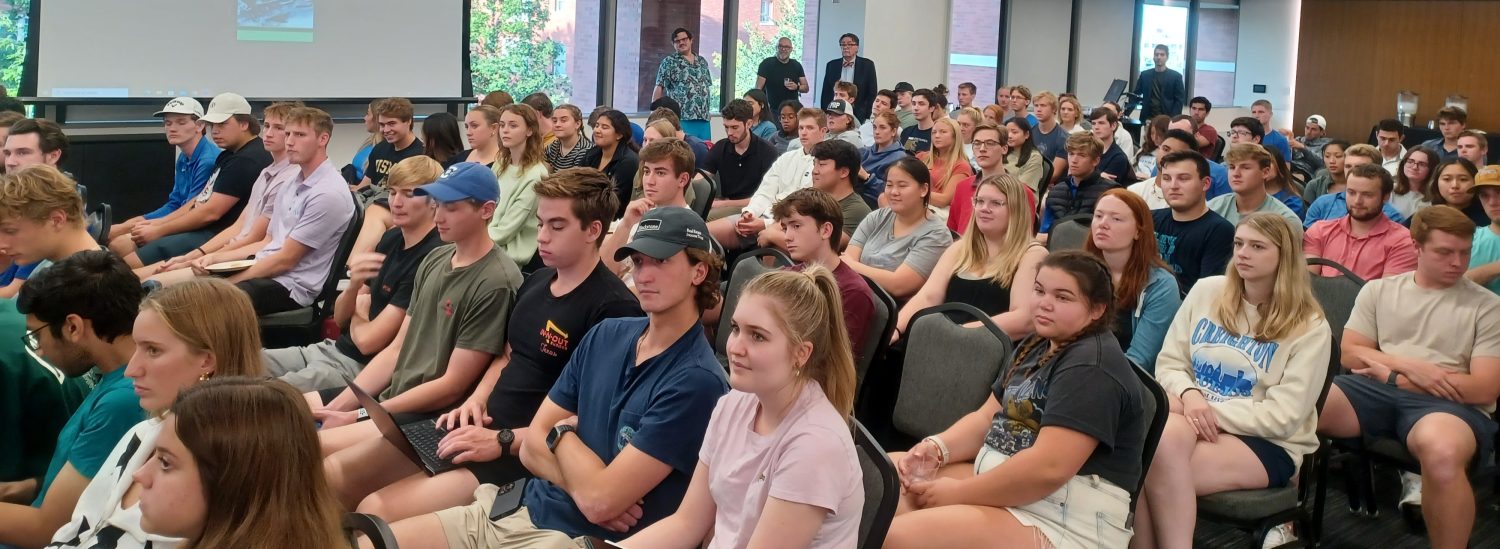
2015 Inaugural “Business, Faith and the Common Good” class at Heider College of Business

In the spring of 2015, Heider approved a course offering for Fall of 2015 entitled “Business, Faith, and the Common Good” as a joint MBA/undergrad course.  The 11 week course culminated in a final night of presentations from students at Johnny’s Cafe in South Omaha.

class 2015 2

Throughout the semester we heard from various faculty and speakers who talked to us about business, faith and the common good including:

Omar Guttierez, from the OMaha Archdiocese, on the Vocation of a Business Leader Document

Alexei Marcoux, Professor of Business Ethics and Society, Creighton on “Entrepreneurship as Vocation”

Neil Nyberg, former Ethics Officer at Kelloggs on faith and work

Tom Kelly, Associate Professor of Theology, Creighton, on “Catholic Social Teachings on Business”

Michael Thomas, Assistant Professor of Economics, Creighton, on “Economics and Theology”

John Gallagher, Professor of Management at Maryville College, TN, on “Economy of Communion”

Gene Laczniak, Emeritus Professor of Marketing, Marquette U., “Catholic Social Thought and Marketing”

Patrick Murray, Professor of Philosophy, Creighton, “Baudrillard, Consumerism, and Catholic Thought”

john gallagher

It was an outstanding group of speakers.  Most nights our speaker would talk with us in a roundtable setting from 6-7:30, and then the second half of class we would discuss questions I had preassigned to that weeks readings.  The readings varied in scope, but included many documents of the Catholic Church, protestant readings on business and faith, some Jewish and even Muslim writings on business, and a few readings on business and the common good as well.

The students were great, and some of the book reviews and research papers and projects of the students will be put up as resources on the Business, Faith and Common Good website soon.   I am very grateful to be able to put together courses such as this.  It is a remarkable privilege to work at a Jesuit school which encourages such classes in the business curriculum.


Review of the 2015 Business, Faith and the Common Good Symposium

ken g 3

The 2015 Business Faith and the Common Good Symposium featured 9 companies and organizations who are motivated by faith or the common good (or both!) in their business practices.  Our keynote speaker was Ken Goodpaster, who taught for a decade at Notre Dame, a decade at Harvard, and then held an endowed chair in Business Ethics at the University of St. Thomas MN for over 20 years.   Demonstrating his ability as a master teacher, and his wisdom as a scholar in his field his talk was on business as a vocational calling.

poster2 daphneposed photo

The goal of the symposium is to bring together the concerns of faith values, business, and the common good, and so to that end we had presentations from 9 companies and organizations.

lori hogan hihome instead

Lori Hogan and Mark Goetz of Home Instead explained the mission and vision of Home Instead, an in-home care provider with 1,000 franchisees worldwide, from Omaha to Hong Kong.

max insuranceMAX-Faith-Based-Insurance-logo

MAX insurance, a B-Corp from Kansas was represented by Bill Musgrave.  He explained the history of this company which arose from Amish beginnings, and the reasons they decided to be a B-Corp.

thrasher     thrasher

Thrasher’s tagline is “there’s only one right way” and they have been known for years for their integrity and quality throughout the midwest.  Nick Rohe, VP, spoke on the strong faith culture within the company, and the ways in which that guides decisionmaking and impacts the company culture.

bench   bench

Ben Petersen from BENCH had a vision for a community workshop, where he could pursue his own profession as a woodworker and also provide space for other artisans, which resulted in his community workshop called Bench.

firespring 2  firespring

Firespring, another B-Corp from Lincoln Nebraska was represented by Ben Spence, who told their story, explained their fun-loving community culture, and their pursuit of the common good.  Even their tagline is: “A Force for Good”

jeff slobotski router

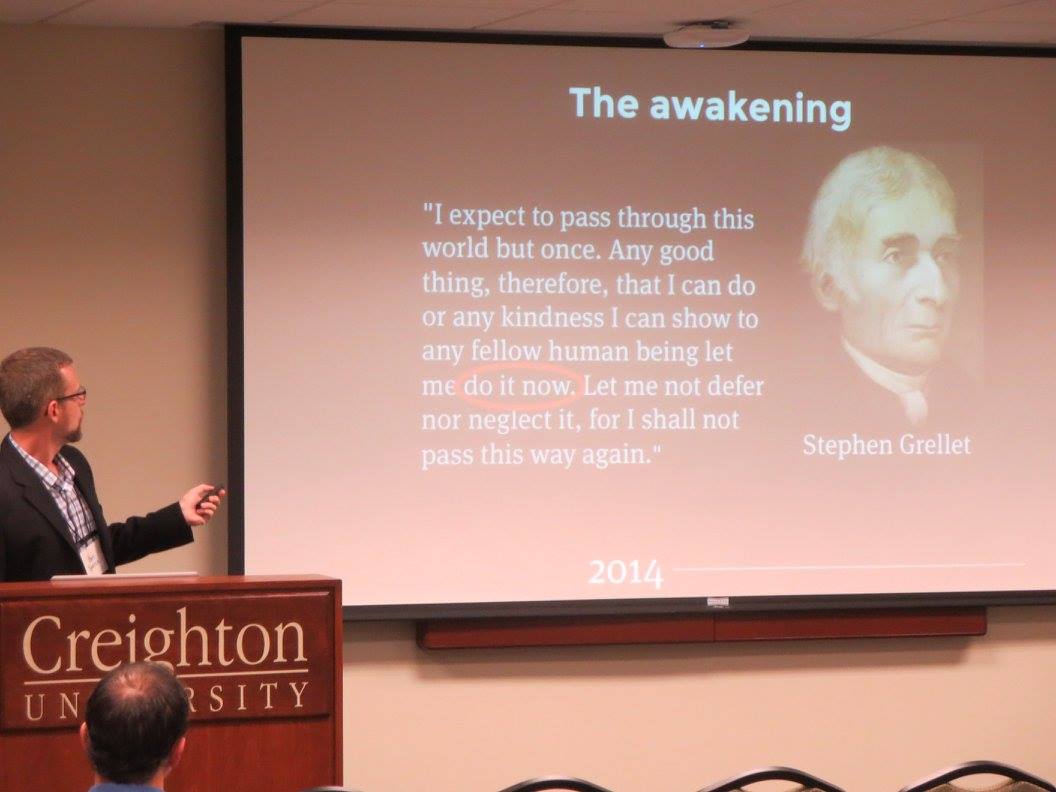
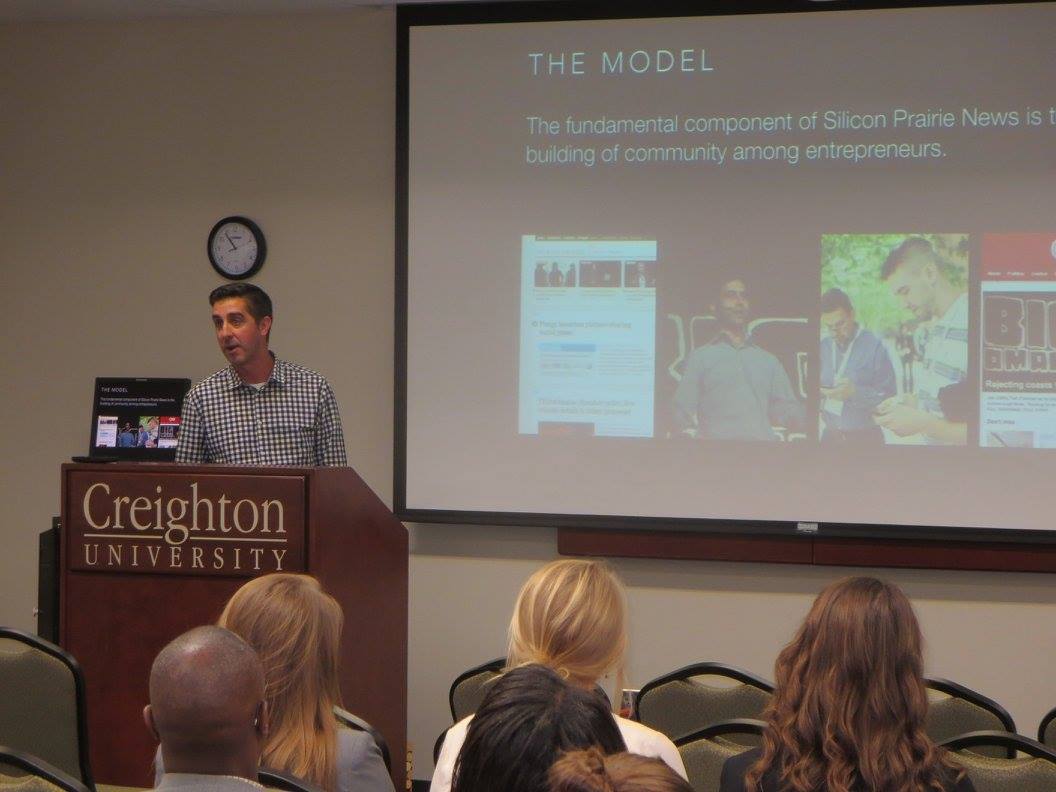
Jeff Slobotski, who started Silicon Prarie News and the Big Omaha event, talked about doing business in a collaborative way which thinks beyond simply what it in it for me.  His social mindset and entrepreneurial spirit have led him to do many things which have contributed to the good of Omaha, and his Router Ventures is one of his latest projects towards that end.

icarusicarus

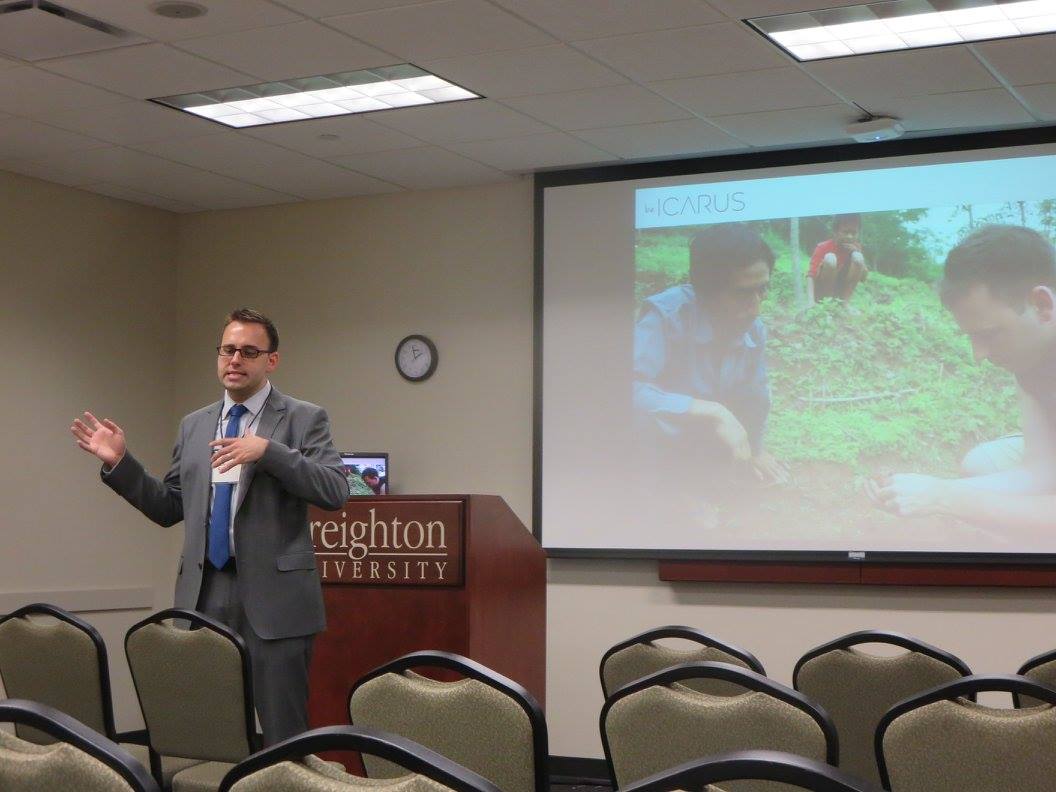
BE ICARUS is an entrepreneurial venture of Chris Alford and his wife.  A serial entrepreneur and gifted in helping companies market and tell their story, Chris started coffee shops in China years ago, but has now returned to Omaha to create an online marketplace for fair trade goods called Be Icarus.

john gallagher    economy of communion

Economy of Communion is an international organization and movement with a North American affiliate group.  With 40+ companies participating in North America, and 800 more worldwide, the EoC members are committed to business which is done more humanely, with a concern for gratuity and reciprocity.  John Gallagher, professor of management and author of Structures of Grace, written from interviews with 12 of the EoC companies, provided an overview of the history and vision of Eoc.

reception 4good one

Every presentation was quite good and the students and faculty who attended were stimulated and encouraged to see how that faith and a pursuit of the common good can be a powerful motivation for very successful companies in Omaha and beyond.

Friday was also the job fair in the Heider College of Business, and so 75+ companies were here recruiting students.  As I got into an elevator, one of my students chased me down holding out a business card of one of the employers here that day and said, “hey when I told the guy from this company about the symposium going on he asked me to give you his card in hopes that maybe next year you would invite his company to participate!”  I think I will!  Momentum is building for this symposium, and as word spreads, we hope that more and more people will want to come hear and be inspired by the companies whose practices and thinking are motivated by faith and a pursuit of the common good.

celebrationdead matterimplicationseducatingcocreation

2015 Business, Faith and the Common Good Symposium (Friday Oct 9th)

home instead lori hogan MAX-Faith-Based-Insurance-logo Prairie-Plains-Resource-Institute.png verdis

The 2015 Business, Faith and the Common Good Symposium will be held October 9th in the Harper Center at Creighton University (20th & California)  The purpose of the symposium is to bring social entrepreneurs and business people whose work is inspired by their faith and pursuit of the common good to Creighton’s campus to share their work and vision with students, faculty, and the public.  From environmental engineering, senior care, and insurance to prairie restoration, organic foods, and internet entrepreneurs, this year’s lineup will be diverse.  firespring  icarus economy of communion

Click here for poster: 15 BFCG Symposium

Click here for schedule of speakers: BFCGS Speakers 2015 final

The entire symposium will be on the 3rd floor of Harper, and the general schedule will be as follows:

8:30-9am: Breakfast foods and drinks

9am: Introductions and Welcome

9:15 Session 1 (rooms A,B,C)

A. (H3023) Economy of Communion (John Gallagher, Maryville College)

B. (H3027) Home Instead (Lori Hogan)

C. (H3029) Prarie Plains Institute

D. (H3053) Bench Community Workshop (Ben Petersen)

10:30 Break

10:45: Session 2 (rooms A,B,C)

A. (H3023) Thrasher (Nick Rohe)

B. (H3027) Jeff Slobotski

C. (H3029)Firespring

D. (H3053)

12: Lunch

1:30 Session 3 (rooms A,B,C)

A. (H3023) MAX Insurance (Bill Musgrave)

B. (H3027) Be ICARUS social Marketplace

C. (H3029) Verdis Group (Dan Lawse)

D. (H3053)

2:45 Break

3:00 Keynote: Ken Goodpaster, St. Thomas

4:15 Reception for all

All students, faculty, and staff are invited, as well as the general public.  Please invite anyone you wish, and if you have questions please don’t hesitate to contact Andy Gustafson andrewgustafson@creighton.edu.

The symposium is generously funded by the Center for Catholic Thought, and directed by the Heider College of Business and Theology Department.  The Business, Faith and the Common Good Insititute also has supported the effort.

HeiderCOB 2

Economy of Communion

EOCI

The Economy of Communion is a group made up of laypeople, entrepreneurs and business owners, and academics committed to promoting and practicing an economic culture which is oriented around people, and communion together.  The concepts of gratuity and reciprocity are key to them in thinking about business practices, and they see themselves to be offering an alternative to typical business practices that we find in the world around us.  They sometimes refer to their way of thinking as a “culture of giving”.

Those who participate in the Economy of Communion are committed to run their businesses in ways which demonstrate the values of EoC.  While financial poverty is a concern, there is also the significant poverty of isolation and being disconnected from society which EoC sees as a key problem.  They seek to encourage engagement with anyone who are willing to “conceive and live their activity as a vocation and service for the common good, aiming at the excluded in every part of the world and every social context…” (from their website).

I had the wonderful opportunity to go to the 2015 meeting held in Washington D.C. this weekend.  There I got to meet a lot of interesting and committed people who see in business a means to transform the lives of others, and to bring them into communion with others.   There were many varied stories about how that was practically lived out.  One filmmaker shared his experience in upstate New York of finding himself developing a community of artists and people involved in film, and helping establish a common space for them to work– even though some of them are his competition.  One construction business owner shared his experience of being involved in very difficult negotiations with the lawyers of a company suing him, but taking time to discuss a personal concern of one of the opposing lawyers, and soon they were all sharing problems together and sympathizing across the table.  That (obviously) changed the whole nature of the meeting, and in the end, the opposing company ended up being much more gracious than they would have otherwise.  Another company owner involved in information technology services shared an opportunity he had had to collude with another minority company to get some government money for a large project, and turning it down because of his commitment to the EoC values.

These were business people firmly committed to doing business in a way which looks beyond the bottom line.

There is more to it than just ‘doing the right thing’ though.  There are ways that these business owners spend their money– not just on themselves, but in ways which are beneficial to others.  There is a strong commitment to bring what some might consider overly-generous benefit to employees and customers above and beyond what is necessary or expected normally.  But that is the generosity and culture of reciprocity which they want to live out.

The EoC, while its origins are from the Focolare movement of a group of Catholics, is open to all, not just Catholics, and not just Christians– there was one Muslim at the meeting as well.  What the EoC does well is try to bring faith and spirituality to bear on how someone conducts their business– the values we often profess are hard to live out concretely because we get so focused on the tasks at hand, but there is a great deal of satisfaction living out your values through your work practices and how you run your business.

If you have an interest in being a part of the EoC, let me know.  After doing a brief presentation for them about my rental projects, they welcomed me in as one of them! 🙂

October 9, 2015: Symposium on Business, Faith, and the Common Good

       IMG_1672

This year’s 2015 Business, Faith and the Common Good symposium will be held at the Harper Center in the Heider College of business.   Our keynote speaker will be Kenneth Goodpaster, who has taught at Notre Dame, Harvard, and held a Chair in Business Ethics at St. Thomas University for many years, and has written extensively on how faith should affect our business practices.

The symposium is an all day event on Friday, October 9th, and like our 2014 symposium, we hope to bring in business leaders from the local community who own or manage companies with a mindset directed by their faith and their concern for the common good.  Typically we’ve had 3 breakout sessions at a time, each with different business owner who intentionally seeks to do business with a special concern for the common good or with faith-rooted principles and values, or both.  We are looking for suggestions for presenters, so if you have any ideas, please don’t hesitate to contact Andy Gustafson at andrewgustafson@creighton.edu  If you want to be get notices of events, email us or join our facebook page.

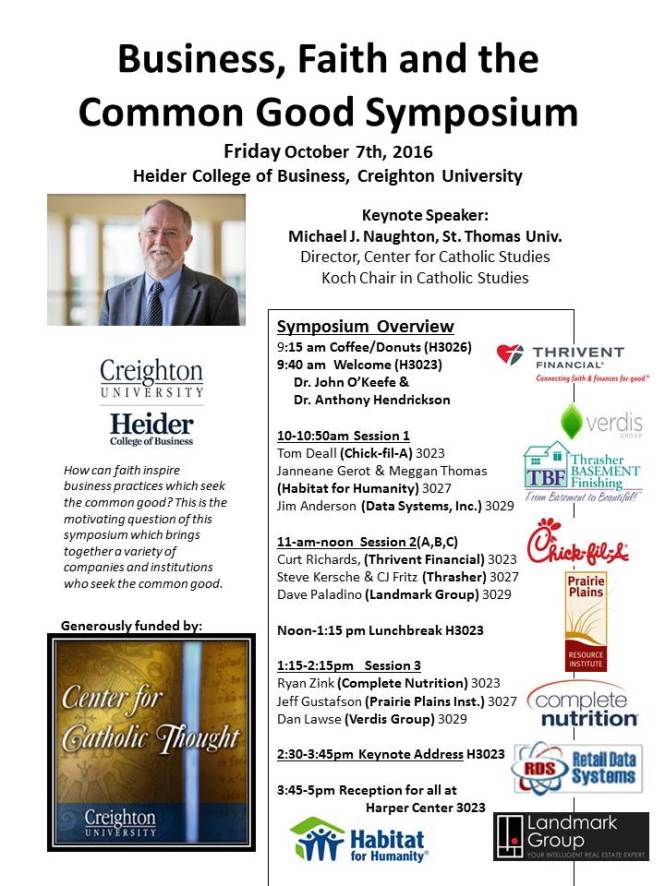
Here is last year’s flyer:

BFCG Symposium

The Poor and the Common Good in the Philippines: Enchanted Farm

a poverty        th_20150228_133106 –Andy Gustafson

Helping the poor to establish a baseline of human dignity for themselves through work is something that is essential.  I just returned from a great conference in the Philippines put on by the Ryan Institute at St. Thomas University, De Lasalle University of the Philippines, and Ateneo University, a Jesuit University in the Philippines.  There were so many great takeaways from the conference having to do with Catholic Social Teaching, but a few were:

1. Philanthropy needs to be directed towards creating possibilities for the poor to have sustainable means of taking care of themselves.  Handouts to the poor are not a long term strategy.

2. In the Philippines, as in many countries, those who gain education are educated to go ‘work for other people’– nursing, maids, laborers, etc.  Usually they are not encouraged to think entrepreneurially– the truly sustainable means by which they might support themselves.

3. One very important insight from Catholic Social Thought– which any Christian can accept I believe– is that of subsidiarity– that grassroots localized projects are better than centralized ones at empowering individuals.  Church, labor unions, and other localized organizations should be used to help people have the means to support themselves.

4. Solidarity: While it is important to help each person to be able to break the cycle of poverty, it is also important to recognize that we are all in this together– and that my actions affect others, and visa-versa.  To act as though we are isolated atomistic beings separate and independent from all others is not only not in line with Christian thought, it is simply false.

th_20150228_170146      th_20150228_143755

Subsidiarity and Solidarity are two of the basic “Catholic Social Teachings” which are, in my mind, acceptable to any Christian.  The fact that they arose from Catholic thinkers is ultimately irrelevant to their truth.

th_20150228_125154th_20150228_133233

So the Enchanted Farm, which we visited on Saturday, is a project of Gawad Kalinga, which is a national movement in the Philippines to empower the poor and help them out of poverty.  In the remainder of this post, I will simply post what their website says– it is a powerful understanding of poverty, the causes of poverty, and their attempt to overcome it:

From their website:

The problem of poverty is not about a lack of money as much as it is a loss of human dignity.

The poor may not have steady financial resources to support their basic needs but what permanently cripples them the most, disabling them from rising from poverty, is the loss of human dignity. Once stripped of their dignity — forced to live in conditions quite close to that of a pig pen, people start to live like pigs. It is then that standards of living decline, value systems crumble and chaos rules. Moreover, they lose their capacity to dream and work towards achieving their dreams.

Poverty is most debilitating to the men who are reduced to living like animals (becoming predators) when they are de-humanized and stripped of their natural male nobility.

Men, by their very nature, are meant to be hunters and protectors of their families and, most especially in the Philippines, men are expected by society to be the providers. Caught in the cycle of poverty and being unable to deliver as he is expected to, Filipino men lose motivation to be productive members of society and instead turn towards vices of drinking, gambling, mendicancy and some, even turn to a life of violence to regain their primacy over society.

The cycle of poverty is rooted in the divisiveness of our nation.

The Filipinos are an intelligent and talented people but most have been pursuing the path of individual gain and achievement without a conscious effort to work for the common good. For decades now politics, religion, socio-economic class and ideology have divided the country.  Further, driven by ambition, self-interest, pride and the need to provide for their children and their family beyond their need, those who have material wealth have turned a blind eye to a great many others who are in need. The Filipino has lost his inherent culture of bayanihan, its culture of working together as a community for the greater good.

That is why GK’s attack to poverty is quite revolutionary. It does not address poverty through a purely financial solution. It addresses poverty through environmental and social engineering. And more than being a non-profit or charity organization,

Gawad Kalinga is a movement of nation-building.

GK focuses on the restoration of the dignity of the poor by building colorful GK homes in beautiful communities.

From flimsy shanties of bleak grey rusted iron sheets, motley brown used plyboards and tattered tarpaulins and plastic, GK builds for the poor sturdy structures painted in bright colors of hope. From unsanitary surroundings, GK brings them to clean, beautifully landscaped communities. From bare survival in structures akin to pig pens and chicken coops the poor now turn to a quality of life equal to upscale subdivisions. By providing them with a middle-class environment the poor start to have middle-class dreams and aspirations to work for.
Where most interventions target women and children, for GK the initial intervention is through the men. 

GK raises the men to their inherent nobility and productivity by getting them to build homes for their family and for their community.  GK puts man’s natural brawn to good use – turning him away from destructive activities in society and instead leading him towards building for his neighbor.


The success of a GK community is hinged on the improved quality of life of the entire community rather than the economic or material standards of living of an individual.

Through its various programs, GK aims to renew the culture of bayanihan in its communities. GK breaks the current culture of individual gain and instead envisions a strong united community that builds together, plants together, harvests together and rises together – believing that no one will be left behind.

Through GK, Filipinos and people of all faiths and races are transcending differences to come together for nation-building. GK unites by not discriminating in terms of politics, religion or ideology. In Mindanao, GK has forged friendships and partnerships in various communities where Christians, Muslims and lumads build together, live together and rise together.

Breaking out of the usual fund-raising mentality, GK focuses on building strong partnerships.  In GK, everyone is welcomed not as a donor but as a key stakeholder… a committed and passionate partner in re-building the nation.  Through a creative formula of counterparting, GK has been able to forge strong multi-sectoral partnerships that bring together individual resources (financial, human and extraordinary) to effectively fill in gaps. In the model of Kalinga Luzon, the national government through National Disaster Coordinating Council and the Department of Social Welfare and Development provided a 50/50 share of the funds with GK for the construction of homes. The local government secured the land, provided site development and the use of heavy equipment.  Other groups come in to drive the programs on-ground.

I was so grateful for the opportunity to learn about the work of Gawad Kalinga and the Enchanted Farm.

th_20150228_155238 th_20150228_133244