Economy of Communion 2017 Meeting

June 20-24 I got to go to Mariapolis near Hyde Park, NY, one of the Focolare centers in the US to participate in an Economy of Communion workshop for young entrepreneurs, and then also to be at part of the EOC annual meeting.

Image may contain: 4 people, people sitting and indoor  Image may contain: 5 people, people smiling, people sitting and table

The Focolare are a lay movement which started in the Catholic church but now extends to the Lutheran, Anglican, and even Baptist traditions, focusing on loving the poor and living for Christ.  The Economy of Communion is one of their offshoot movements started in 1981 to help the poor by creating jobs through private enterprise, rather than handouts.  Their idea is that job creation enables people to experience the dignity of self-sustaining work.

Image may contain: 2 people, people sitting and outdoor       Image may contain: 5 people, people sitting and shoes

This was the first ever “EOC entrepreneur bootcamp” in the US, and I was grateful for an opportunity to talk about what the EOC is and to give people some vision of its purpose and hopes.  You can see part of my video of the talk at the “Economy of Communion in North America” facebook page here.

Image may contain: 30 people, people smiling, indoor   Image may contain: tree, plant, sky, grass, outdoor and nature

Mariapolis was once a kids camp, but the Focolare bought it and have over time rehabbed it into a truly peaceful place.  Each evening we had a social time together, and for every meal we ate together in the dining area (usually outside on the veranda).


The bootcamp/workshop went from Tuesday night until Friday noon.  Then the EOC regular annual meeting started, and many long time EOC members and associates showed up (and some of the students and entrepreneurs who were there for the bootcamp stayed as well).  There are many long standing relationships among these members, who have pursued a vision of serving Christ through practicing their business in a way which seeks to focus on humans and dignity as they make profits.

Image may contain: 22 people, people smiling, people standing and indoor

You can see a nice video on EOC here.

Like I said, I am grateful for the opportunity I had to be at the workshop and conference, and plan to be a regular there.

Image may contain: tree, sky, grass, plant, outdoor, nature and water

Economy of Communion in Rome: An Audience With Pope Francis

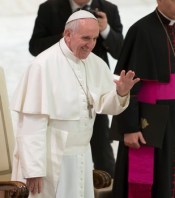
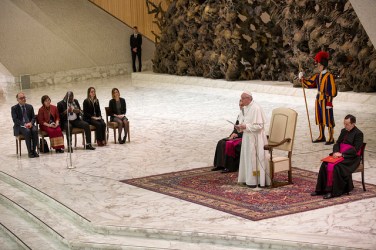
As a business-member of the Economy of Communion, I was invited to join a worldwide conference on EOC in Rome,  culminating in a meeting with Pope Francis where he spoke to our group.  Pope Francis had asked that we come to meet with him and hear from him at the Vatican.

In his talk to the Economy of Communion group, Pope Francis put his finger on a key point: “Capitalism knows philanthropy, not communion. It is simple to give a part of the profits, without embracing and touching the people who receive those ‘crumbs’.”  This is ultimately what is so different about the economy of communion—it is a vision to live out our lives and practice our faith through our business activities in a way which is truly novel and transformative.  Economy of Communion is not a philosophy of sharing money, it is a vision of using business to help build community and to help people through our private enterprise.  Through business we help bring about communion.
pope-waving

In this vision, Pope Francis pointed out, “You see the entrepreneur as an agent of communion. By introducing into the economy the good seed of communion, you have begun a profound change in the way of seeing and living business.”  This has significant affects on how and why one participates in business practices—and bringing even our business practices into our way of forming communion impacts our communion as well:

Certainly the economy becomes more beautiful, but communion is also more beautiful, because the spiritual communion of hearts is even fuller when it becomes the communion of goods, of talents, of profits. .

While Pope Francis has in various contexts brought up criticisms of aspects of the current capitalist system, he is not against capitalism.  He, as most Popes, agree with St. Thomas Aquinas that private property and private ownership is important.  That is why, when one of my fellow parishioners at church asked if Pope Francis is a Marxist, I could say without hesitation, “certainly not, nor a socialist”.  But he does think we as business owners can use our business to bring about communion in society.
32366979920_1f62e3412d_z

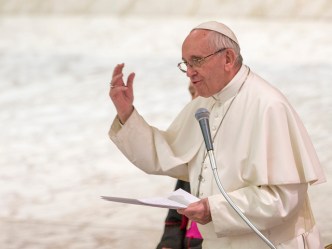
In speaking to us, Pope Francis said he had three things he wanted to talk about.  First, money.  “Money is important, especially when there is none, and food, school, and the children’s future depend on it. But it becomes an idol when it becomes the aim.”  When the accumulation of money for ourselves per se becomes the aim, it becomes idolatrous, and “When capitalism makes the seeking of profit its only purpose, it runs the risk of becoming an idolatrous framework, a form of worship.”  Pope Francis pointed out that the pursuit of security in money is a deluded quest for immortality.

His advice for not making money an idol is hard but simple:

The best and most practical way to avoid making an idol of money is to share it with others, above all with the poor, or to enable young people to study and work, overcoming the idolatrous temptation with communion. When you share and donate your profits, you are performing an act of lofty spirituality, saying to money through deeds: you are not God, you are not a lord, you are not a master!

We overcome the temptation to let money become our idol by giving it, giving ourselves, and spending ourselves and our money for purposes beyond ourselves—for God’s purposes.  This practice is essential.
32366978720_e8e29c81a8_z

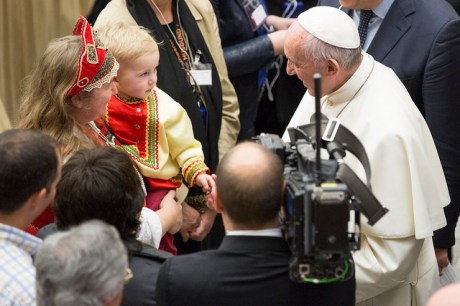
Second, Pope Francis spoke about poverty, pointing out that since Biblical times, the poor have always been with us, and they are often considered by society to be ‘discarded lives’.  Though we have some new ways to help some of the poor, “The principal ethical dilemma of this capitalism is the creation of discarded people, then trying to hide them or make sure they are no longer seen.”  And eventually we can become blind to this discarding, and to the discarded.  Francis said, “A serious form of poverty in a civilization is when it is no longer able to see its poor, who are first discarded and then hidden.”  Insofar as we shield ourselves from the poor, we become poor as well.

He then spoke about the ironic hypocrisy of a system which cares for the poor which it itself helps to create:

Aircraft pollute the atmosphere, but, with a small part of the cost of the ticket, they will plant trees to compensate for part of the damage created. Gambling companies finance campaigns to care for the pathological gamblers that they create. And the day that the weapons industry finances hospitals to care for the children mutilated by their bombs, the system will have reached its pinnacle. This is hypocrisy!
31957380634_f0c79dbf6a_z

Rather than try to give aid to the poor, “The economy of communion, if it wants to be faithful to its charism, must not only care for the victims, but build a system where there are ever fewer victims, where, possibly, there may no longer be any.”   Charity is not enough, we must work towards “changing the rules of the game of the socio-economic system.”  The Good Samaritan helps the victim, but we must work to change the system to help reduce the amount of victims to begin with.  This is done by us in the way that we conduct our own business- the values which guide our decision-making, our conduct towards employees and other businesses, our customers, and how we envision the purpose of our business itself.  It especially will affect the way we treat others.  Often it is said that Economy of Communion is about gratuity and reciprocity—meaning that we act with grace towards others through business, and that we act in faith that there will be reciprocity of kindness and goodwill.  That is a radical departure from the dog-eat-dog world of business where people treat others poorly, then excuse it by saying, “sorry, nothing personal, its just business”.  Those with a vision of business informed by the Economy of Communion will act quite differently, living out gratuity and reciprocity as we pursue communion through business:

For communion one must imitate the merciful Father of the parable of the Prodigal Son and wait at home for the children, workers and coworkers who have done wrong, and there embrace them and celebrate with and for them — and not be impeded by the meritocracy invoked by the older son and by many who deny mercy in the name of merit. An entrepreneur of communion is called to do everything possible so that even those who do wrong and leave home can hope for work and for dignified earnings, and not wind up eating with the swine. No son, no man, not even the most rebellious, deserves acorns.
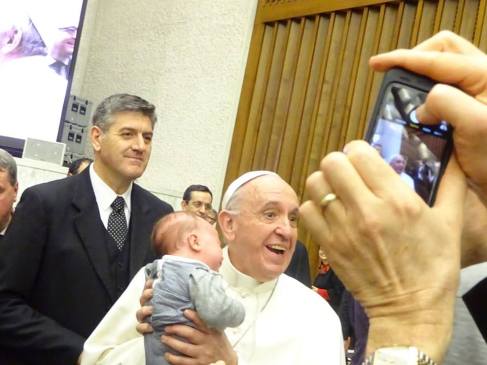
 

pope-baby

Third, Pope Francis spoke about the future.  The EOC has existed for 25 years (since 1981), but what should our future hold?  He encouraged us that though we are a very small group of businesses with this vision of communion guiding us, we can be salt and light and leaven in the world.  The key is, “What do we do so as not to lose the active ingredient, the ‘enzyme’ of communion?”  His answer is that we must share it: “The economy of communion will have a future if you give it to everyone and it does not remain only inside your ‘house’. Give it to everyone, firstly to the poor and the young, who are those who need it most and know how to make the gift received bear fruit!”  And this giving is not just giving of the profits of our business, but of ourselves—the gift of ourselves to others.  He says, “Today’s economy, the poor, the young, need first of all your spirit, your respectful and humble fraternity, your will to live and, only then, your money.”  Money is important of course, but it comes last.  This is why EOC is so much more than charity or aid.

Finally, Pope Francis concluded his remarks with a challenge to all of us:

You already do these things. But you can share more profits in order to combat idolatry, change the structures in order to prevent the creation of victims and discarded people, give more of your leaven so as to leaven the bread of many. May the ‘no’ to an economy that kills become a ‘yes’ to an economy that lets live, because it shares, includes the poor, uses profits to create communion.

I hope you continue on your path, with courage, humility and joy. “God loves a cheerful giver” (2 Cor 9,7). God loves your joyfully given profits and talents. You already do this; you can do so even more.

I hope you continue to be the seed, salt and leaven of another economy: the economy of the Kingdom, where the rich know how to share their wealth, and the poor are called ‘blessed’. Thank you.

It was a powerful message to us.  At times he was literally preaching to us—admonishing us and encouraging us to rise to the challenge.  It was a pastoral message we will not forget, I am quite sure, and it is clear that Pope Francis understands what the Economy of Communion movement is about, and wants it to spread like leaven throughout the economies of the world.
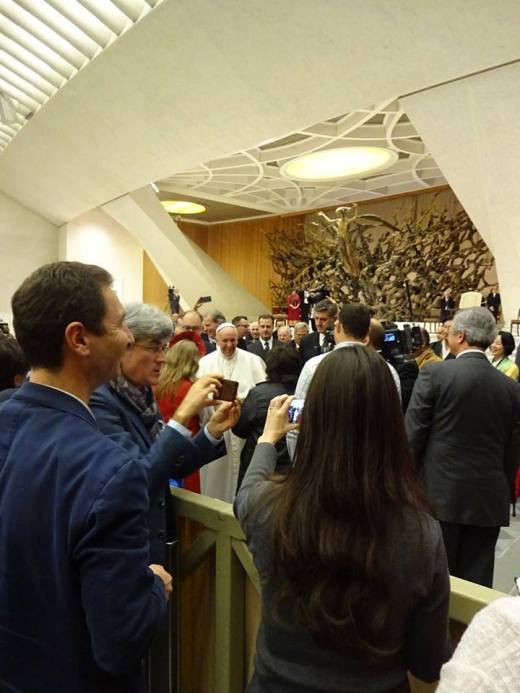
pope-crowd

Recap of the 2016 Business, Faith and Common Good Symposium


20161007_152209  20161007_160637

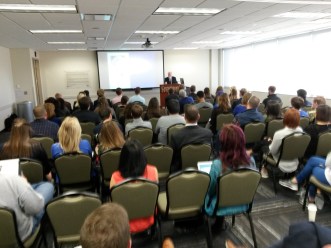
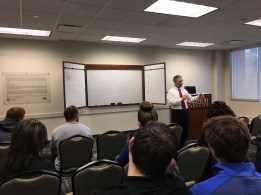
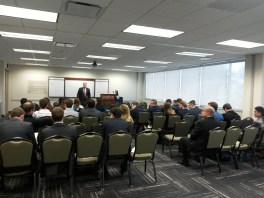
The 2016 Business, Faith and Common Good Symposium was an event to highlight the ways faith and a concern for the common good can motivate business practices.  We brought in 9 businesses and organizations, and had Michael Naughton as our keynote speaker.

thriventcomplete-nutritionverdishabitatthrasher chick-fil-a  data-systems

Companies represented included Complete Nutrition, Thrasher, Thrivent, Chick-fil-A, Habitat for Humanity, Prairie Plains Resource Institute, Data Systems, Verdis, and Landmark Group.  Five of those nine were new– Thrivent had actually heard about the symposium and asked if they might participate– and it was great to bring in new perspectives which were inspirational to the students.  It was also great to bring back companies who have such a strong story that we wanted them back again.  The format was that each of these companies had their own session.  There were three breakout sessions at three different times, for a total of 9 presentations.  Typically they were 30-35 minutes with 10-15 minutes for Q&A.

image2 20161007_115159

Professor Michael Naughton, director of the Center for Catholic Studies at St. Thomas University was this year’s keynote speaker.   Naughton is really a preeminent scholar at the intersection of Catholic Social Thought and business, with 5 books and 40 articles, mostly related to that topic.   He also helped coordinate and write the Vocation of the Business Leader issued by the Pontifical Council for Justice and Peace (2012) which is a key document for thinking about business practices from a faith perspective.

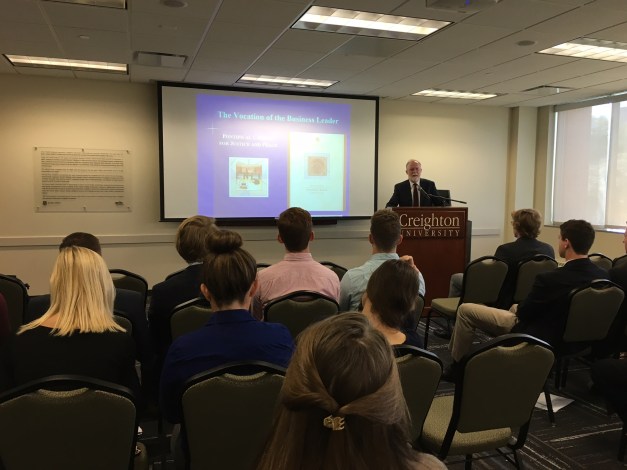
image4Naughton’s keynote drew on the ” Vocation of the Business Leader” document, which he helped write as a summary of some of the key teachings of Caritas En Veritate.  He contrasted three notions of work, each paired with a distinct notion of leisure.  First, one might think of their work as just a job, and be fairly disengaged from work, seeing it merely as something which must be done for money.   If you view work as a job, then you view leisure as an escape from your job’s drudgery– so an unhealthy detached view of work leads to an equally unhealthy view of leisure.  Leisure on this view is a-musement.   Atheist means literally without-God, and sine muse means “to consider thoughtfully”, “amusement” means “without thought”– when we amuse ourselves we are trying to escape thinking and consideration of our situation.  And ironically to escape more often requires more money, so you have to work more, which leads you to need to escape more, in a vicious cycle!   On the other hand, if you are all too engaged in work, it may lead to a careerism where work is everything and it consumes you.  Leisure, on this careerist view, is simply time to recharge so you can do more work– sharpening your saw– and so leisure’s sole purpose is for the utility of working more.  The better view of work, according to Naughton, is a view of work as a vocation– a calling. With such a view of your work, you see that God has called you to a particular task in a community of persons.  All people have dignity, and each has a vocation of their own to help serve the common good.  Leisure linked to this vocation view of work is sabbath, where one rests to reflect on one’s place in the world, on things beyond work which actually give meaning to the work, and on one’s relationships to others.  This thoughtful consideration is literally the opposite of a-musement!

20161007_103515  20161007_160639  20161007_103421

The symposium has definitely developed over time.  In 2013 we invited a speaker, internationally known Christian philosopher Robert Audi of Notre Dame, to give a talk on “business and the common good” here at Heider.  It was a nice event, and well attended.  For 2014 Tom Kelly and I worked to develop the first symposium, coming up with the idea to invite and we had as keynote Daniel Finn, a very well known Theologian who is also an economist.  For 2015 we had a reknown Catholic business ethicist Ken Goodpaster, and this year we had Michael Naughton.  Really, these are three of the greats in the field, so we have an outstanding track record and legacy.   So we are very proud of that.    The students who went to the sessions gave me some great feedback on the sessions– even the lesser-attended sessions were generally well-liked by students.  Students were moved by many of the presentations, but I got significant outstanding feedback on Naughton.  One student said that his talk helped her to see where she is at, and where she wants to be.  That is exactly the kind of transformational learning we are hoping for through the symposium speakers and events.

20161007_184013

2016 BFCG Symposium

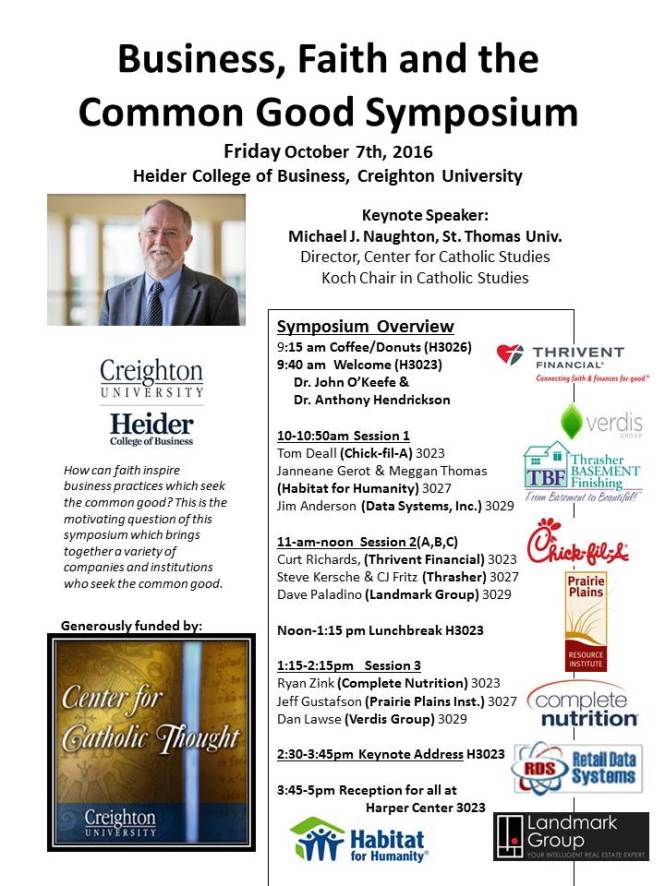
We are very excited for our annual Business, Faith and the Common Good Symposium on Friday October 7, 2016.  Our symposium is open to all students, faculty, and the general public.  9 businesses who are motivated by faith or a pursuit of the common good (or both!) will present.  We will kick it off just after 9:30 am, and then there will be three sessions simultaneously at 10, 11, and 1:15, with a keynote at 2:30 by Dr. Michael Naughton of the University of St. Thomas (Minneapolis).  An open bar reception will follow that keynote.  Please come for any or all of the symposium!   Questions?: contact andrewgustafson@creighton.edu

16-bfcg-symposium

2017 BFCG Speaker Series

The “Business, Faith and the Common Good” speaker series aims to bring to Creighton high caliber thinkers who have written on topics related to business, faith, and the common good. They include thinkers coming from philosophy, theology, management, marketing, and other various fields of thought.

We are excited about the 2017 Speakers for our  Business, Faith, and the Common Good Speakers Series:

 September 21st  Gregory Beabout (St. Louis U.)   “Catholic Social Thought and Business” Noon Lunch talk at Harper Center (co-sponsored by Creighton’s Institute for Economic Inquiry)

Gregory Beabout is professor of philosophy, and author of over 40 articles and reviews and books including The Character of the Manager: From Office Executive to Wise Steward;  Freedom and Its Misuses: Kierkegaard on Anxiety and Despair; Beyond Self Interest: A Personalist Approach to Human Action; and editor of A Celebration of the Thought of Pope John Paul II: On the Occasion of the Papal Visit to St. Louis and A Handbook of Virtue Ethics in Business and Management.

  September 27th David Ozar (Loyola, Chicago)    “Business and the Common Good: What Would Aristotle or J.S. Mill Do?” 6pm, Harper Center Harper Ballroom A

David Ozar was Professor and Co-Director of Graduate Studies in Health Care Ethics in the Department of Philosophy at Loyola University Chicago, and from 1993 to 2006 was Director of Loyola’s Center for Ethics.  He has taught and done extensive work in John Stuart Mill’s Utilitarianism and Aristotle’s virtue ethics.  He was the founder and first president of the Professional Ethics in Dentistry Network and has held offices in the Society for Health and Human Values, the American Philosophical Association, and other professional organizations. His publications are wide-ranging, including articles on whistleblowing in dentistry, whether or not corporations have moral rights, and what should be done with unused frozen embryos.

Veith_for_web.jpgOctober 4th  Gene Veith (Patrick Henry College)     Working for Our Neighbor: A Lutheran Primer on Vocation, Economics, and Ordinary Life              “Lutheran Perspectives on Vocation and Economics” 6pm Harper Center 3023

Dr. Gene Edward Veith was until recent retirement Provost and Professor of Literature at Patrick Henry College.  Dr. Veith is the author of 20 books on topics involving Christianity and culture, classical education, literature, and the arts, and including books on Christian God at Work: Your Christian Vocation in All of Life and his 2016 book, Working for Our Neighbor: A Lutheran Primer on Vocation, Economics, and Ordinary Life .

Dr. Michael J. Naughton portrait October 7th Michael Naughton (St. Thomas University)   (Symposium Keynote, Harper Center, 3pm)

Michael Naughton holds an endowed chair in Catholic Studies at the University of St. Thomas (Minnesota) as a full professor. He is the director of the Center for Catholic Studies, which is the oldest and largest Catholic Studies program in the world.  He is the author and editor of nine books and over 40 articles.  He is the keynote speaker at this year’s Business Faith and the Common Good Symposium.

 November 1st David Cloutier (Catholic U. of America)   “cover artThe Vice of Luxury” 6pm, Harper Center Ballroom A

David Cloutier teaches in the Theology department at Catholic University.  He has written Love, Reason, and God’s Story: An Introduction to Catholic Sexual Ethics (2008), Walking God’s Earth: The Environment and Catholic Faith (2014) and The Vice of Luxury: Economic Excess in a Consumer Age (2015), in which he gives a historical account of the concept of luxury, shows why luxury is a problem, explains how to identify what counts as the vice of luxury today, and develops an ethic of consumption that is grounded in Christian moral convictions.

Gene Laczniak November 7th Gene Laczniak (Marquette U.)  “The 2016 Jesuit Task Force Report on ‘Justice in the Global Economy’: Analysis, Implications and Actions for Jesuit Business Schools”  12:30, Harper Center 3027

 In 2012, Gene Laczniak received a lifetime achievement award from the American Marketing Association for his contributions to marketing ethics, corporate social responsibility and public policy scholarship.  Laczniak currently serves as President of the Macromarketing Society, and from 1998 to 2002, he was the Associate Vice-President/Associate Provost for Academic Affairs at the Marquette.  Laczniak was a member of the editorial review board of the Journal of Marketing for 15 years and continues to serve on two academic journal review boards. He is co-author of five books on business ethics with his most recent being Ethics in Marketing: International Cases and Perspectives (Routledge, 2012).”  He has been a member of the board of directors of four non-profit organizations with 18 years of aggregate service. He has taught executive development classes in the U.S., Europe and Asia winning several teaching awards. Laczniak has published over 150 journal articles and papers.

The speaker series is made possible by  donations from various individuals and businesses who are supporters of the Business, Faith and Common Good Institute.  If you wish to give a tax-deductible contribution, your donation can be given through the Creighton University Development Office.  Please contact Andy Gustafson for more details (andrewgustafson@creighton.edu)


afs_andys

Andy and Celeste Gustafson

June 2016 Economy of Communion Conference

By Andy Gustafson

In June, I attended an Economy of Communion conference at the University of St. Thomas in Minneapolis.  Its an interesting conference because, while there are professors and academics at the conference, it is also made up of entrepreneurs, business owners, and laypeople inspired by the notion that business and spirituality can go together, and that the providence of God can be seen in and through business practice.

13442128_764751674760_2292281598888792247_n    13346293_10209401261770547_4179767570539872884_o

Highlights of this years conference were a showing of “Poverty Inc” with Michael Miller, the director with us to do Q&A.  Also Michael Naughton gave a fantastic keynote presentation on Subsidiarity, highlighting key aspects of that concept.  There were also powerful testimonies of real life situations from some of the business people at the conference.

13434824_10208511199210059_978511461531895014_n    160609-12_eoc_meeting_2016_04_rid

I first became aware of the Economy of Communion in 2015 when I attended a  conference in Manilla, Philippines, and met John Gallagher, a professor of management from Maryville College in Tennessee.  He had done research on EOC businesses in the U.S..

I immediately identified with two of the core descriptors of the EOC: gratuity and reciprocity.  I found that a lot of the ways they described business fit very well with the ways that we run our house renovation and rental business.  It was inspiring to know that there were other Christians trying to live out their values and spirituality not only alongside but actually through their business practices.  I had often thought of our redemption of buildings as a strange sort of theological practice– imitating the redemptive work of God in the world.

Picture1EOC itself began in 1991 as a movement of the Focolare, a Catholic Spiritual group founded n 1943 by Chiara Lubick in Trent, Italy.  It has hundreds of thousands of participants worldwide.  In May 1991, while Chiara Lubich was on a plane approaching the city of San Paolo, Brazil, she was struck by the sight of the vast ring of ”favelas“ or ”shanty-towns“ surrounding one of the greatest concentrations of skyscrapers in the world. When she arrived at the little city of the Focolare Movement, Mariapolis Ginetta, near San Paolo, she learned that the communion of goods carried out by members of the Focolare Movement was insufficient to help all those Brazilians so close to her heart who were experiencing difficult times. This realization motivated her to provide food, shelter, medicine and, if possible, a job for as many as possible.  Having in her heart the newly published Encyclical by John Paul II, ”Centesimus Annus“, she launched the Economy of Communion: Businesses will freely put their profits in common just as the early Christian communities did.  Profits could be divided into three parts (not equal): for aid for the poor, for education and formation that could help foster a culture of giving, and for the development of the businesses themselves.

Economy of Communion is a vision of doing business with a concern for the human person, particularly the poor, with ideals of unity, brotherhood, eyes to see providence of God.  It began as Roman Catholic but is now multi-faith.  Currently, the EOC has ~800 member companies worldwide (50+ in U.S).   Some of its key characteristics are:

  • EOC focuses on Business as human interaction
  • EOC sees value and dignity of all people, and seeks unity with all.
  • EOC has eyes to see Providence at work in the world
  • EOC attempts to conduct business around the principles of gratuity and reciprocity
  • EOC promotes a lifestyle of communion with others through business

It was very encouraging to be with so many like minded friends who are very thoughtful about the ways and whys of how they do business.

For a brief article about my participation in the EOC, see this:   https://eocnoam.org/2015/11/07/meeting-new-eoc-member-andrew-gustafson-of-communion-properties/


Review of: God in the Marketplace

Book Review: God in the Marketplace (Henry T. Blackaby)

Stephie Grier

God in the Marketplace by Henry Blackaby details a collection of thought-provoking and self-reflecting questions for Christian businesspeople.  Written in a fashion that can be used as a self-study, the book is divided into six sections, each with a separate focus of different aspects of one’s life.  The sections were categorized as such based on the deepest concerns expressed by business leaders.  Blackaby reminds readers that regardless of where one stands in his or her career stage, man is created in God’s image and the purpose of life is to glorify God through respecting Him and living life in a God-honoring manner.  The following sections detail questions asked by business leaders wanting to know how their relationship with God affects their personal lives and business careers and ultimately how to honor God in all aspects of their lives.

Part one focuses on one’s personal life.  The first question expresses the concern of trying to incorporate Christianity wholly into one’s life: “What is God’s ultimate goal for my life as a businessperson?”  While compartmentalization of one’s business life, personal life, and religious life may become habit, it is these separations that strain one’s relationship with God.  Blackaby describes a scenario that seems ironic when balancing a business life and a religious life – individuals pray for God in want of something, but do not pray for God to become more Christlike.  Shifting this imbalance and merging the lines of compartment separation begins with understanding priorities and asking oneself how do those priorities glorify God.

Part two of the book focuses on one’s business life.  Assumptions that God is only concerned with sanctified issues such as the church is wrong because everything is sacred to God.  When one finds their calling in business, it should involve using the gifts God granted in ways that return thanks to Him and serves his purpose of helping others in the world.  So if one is asking, “Does God really care about my business decisions,” the answer is yes.  Incorporating God’s guidance into all business aspects, including business decisions, the overall well-being of the business, employee relations, strategy development, and crisis management should be innate.

“What is God’s will for my life?”  As the most often asked question, part three of the book focuses on the devotional life.  Often overcome by meetings, travel, and deadline in a market where success is a financial measurement and where “time is money,” it is this mentality that crowds out the time to have a relationship with God.  Businesspeople often divert their energy to gain the “good things” at the expense of their relationship with God, but Blackaby stresses that the opposite is the truth.  “When you delight yourself in the Lord, he provides everything you require to have a joy-filled life” (Ps. 37:4).  “Godliness is like a muscle, it needs daily exercise.”

The fourth part of the book focuses on one’s family life.  Unfortunately, it is not uncommon to see broken relationships among family when pursuing careers.  The often sought “work-life” balance is never in a state of equilibrium and that is to be expected.  Blackaby reminds readers that Jesus never had a work-life balance as he was living the life God commanded of him, abiding by God’s agenda.  Individuals struggling to balance family and job obligations must have faith that God will not allow one to neglect these things.  Seek God’s help and guidance will present itself to direct individuals balance work and family.

The fifth part of the book focuses on one’s commitment to church and his/her community life.  Distinguishing how to use one’s talents in the church is the work of God.  “God adds members to the church as it pleases him,” (1 Cor. 12:18).  Whether one’s role is as a follower, leader, or source of change, every congregation has a mission.  Businesspeople should invest their time in the church, focusing where their talents, whether in finance, management, medicine, etc., can make an impact, being sure to remember that God added an individual to a church because He knew that is where one belongs.

The last section of the book focuses on one fits and plays into God’s kingdom.  One’s life is viewed from a global and eternal perspective from God, not just what one does with his or her career.  Because of this global perspective, businesspeople should be concerned with how the business they participate in affects others across nation’s borders.  Involvement in social issues allows an individual to gain perspective of other’s spiritual and physical needs, two things that concern God when it comes to people’s salvation and eternity.  One need ask him-/herself, “What do you sense God wants you to do specifically to minister to the needy?”

Overall, the book is structured in a manner that is relevant to businesspeople regardless of career level and spiritual level.  Each chapter focuses on one question, allowing for a concise response and time to focus on the end-of-the-chapter reflection questions.  These questions encourage the reader to reexamine his/her relationship with God and in business.  More than responses to a question, Blackaby offers concrete suggestions for how to incorporate God into daily life and business transactions.  Most impressive, Blackaby prefaces that God in the Marketplace is not a one-stop definitive answers book.  Test everything, Blackaby mentions, because only you as the reader can think for yourself and discern God’s Word.

Review of: The Search for God and Guinness

Review of:  The Search for God and Guinness  (by Stephen Mansfield)

Julia Casey

Business as a force for good is not a popular or common notion.  Often, business is seen as a source of social ills and in contradiction to faith.  Stephen Mansfield challenges this notion is his book The Search for God and Guinness: A Biography of the Beer that Changed the World.

Stephen Mansfield is a celebrated historic and biographical writer that explores the role of faith in the lives of his subjects.  Mansfield has a bachelor’s degree in Theology, a master’s in Public Policy, and a Doctorate in History.

Mansfield’s work, The Search for God and Guinness, traces the lives of the generations of the Guinness family most widely known for establishing the Guinness brewing empire.  It is primarily set in Dublin, Ireland where the Guinness brewing business was founded.  Throughout the time this book covers, Ireland was a place of extreme poverty and rampant social, political, and religious unrest.

In The Search for God and Guinness, Mansfield uses the Guinness story to present the idea that business is an act of faith through a calling from God and that this calling is not exclusive to entrepreneurs but can span across generations.  While I think Mansfield succeeded in illustrating this point through The Search for God and Guinness, his treats the Guinness story with rose-colored glasses in not presenting their shortcomings.

The Search for God and Guinness: A Biography of the Beer that Changed the World describes the story and evolution of the Guinness brewing company and the Guinness family.  The author begins by describing the brewing process and its evolution.  The way Mansfield describes brewing makes one fall in love with this art form.  He writes, “He told me he felt closer to God brewing beer than he did in church, because when he is brewing he feels like he is participating in the secret ways of the creator (pg. 14).”  Mansfield then explores Christian attitudes toward beer before starting his description of the patriarch of the Guinness lineage, Arthur Guinness, and the generations that would follow.  Arthur Guinness was a deeply faithful Protestant heavily influenced John Wesley’s Methodist movement (pg. 62).  Arthur saw the heavy consumption of liquor and the resulting drunkenness as one of the foremost social ill of his time.  He felt God was calling him to create a healthy, nutritiously valuable drink for the masses – beer and, thus, stared a brewing company.

After depicting the life of Arthur Guinness and the founding of his brewing company as St. James’s Gates, Mansfield split the resulting generations into three categories: the brewing Guinness’s, the religious/missionary Guinness’s, and the banking Guinness’s.  Mansfield follows the brewing and religious Guinness’s most closely throughout the book and ends the Guinness saga in 1986 when Benjamin Guinness stepped down as chair and effectively ended the Guinness family reign of the Guinness brewing company.  Stephen Mansfield wraps up The Search for God and Guinness with three lessons that one should learn from the Guinness family legacy.  These three lessons include: to “discern the ways of God for life and business”, to “think of generations yet to come”, and “whatever else you do, do one thing very well” (pg. 254-257).

Stephen Mansfield creates an interesting and compelling story through The Search for God and Guinness.  He covers a lot of history while staying true to his theme.  However, the amount of history he covered results in a work that does not look critically at the Guinness’s and their legacy.  For example, he speaks of the missionary Guinness’s as almost heroic in their mission of proselytization without acknowledging or engaging in discussion about the negative externalities that these missions often caused (pgs. 155-200).  Additionally, Mansfield almost exclusively follows the males of the Guinness lineage with barely a nod to the female descendants and their roles within the three categories of the Guinness’s.  Given these critiques, I still found this novel absorbing.  I, particularly, like that the author outlines ways in which the Guinness’s provide relevant lessons to the reader’s life.

The Search for God and Guinness by Stephen Mansfield follows the legacy of the Guinness family from the patriarch’s establishment of the brewery through the generations.  Mansfield’s overarching theme throughout the book is that business combined with faith can have a positive impact that spans through generations.  Mansfield does not look critically at what negative impacts the Guinness family had.  He also fails to follow any of the female descendants of Arthur Guinness.  However, The Search for God and Guinness was a thoroughly entertaining read and made the lessons of history relevant to the present-day reader.


Works Cited

Mansfield, Stephen. The Search for God and Guiness: A Biography of the Beer that   Changed the World. Nashville: Thomas Nelson, Inc., 2009.

Review of The Economy of Desire: Christianity and Capitalism in a Postmodern World

Review of The Economy of Desire: Christianity and Capitalism in a Postmodern World

by Luke Buffington

The Economy of Desire: Christianity and Capitalism in a Postmodern World by Daniel Bell is one installment in a series called The Church and Postmodern Culture, that seeks to engage postmodern thinking and philosophy and explore the ways in which the church should embrace it, challenge it, or interact with it.  In this installment, Daniel M. Bell Jr., builds on Michel Foucault’s and Giles Deleuze’s understandings of desire and its relation to capitalism, and extends their conceptual framework to create what he calls a “Christian economy of desire.”  In doing so he creates a critique of the capitalist system that is based on the way in which it forms and shapes desires contrary to God’s desire for humanity. While his sketch of capitalism and its supporters is, as I will explain later, a bit lacking in nuance and charity, his critique is none the less a powerful call to self-reflection and maybe more importantly a call into community for Christian’s living in a post-modern capitalist world.

In the first section of the book Bell begins by examining the works of Foucault and Deleuze in order to help the reader understand the concept of desire as he uses it throughout the book.  Deleuze in particular focuses on desire as a primal creative force that cannot be contained. In his narrative for centuries the state-form sought to find ways to control and subordinate desire to its purposes, but desire eventually became to much to contain. Next, capitalism came along and as an alternative, trying to direct and harness the creative power of desire to its own ends. In this way, capitalism was more successful than previous state-forms, but Deleuze still sees capitalism as repressive of desire, and urges reformers to, instead of trying to find new state-forms such as socialism, to embrace the anarchaic nature of desire and let it subsume capitalism. Bell later brings to doubt whether desire can properly overcome the capitalist system’s ability to shape and form it towards its own ends, but regardless, Bell at least is interested in painting capitalism as more than a mode of production, but instead an economy of desire.

In the second section of the book, he then proceeds to sketch a capitalist anthropology, based on what are generally considered to be the underlying assumptions of economists. He draws on quotes from scores economists to paint the picture of “homo economicus” or the economic man. It is clear that Bell is well read and has immersed himself in the writings of great economists. However, it is in this section where I feel he is less charitable than he could be in his depiction of various figures. Particularly, Bell characterizes Adam Smith as the consummate individualist and sets him up as a sort of false prophet preaching the gospel of a disinterested deistic god who simply controls and directs sin toward good using the invisible hand. While he may be write that Smith was more a deist than a professing Christian (there is much debate about Smith’s religious views) Smith was not as individualistic as Bell would lead readers to believe. In fact, Smith’s Theory of Moral Sentiments is largely focused on understanding how humans develop moral sentiments and is heavily focused on community and group dynamics as a source of moral understanding.  To be fair to Bell, he may be more critiquing the caricature of Smith that neo-classical economics has created, since economists themselves have not done well at understanding the nuance is Smith until fairly recently. Either way, the capitalist anthropology Bell lays out, one that individualism, utility maximization, freedom of choice, insatiable desire, and competition is broadly accepted to a degree that the specifics of his claims in this section are not of great importance to his argument.

In the next section he explains how the capitalist formation of desire is at odds with a Christian economy of desire. The focus on the individual, for one, is at odds with what Bell seems to put as God’s central goal for humanity, to bring us into community with one another. Indeed, the focus on autonomy and negative freedom in the capitalist order lead to a rejection of the existence of a greater good (sometimes called value subjectivism). For Bell, this sets us up to be in bondage to capital since Christian understanding of freedom is not about non-interference but about being in line with God’s desire for us, and thus free from the bondage of sin.  He also takes objection to capitalism’s assumption that human desire is insatiable and infinite. He claims that we should instead seek to desire God, rather then material things or even such goods as honor or knowledge. Since the perpetuation of capitalism and its focus on growth is contingent on wants never running out, capitalism’s very survival is contingent on forming human desire to never be satisfied and never rest, as God’s design would have it. Before moving on to his vision for a Christian economy of desire he, briefly turns the critical lens back on Foucault and Deleuze, explaining how their alternative view to capitalism, the freeing and unbounded desire is not compatible with Christianity. Their vision is also based on the unbounded and infinite nature of desire. While less centralized than capitalism, it would do nothing to properly turn our desire toward God.

In his final section, Bell explains the alternative vision he sees for a Christian economy of desire. He draws on the monastic tradition to highlight the virtue of poverty, both voluntary and involuntary. He recognizes that a complete transformation of desire before the resurrection is impossible, and instead calls Christian’s to a diaspora of pilgrim economy. Christian’s should embrace their obligations to one another rather than seek autonomy and individual liberty and thus give freely. Additionally, they should recognize that nothing they own is truly theirs, but all should be directed towards God’s ends, which means that it will be redirected toward helping one another. They should trust in God’s providence and abundance rather than fighting to secure their future. All of this will allow them to make progress in reforming their desire to want the things of God rather than the things of this world such as excessive material possessions, honor or status, or even safety and security. He holds up various movements such as the Catholic Workers Movement and the Foculare as examples of how God is moving in the world, and how even if it can never be complete before the end times, there is sufficient hope and possibility that we can reform our desire and seek sanctification even in todays world.

In summary, Bell’s book as dense as it is brief. Bell is incredibly well read in theology, philosophy, and economics (as evidenced by the nearly 400 endnotes in this fairly short book). While his critique of capitalism is at times scathing, it is clear that he recognizes the fundamental creative power of the system. Unlike many other critics, it is not this he challenges. Instead he makes a convincing case for why the very things capitalist society values and promotes may be contrary to God’s values. It is not clear to what extent Bell would be willing to accept the potentially negative material consequences of a widespread adoption of his views, though I presume he would find then acceptable if more people cam closer to God along the way In this sense Bell provides a somewhat unique perceptive that should challenge any reflective Christian to self-examination and hopefully into greater community with God and one another.

Review of: Amish Enterprise: From Plows to Profits

Book Title:       Amish Enterprise: From Plows to Profits

Reviewer:  Ray Anderson

Authored by Donald B. Kraybill & Steven M. Nolt, The Johns Hopkins University Press, 1995, 2004


Have you passed an Amish buggy traveling down the side of a rural Midwest highway? Can you recognize an Amish follower through their black, gray and colorless clothing style? Or recognize an Amish man by his long, untrimmed beard? Do you recall photos of traditional Amish farmers plowing by horse? Have you shopped a modern ‘Amish’ grocery store that appears to be a throwback in time but laden with an excellent selection of homemade pastries, pies and food items?  Have you seen business advertisements for the excellent artisan work of an Amish wood craftsman? Would you like to receive a better understanding of the Amish and their business practices?

Amish Enterprise, From Plows to Profits, by Kraybill and Nolt is an intriguing read about the history, development and current business opportunities of the Amish population in the United States.  The book very successfully overlays the Amish culture and Amish business practices. Kraybill and Nolt are leading experts in both Amish and the Anabaptist movements which lends significant credibility to the literature.

The book tells the story of the Amish, focusing on Lancaster County, Pennsylvania, who have started to transition their traditional agricultural farming and ‘plows’ as a means of living for the pursuit of profit in microenterprises, factories and mobile work crews.  The result of this transformation has been an intriguing growth of some very successful Amish microenterprises and entrepreneurs. Few Amish businesses fail. A fact presented in the book is that greater than 95% of new Amish business ventures succeed.  This success rate is higher than the non-Amish population.

However, with this business success will also come questions as to how this transformation might impact Amish culture in the future.

Kraybill and Nolt seek to answer, and do provide responses, to five major questions in their analysis of Amish business practices:

  • Why did microenterprises arise at this particular juncture in Amish life?
  • In what ways does Amish culture represent entrepreneurial activity?
  • How are these enterprises distinctive?
  • Why are they successful?
  • How will they influence the future of Amish society?

Amish Enterprise, From Plows to Profits, is an excellent complement to our Creighton University Business, Faith and the Common Good course as it engages in topics including cultural resources, cultural constraints, religion, faith, profits, wealth, marketing and management perspectives in relation to the Amish and business enterprise.

KEY ELEMENTS

Amish Enterprise, From Plows to Profits opens with an excellent introduction of Amish history.  Kraybill and Nolt introduce us to the church founding in the 16th Century as part of the Anabaptist movement and the eventual Amish migration to the United States in the 1800’s. You will quickly understand how the Amish, and how the Anabaptist persecution throughout Europe in the early era, attributes to the Amish culture of today.

This review of the Amish past is very helpful to establish an understanding of why and how the Amish culture developed as it has. The author’s do an excellent job tying the history and culture into modern day Amish business practice.

For example, two key Amish concepts presented that sculpt culture and business practices include the Ordnung and Gelassenheit.

Ordnung is roughly translated as “the expected conduct of members”. The Ordnung defines the practices, teachings, and taboos of the church.  It articulates the moral order of the community and its practice defines the very essence of the Amish community. The book walks through many excellent examples of Ordnung, including the reasons for specific styles of clothing, use of buggies and worship services.

Gelassenheit is roughly translated as “submission – yielding to a higher authority”.  The book explains it as a fairly elastic concept carrying many meanings: self-surrender, resignation to God’s will, yielding to God and others, willingness to suffer, self-denial, contentment, and a calm spirit.  Words including obedience, humility, submission, simplicity and plainness are often used to describe Gelassenheit. Gelassenheit is in sharp contrast to the proud, aggressive spirit of individualism found in modern American culture and commerce.

Progressing through the book, you will begin to understand why the Amish encounter with our current world of commerce is indeed a struggle between the quiet and modest habits of the Ordnung, and Gelassenheit, and the efficient high-tech ways of modernity.  However, you will also begin to understand why these Amish principles result in multiple success stories within their business ventures.

Due to Amish cultural sensitivities, the authors were cautious about how to present quotes or photos from community members cited in the book. Although it would be intriguing to read deeper into the individual thought of many of the Amish citizens, including photographs, the authors do note and explain that out of respect to the culture this is accomplished less than traditional book writings.

RECOMMENDATION

Amish Enterprise, From Plows to Profits is a very refreshing read.  I offer a very high and excellent rating for this book. The book is very well written and the topics integrate extremely well as you progress through the book.  The ties between history, church beliefs and business are brought together seamlessly to leave you with an excellent understanding of the Amish.  There are several characteristics of the Amish business culture that, many of which are biblical based, leave you with a refreshing impression of this unique community.  Upon completion of the book, you will have obtained a much more clear understanding of the Amish.

In addition to the learning, you may appreciate and long for the simplicity the Amish incorporate into both their business ventures and their lifestyle.