We recently received the very good news that the Templeton Foundation has awarded us a $1.2 Million 3 year grant starting Oct 1, 2025 to develop resources to promote the Economy of Communion. Here is the basic overview:

Project Title: Economy of Communion Promotion Project: Helping the Poor Achieve Dignity, Freedom, and Financial Security Through Private Enterprise
Project Summary:
Society is skeptical about business, in part because often it is thought that business tends to be self-interested, self-serving, and generally not concerned for others. The Economy of Communion (EoC) provides a fresh and inspiring alternative to this way of thinking about business by which entrepreneurs operating in free markets freely choose to leverage their business practices to help the poor and foster communion between people. EoC originated from the Focolare movement, a Catholic ecumenical worldwide movement whose fundamental value and charism is unity. So, EoC seeks to inspire unity among all people of all strata of society through free economic engagement and the natural societal power of business. Business need not be selfish. It can be a gift, a means of living out one’s values and spiritual commitments to humanity through our entrepreneurial business practices when one can choose to do so in a free market economy. Our project will promote the entrepreneurial values and practices of the EoC with a 3-year project at the Institute for Business, Faith, and the Common Good in our college of business at Creighton University. Through the development of a website, creation of online resources for
students, faculty, and entrepreneurs, as well as the publication of three books, we will help spark the vision of faculty, students, and entrepreneurs worldwide to embrace the EoC approach to business.
Justification and Description of the Project:
Introduction
The Economy of Communion, initiated in 1991, focused on the free choice of the entrepreneurs from the beginning and in fact its official title is The Economy of Communion in Freedom. It is a movement which provides a model of how private enterprise can be a powerful force for good in society, and how business can meet fundamental human needs, not merely financial needs. In a private address to over 500 Economy of Communion entrepreneurs at the Vatican in 2017, Pope Francis described his vision of what the Economy of Communion movement represents:
“You see the entrepreneur as an agent of communion. By introducing into the economy the good seed of communion, you have begun a profound change in the way of seeing and living business. Business is not only incapable of destroying communion among people, but can edify it; it can promote it. With your life you demonstrate that economy and communion become more beautiful when they are beside each other. Certainly the economy is more beautiful, but communion is also more beautiful, because the spiritual communion of hearts is even fuller when it becomes the communion of goods, of talents, of profits.” (Address of His Holiness Pope Francis to participants in the meeting “Economy of Communion” Paul VI Audience Hall, Saturday, 4 February 2017)
Practicing business in a free market economy provides entrepreneurs the freedom to pursue their chosen ends through business. EoC depends on and supports the free market approach, as EoC entrepreneurs seek to practice business in a way which provides sustainable profit for their businesses while simultaneously and intentionally seeking to bring about communion among people, and to help address poverty (both financial, as well as relational poverty and societal poverty). Currently, there are more than 750 EoC entrepreneurs in over 50 countries. Despite its proven worldwide success in aiding the poor and promoting communion and dignity through business, EoC entrepreneurs in North America often lack time to promote the movement themselves by developing resources to help young entrepreneurs, faculty or students understand EoC catch the vision for how business can be a transformative practice improving the lives of the poor and creating communion among people. They also have not spent time developing how that EOC values can be practiced even by non-entrepreneurs to help the poor to thrive through market participation. This project aims to fill that gap.
Economy of Communion (EoC) is an established yet relatively unknown approach to business entrepreneurship which encourages entrepreneurs and anyone involved in business activity, working within the free market system, to use their private enterprise to practice business intentionally aimed at helping the poor and contributing to the common good. The EoC emphasizes not only contributing economically, but also interpersonally—fostering unity through the natural human interaction in business activities. Business practice can inspire human encounter when it intentionally leverages business power for the common good, when business actions can become more purpose-driven, contributing to the well-being of others, supporting the dignity of each individual, and fostering connections (i.e., ‘communion’) between people.
Specifically, this funding will enable the establishment of the EoC project with the three following broad goals:
- Encourage and support established and potential new entrepreneurs to embrace the EoC vision in their businesses.
- Create powerful resources to educate students, business professionals, and society at large about the EoC vision, showcasing business as a means of helping humanity through free market participation. This will be achieved by capturing experiences of veteran EoC entrepreneurs to promote EoC and its vision of life and business.
- Ignite academic cross-fertilization of EoC principles to inspire others who write about the good businesses can do in the world. This will be facilitated by hosting a symposium of select scholars with aligned values to EoC who will engage with EoC, resulting in an academic publication.
Practically, our goal of promoting the values and vision of EoC will be achieved by our project through creating video and written media, establishing a comprehensive website for global access, and publishing books. The projects are interconnected, and the materials will be used in multiple ways:
- The symposium presentations will be captured on video and edited for the website. The resulting symposium papers will also be revised by authors and then edited and published in a book.
- The interviews with EoC entrepreneurs will be edited as complete interviews, but also snippets will be taken and edited from the interviews which will provide a series of short-clip videos on particular instances, cases, or topics. In addition, we will create a series of animated videos to explain central topics of EoC. The interview transcripts from those interviews will be also edited down and published as a book as well, and examples from the interviews will also be harvested and turned into case studies to be put online and also to be published in the interviews book.
- The solicited teaching essays will be short essays designed to be inserted into existing courses so as to introduce students to the EoC approach. For example we will have a short essay written, which is aimed for classroom use, which will provide an EoC approach to marketing, another on EoC approach to management, one on how to engage with competition, and another on an EoC human-centered approach to treatment of employees, of customers, etc. These essays will be published in a special issue of an online journal, and made available on the website, and also edited and then published as a small book or booklet. The aim of these materials is to disseminate, as widely as possible, the EoC vision of business to students, academics, entrepreneurs, and society at large.
- EoC Course: Made up of 18 20-minute videos created by key experts in EoC, this course is designed to help introduce key concepts of the EoC to students and entrepreneurs.
Background
Economy of Communion began as a movement in 1991 in Sao Paulo, Brazil, initiated by members of the local Focolare community who voluntarily chose to start viable free market businesses with the purpose of providing sustainable and dignified means for the poor to gain employment and economic freedom and to flourish through participating in the market. This human centered focus of the EoC views business as a means to foster communion among people. EoC entrepreneurs view every business activity as opportunity to act with generosity and gift towards others, including employees, customers, and suppliers. In initiating with gift in the market, the EoC entrepreneur often inspires reciprocal generosity from others, so that business can become a means of spreading kindness, dignity, and even gift. In this way it cuts out the ‘charity’ middle-man, using business to support the poor directly, through jobs and the dignity of work, as well as simply direct human engagement. The EoC approach sees all business engagements as meaningful, in contrast to the perception that business is merely a matter of financial transactions. EoC is also dependent on private enterprise choosing to aid the common good directly through business practices, rather than the typical philanthropy or government welfare models. Acting with grace and kindness towards others through business opens the possibility for deep and meaningful relationships through business activity, leading to a flourishing life, while advancing freedom and prosperity to others. Our project aims to capture those stories, experiences, and understandings of business and develop resources that will inspire faculty, students, and entrepreneurs to embrace the vision of EoC and adopt some of its practices
Previous work on EoC:
EoC is a worldwide movement, with its strongest examples and roots in Italy and Brazil, and that is where the majority of research and promotion of the movement has happened. Very little of the Brazilian research has been published in English. Italians have had more translated work published, particularly by New City Press, the publication arm of the Focolare. Luigino Bruni and other Italian economists have written extensively about the Economy of Communion, although they have a particular Italian focus, and also write in a peculiarly Italian way which makes the translations not always easily accessible to North American readers. Lorna Gold’s book New Financial Horizons (2010) is perhaps the most helpful introduction to the power and promise of EOC, looking at the first 19 years (1991—2009) of the EoC movement. It provides helpful economic insights about the EoC.
The one book examining EoC companies in North American is Gallagher and Buckeye’s Structures of Grace: The Business Practices of the Economy of Communion (2014) which investigates around a dozen EoC companies, and provide some basic management principles as takeaways. This book is useful, as far as it goes, but it not easily accessible to practitioners, and doesn’t tell the story of EoC entrepreneurs individually or provide practical case studies, etc.
Gustafson and Harvey’s edited book, Finding Faith in Business: An Economy of Communion Vision of Business (2024) provides a collection of essays from various scholars who were asked to write essays engaging with EoC thought from their own particular fields of interest. This was the result of a symposium at Creighton University in 2018, and includes essays considering how EoC might apply to issues such as consumerism, work, succession planning, treatment of workers, poverty, subsidiarity, how EoC differs from other social entrepreneurship projects, what Pope Francis has said in support of EoC viewpoints, and how EoC displays personalism values, among others.
The Import and Hoped for Effects of this Project:
In some sense, the symposium and resulting book from this grant proposal will be a follow up work to this initial attempt by Gustafson and Harvey. Relatively few academic articles have been written in North America about the EoC movement, and so this symposium book will help fill that gap and continue to develop a stream of academic research and interest by established scholars into this work.
The other aspects of this grant are also extremely important for generating knowledge of EoC both to practitioners and students, and also in academia.
First, the interviews with EoC entrepreneurs will provide concrete resources for people to learn about the first hand accounts of EoC practices by entrepreneurs. Right now some random talks by them given at various conferences can be found through google-searches online, but they are few and far between, and not easily accessible. To create some systematically developed interviews and then to highlight key examples and concepts from those in snippets and also resulting written case studies and the published book of the transcripts of the interviews will provide an outstanding resource for interested students and entrepreneurs, as well as scholars who want to cite examples in their research. The only places to find any such North American examples currently are the book by Gold (2010) and Gallagher and Buckeye (2014) as well as various examples in Gustafson (2020, 2023).
Second, the EoC course videos are groundbreaking, because no other such course has been produced to help explain the basic principles and values of Economy of Communion for North American Audiences (or anywhere in the world, to our knowledge). The speakers in the videos are known experts in the field, both academics and entrepreneurs. Some of the videos have been rough-captured already, but need additional editing, and some are yet to be filmed.
Third, the curricula which we will put together—including at least 10 essays introducing EoC concepts in various fields of study (for example “An EoC approach to Marketing” or “EoC and Traditional Economics”) so that faculty can insert these articles into their classes for a day’s discussion on EoC. This will make it easy for EoC to make its way into a variety of classroom settings without a lot of extra work on the part of the faculty teaching the courses. Also the case studies which will be developed from our entrepreneur videos will provide additional teaching resources for faculty to use.
One of the most important parts of this project will be getting the message out about this content. That will be done through a thoughtful social media strategy, developed with strong input from our student workers. We will use EoC accounts on X, Instagram, and tiktok, as well as linkedin and other platforms to send out content and to generate interest and knowledge about what we have available.
Project Activities
Symposium
The symposium will be a very significant event of this project. We have a great group of scholars willing to participate, and we will likely hold the event in Spring of 2027. The symposium will be filmed, and those videos will be edited and put on the website. The participants will get feedback on their presented papers, and be asked to make revisions accordingly and to turn in the improved essays which will then be edited finally for publication in a book. Andrew Gustafson has selected potential scholars and will be in contact with them to arrange for the event. The assistant director will help with local arrangements at Creighton, and travel and lodging. The tangible deliverables will be both the recorded presentations as well as the published book of essays. Other downstream effects of this will be that 12 scholars who are active in their respective fields will be more knowledgeable of the Economy of Communion, and may incorporate aspects of it into further work down the line. We expect to have at least 5 book reviews within 2 years of publication of the book, and to have it cited at least 10 times by 2029.
EoC Entrepreneur Interviews
The interviews with EoC entrepreneurs is one of the most important deliverables for promoting and disseminating the vision of EoC. Those videos will themselves be important learning tools to be put on the website for all to see. The snippets taken from the videos on particulate examples or cases will also be great learning tools to make available. The transcripts of the interviews will also be published in written form, which will provide an essential source of research to cite in future publications and scholarship on the Economy of Communion. Andrew Gustafson will oversee the filming of the interviews, and the assistant director and students will oversee the editing of those videos, with additional help from a professional video editor. We will measure the effectiveness of the videos by keeping track of views of the interviews and of snippets, and also the success of the book. We aim to have 3-5 book reviews published on the interviews book by 2029 and that it will be cited 10 times by 2030.
EoC Course Videos
We have already captured a lot of these videos, but they need professional editing, and we still have a few more to do. They will provide a means for people who want to get a thorough understanding of the Economy of Communion to hear from both entrepreneurs and other experts in EoC. Each video module is about 20-30 minutes long. They will all be made available on the website. Loretta Rauschuber has directed a lot of the work so far, but that work will be continued by Andrew Gustafson, the assistant director, the student helpers, and the video editor that we hire to help with the work. We want these videos to be looked at and we will determine their significance and effectiveness by the amount of downloads that we achieve.
| Online Course | ||
| Videos in order as they should appear in the course | Person | |
| 1 | Introduction: Course format, description, instructors, etc. | Loretta Rauschuber |
| 2 | Expected Outcomes | Loretta Rauschuber |
| 3 | Connecting Video: Intro to What is the EoC | Loretta Rauschuber |
| 4 | Lesson: What is the EoC | John Gallagher, Professor |
| 5 | Connecting Video: Intro Entrepreneur’s experience | Loretta Rauschuber |
| 6 | What is the EoC, Experience of an Entrepreneur, Sung Sim Dang Bakery | Amata Kim & Fedes Im, entrepreneurs |
| 7 | Connecting Video: Conclusion What is the EoC/Intro EoC in Action | Loretta Rauschuber |
| 8 | Lesson: EoC in Action | Lawrence Chong, entrepreneur |
| 9 | Connecting Video: Conclusion Lesson, EoC in Action, Intro Entrep. Experience | Loretta Rauschuber |
| 10 | EoC in Action, Experience of an Entrepreneur, Acedeo Padevi in Columbia | Fr. Emiro Rojas, Founder of Acedeco Padevi in Columbia |
| 11 | Connecting Video: Conclusion lesson on EoC in Action/Intro EoC Principles | Loretta Rauschuber |
| 12 | Lesson: EoC Principles | Roberta Serlazzo, Professor |
| 13 | Connecting Video: Conclusion Lesson EoC Principles / Intro Entrep. Experience | Loretta Rauschuber |
| 14 | EoC Principles, Experience of an Entreprenuer | Paul Catipon & Christian Veldboer, entrepreneurs |
| 15 | Connecting Video: Conclusion lesson/exp. EoC Principles / Intro Lesson EoC & Poverty | Loretta Rauschuber |
| 16 | Lesson: EoC & Poverty | Andy Gustofson, Professor |
| 17 | Connecting Video: Conclusion lesson EoC & Poverty / Intro Entrepr. Experience | Loretta Rauschuber |
| 18 | EoC & Poverty, Experience of an Entrepreneur | John Mundell, entrepreneur |
| 19 | Connecting Video: Conclusion lesson and experience EoC & Poverty / Intro lesson on The Economic Theory of the EoC | Loretta Rauschuber |
| 20 | Lesson: The Economic Theory of the EoC | Andy Gustofson, Professor |
| 21 | Connecting Video: Conclusion lesson The Econ. Theory of the EoC / Intro Experience Entrepre. The Economic Theory of the EoC | Loretta Rauschuber |
| 22 | The Economy Theory of the EoC, Experience of an Entrepreneur | Nick Sanna, entrepreneur |
| 23 | Connecting Video: Conclusion lesson and experience The Economic Theory of the EoC / Intro lesson on The Distinguishing Mark of the EoC | Loretta Rauschuber |
| 24 | Lesson: The Distinguishing Mark of the EoC | Celeste Harvey, Professor |
| 25 | Connecting Video: Lesson Distinguishing Mark/ Experience of Entrepr. Distinguishing Mark | Loretta Rauschuber |
| 26 | The Distinguishing Mark of the EoC, Experience of an Entrepreneur | Julie Mundell, entrepreneur |
| 27 | Connecting Video: Conclusion lesson and experience, The Distinguishing Mark / Intro lesson Getting Started | Loretta Rauschuber |
| 28 | Lesson: Getting Started | An Animated Video |
| 29 | Course Recap, Acknowledgements and Conclusion | Loretta Rauschuber |
| Additional Material: | ||
| 1 | Connecting Role of Focolare Movement + Spirituality | Loretta Rauschuber |
| 2 | Video Fr. Patrick Gilger | Fr. Patrick Gilger (may need to crop some of the video) |
| 3 | Spirituality Video 1 | Loretta Rauschuber |
| 4 | Spirituality Video 2 | Loretta Rauschuber |
| 5 | Spirituality Video 3 | Loretta Rauschuber |
| 6 | Spirituality Video 4 | Loretta Rauschuber |
| 7 | Spirituality Video 5 | Loretta Rauschuber |
| 8 | Spirituality Video 6 | Loretta Rauschuber |
| 9 | Spirituality Video 7 | Loretta Rauschuber |
| 10 | Spirituality Video 8 | Loretta Rauschuber |
| 11 | Spirituality Video 9 | Loretta Rauschuber |
| 12 | Spirituality Video 10 | Loretta Rauschuber |
Ongoing Marketing and Messaging
A significant ongoing activity which will happen throughout the project will be the ongoing marketing and messaging of the EoC and our materials available, primarily through social media (Instagram, X, and tictok). The associate director, assistant director, and Gustafson will oversee the vision and strategy, but we will also rely on student workers to help create the messaging and give input on what sorts of strategies will be most effective. We plan to post on those platforms at least once per week, and to do other short interviews along the way (in addition to the EoC entrepreneurs videos) which will help to drive interest and traffic to our website.
Theory of Change
Our project has a multi-pronged approach. We hope that the activities and outputs will successfully achieve our desired outcomes. They are intertwined, as in many cases one output will lead to the possibility of the other outputs and outcomes.
The symposium will provide and opportunity for a cross-pollination of EoC ideas with many different areas of study. We have scholars involved who have interests in economics, public policy, public choice, meaningful life studies, virtue ethics and flourishing, business ethics, business law, management studies, faith and religion, Catholic Social Thought, markets and morality, and capitalism, among others. The desired outcome will be some significant essays which will highlight the EoC and bring its thinking and principles into more mainstream discussions.
The EoC entrepreneurial interviews will be very significant in themselves as a teaching tool and means to convey the heart of what EoC is about to laypeople, entrepreneurs, students and academics. The snippets from those videos as well as animated shorts will be an additional output which will have educational value as well. Publishing the interviews in written form will provide the output of much needed concrete empirical data for researchers to cite when providing examples of EoC practices, which will allow for additional downstream outputs of more research articles being published, all of these leading to the outcome of more widespread distribution of the EoC way of thinking.
The EoC Course videos which provide experts speaking on different aspects of EoC will be an output providing a very valuable source of education for laypeople, entrepreneurs, students, and academics. The videos will provide a systematic and extended account of the Economy of Communion, and will help people to understand the full dimensions of the movement and its values. To have a whole series of courses sharing EoC values principles and practices is certainly unprecedented in North America, and perhaps even worldwide.
The EoC curriculum resources will primarily be the set of commissioned essays each of which explain how EoC might approach a particular issue or field of study. For example, there will be articles on “EoC and Traditional economics”, and “An EoC Approach to treating Customers” and “An EoC approach to the Employer-Employee Relationship”, and “an EoC approach to the purpose of business” etc etc. These outputs will make it possible for faculty to provide short student-aimed essays to their classes to consider. Alongside the essays, we will be preparing case studies from EoC experiences of entrepreneurs, to help students see the difference that the EoC approach might make in business practices.
Most all of these resources will be made available on the website, which will be the central portal of all things related to EoC in North America. It will provide a place for entrepreneurs to find resources as they seek to live out EoC values, and a place for students and faculty to find resources to help them become more educated about EoC and its distinctive characteristics. Making this website available to all will, we hope, provide a very helpful resource to anyone anywhere in the world to catch the EoC vision and to consider ways they might practice business in a way which brings about communion with others.
A risk, of course, is that we will produce all of these resources and they will go unused. We plan to constantly be using an EoC Instagram, X, and tiktok accounts to promote work we are doing, and bring it to people through social media. We will have an ongoing social media strategy developed in part with our student workers who will oversee much of that aspect of our publicizing and marketing of EoC.
Team Qualifications:
We have a very high likelihood of success, if given the grant. This is due to the following factors to institutional support, international collaboration, community engagement, proven leadership, and an outstanding group of scholars willing to participate:
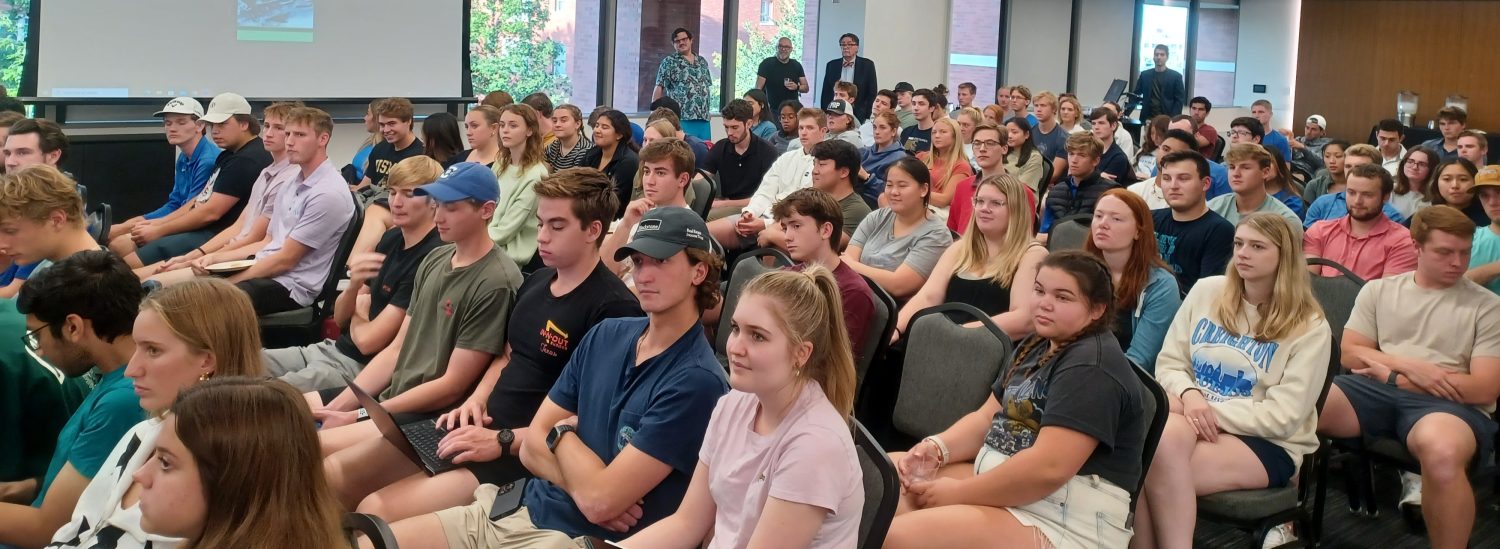
a. Creighton University has committed to providing the EoC project with dedicated space and office resources. We have received full support from both university administration and Heider College of Business leadership. Tony Hendrickson, the dean of the Heider College of Business fully supports our initiative, and in fact all of the students in what is essentially our freshman honors program in the college of business were given a copy of Gustafson’s book Finding Faith in Business: An Economy of Communion Approach to read this Fall, at the direction of the dean. As a Jesuit Institution, the Economy of Communion project reflects our mission statement well, which is Seeing God in all things through the pursuit of truth in all its forms. Embracing Gospel values through a commitment to a faith that does justice. Sharing our God-given gifts for and with others. Developing the whole person – body, soul, and mind. Creighton University is a well run organization, and being the largest Catholic Medical School in the country, they have a record of receiving and managing grants well.
b. The International Focolare movement is highly enthusiastic about this project, and, if it is funded, they will consider starting a Focolare house (a consecrated lay-community) in Omaha. This could potentially include relocating the president of the North American EoC from Los Angeles to serve as assistant director to support the overall project).
c. EoC entrepreneurs are enthusiastic about this project, and they have pledged their assistance in developing valuable materials for the website and prospective entrepreneurs. Well known EoC entrepreneurs such as John Mundell, Nick Sanna, Paul Capitan, Philip Solinsky and Jim Funk are fully committed for interviews.
d. Andrew Gustafson, Ph.D. the project leader, has a proven track record putting together conferences and symposia, including the event that lead to an earlier book Finding Faith in Business: An Economy of Communion Vision (2024), a collection of essays from scholars writing on topics engaging with EoC. He has also published multiple articles on EoC in journals such as the Journal of Humanistic Management, Journal of Religion and Society, Journal of Jesuit Business Education, and other book chapters. Gustafson is very well connected in the North American and International EoC community, and an EoC entrepreneur himself, managing his own EoC company with an annual revenue of around $500,000 per year, so he and is personally very committed to the Economy of Communion and wants to see this project succeed.
As director of the Business, Faith and Common Good Institute, Andrew has brought over 80 speakers to Creighton in the last 10 years, including Ross Emmet, Gary Chartier, Robert Audi, James Stacey Taylor, Michael Naughton, Ken Goodpaster, Charles Clark, Greg Beabout, Mary Hirschfeld, etc. Gustafson also currently serves as the executive director of the Society for Business Ethics for a five-year term (2022-2025) and is well networked, which is evidenced by the diverse group of scholars willing to participate in the Symposium.
e. Loretta Raushuber (possible assistant director) Loretta serves as president of the North American Economy of Communion organization, and as a committed and consecrated member of the Focolare for nearly 40 years, has extensive connections throughout the Focolare movement worldwide, having served in Italy for 20 years at the right hand of Chiara Lubich. She has extensive experience as a software engineer and accounting. She fully support this project and will do all she can to help it succeed. Her personal commitment to the Focolare and EOC make her a great person to help guide many aspects of this grant project.
f. Student workers: Creighton business students are very savvy and we will get workers who can help especially with our online social media presence, utilizing Instagram, tiktok, and X to share content and generate interest and excitement in the EoC vision of business.
g. Symposium Participants: We have a strong field of potential participants for the symposium. We expect to have participation from high-caliber faculty such as the following:
Kevin Jackson (Fordham) has published extensively on business ethics and he has a keen interest in the intersection of faith and business. He has three books including Virtuosity in business: Invisible Law Guiding the Invisible Hand (U Penn, 2012).
Martin Schlag (U. St. Thomas) has published extensively on faith and business, and the role of business in society. He has edited 14 books and written 9, including Business in Catholic Social Thought (2016) and The Business Francis Means: Understanding the Pope’s Message on the Economy (2017).
Christina McRorie (Boston College) has written on Catholic thought and economics in many different outlets, and has a special interest in Adam Smith and Capitalism, from a theological perspective.
Caleb Bernacchio (U. New Orleans) is the Legendre-Soulé Chair in Business Ethics & Faculty Director of the Center for Ethics and Economic Justice, and he has published extensively on virtue ethics and business ethics. He is currently completing a monograph on business ethics, offering a comprehensive account of the ethics of markets, firms, and stakeholder relations from a neo-Aristotelian perspective. He is also interested in Thomism, Catholic Social Teaching, and Ignatian Spirituality.
Bonnie Wilson (St. Louis University) is an economist who has published broadly in economics, especially public choice and development economics. She teaches on topics such as humanomics and the economy of Francesco, and has published in Public Choice, Public Finance Review, Jesuit Higher Education, Economics and Politics, and many other outlets.
Joe Vukov (Loyola Chicago) is a philosopher who has written extensively on remaining human in an age of AI, and is especially interested in what it takes to help humans flourish. Vukov’s research explores questions at the intersection of ethics, neuroscience, and philosophy of mind, and at the intersection of science and religion. In 2022, he published Navigating Faith and Science, and in 2023, he published The Perils of Perfection, and in spring 2024, he Published Staying Human in an Era of AI.
Steven McMullen (Hope College) is professor of economics, fellow at the Oxford Centre for Animal Ethics, and Associate Fellow of the Kirby Liang Centre for Public Theology. He has published three books including Should Wealth Be Redistributed? A Debate (Routledge, 2022) and has published on economics and morality in many outlets including the Journal of Markets and Morality.
Elisabeth Kincaid (Baylor) Is very interested in the work of the Economy of Communion due to her deep interest in Catholic Social Thought and business. With a Ph.D in Theology and a J.D. she is an expert in Suarez and recently published her book Law from Below: How the Thought of Francisco Suárez, SJ, Can Renew Contemporary Legal Engagement (Georgetown, 2024)
Lucas Scripter (Hong Kong Polytechnic University) teaches philosophy in Hong Kong. He has published extensively on meaning and meaningful lives in journals such as Philosophy, Human Affairs, AI and Society, Ratio, Journal of Value Inquiry, and International Philosophical Quarterly.
Karel Sovak (U. of Mary) is the Dean of the business school at University of Mary, and has extensive experience in teaching and administration. He is a frequent participant in Hillsdale’s Free Market Forum and also has published on human dignity in business.
Andrew Lynn (U. Virginia) is Research Fellow at the Institute for Advanced Studies in Culture at the University of Virginia. He received a PhD in Sociology at UVA and currently researches and writes at the intersection of ethical theory and efforts of building a more humane economy. He recently published a book, Saving the Protestant Ethic: Creative Class Evangelicalism and the Crisis of Work (Oxford, 2023).
David Mcpherson (U. Florida) Professor of Philosophy in the Hamilton Center for Classical and Civic Education at the University of Florida as well as Affiliate Professor in the Department of Philosophy. He is the author of The Virtues of Limits (Oxford University Press, 2022) and Virtue and Meaning: A Neo-Aristotelian Perspective (Cambridge University Press, 2020), as well as the editor of Spirituality and the Good Life: Philosophical Approaches (Cambridge University Press, 2017).
Kenman Wong (Seattle Pacific) Professor of Business Ethics. He is the co-author or editor of three books, most recently Business for the Common Good: A Christian Vision for the Marketplace. His articles have been published in journals such as the Journal of Business Ethics, Journal of Markets and Morality, and Christian Scholars Review.
Celeste Harvey Gustafson (College of St. Mary) Associate Professor of Philosophy. She is the co-author of Finding Faith in Business: An Economy of Communion Approach, and has published articles in journals such as Hypatia, Humanistic Management Journal, Journal of Religion and Society and the Review of Politics.
Given the institutional support and the quality and record of those involved, this project is extraordinarily likely to succeed.
 Business, Faith, and the Common Good Institute