The Inhumanity of Profit Seeking (OR: Why the Business of Business Should Be Human Flourishing) Lloyd Sandelands (U-Michigan)


sand 8

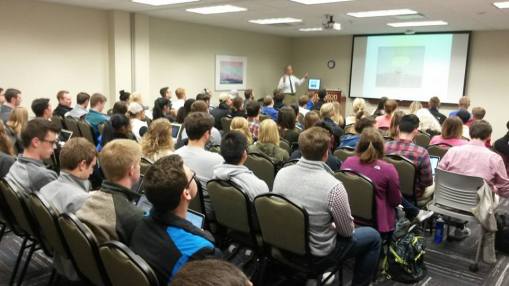
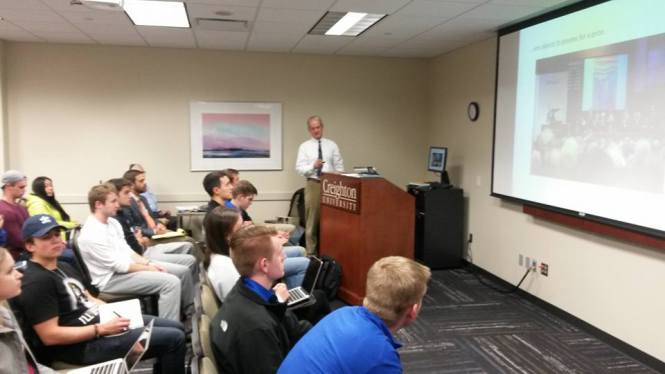
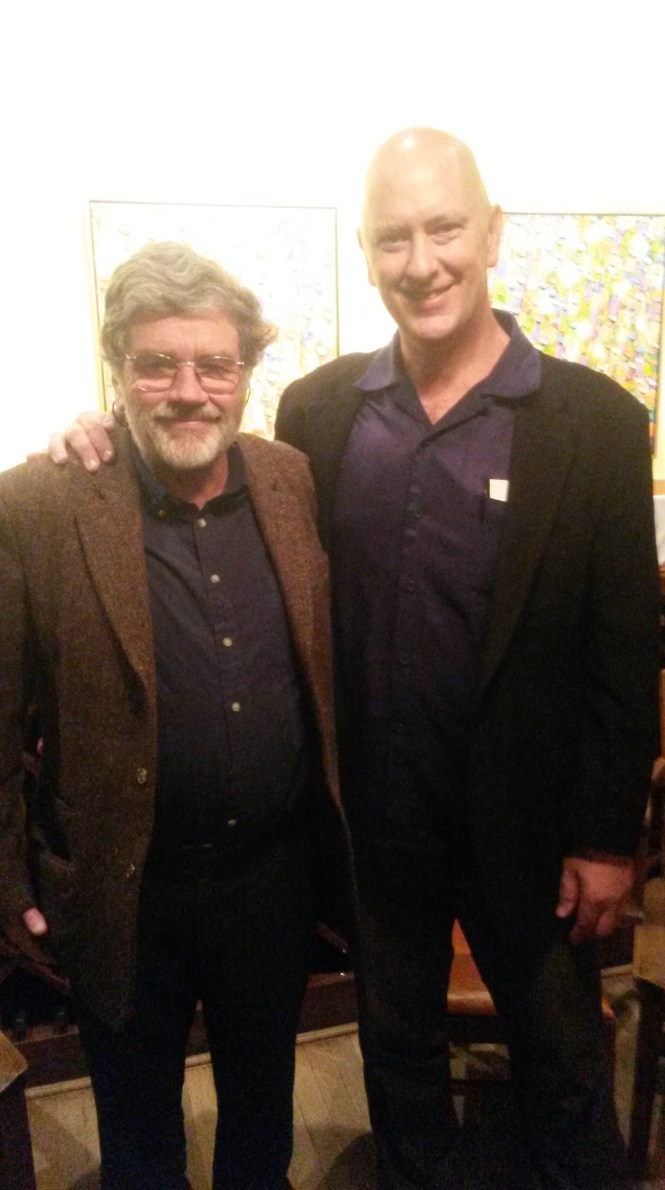
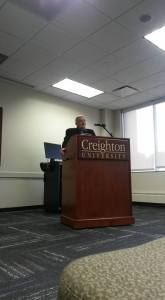
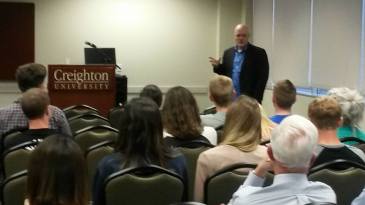
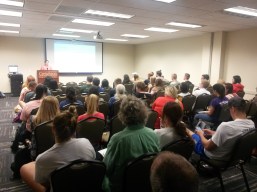
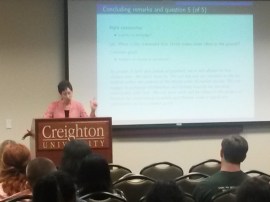
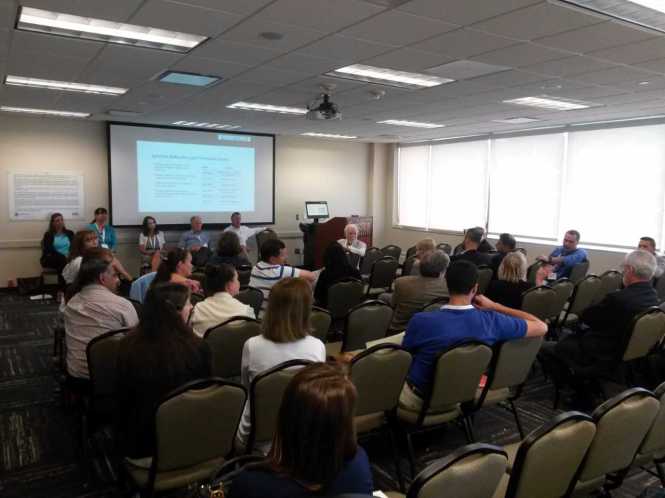
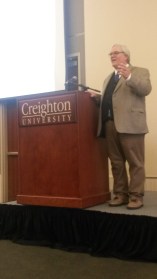
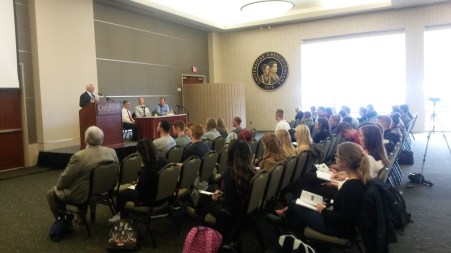
Heider College of Business welcomed Lloyd Sandelands, Professor of Management and Organizational Behavior and Professor of Psychology at the University of Michigan on Thursday night at the Harper Center.  His talk was “The Inhumanity of Profit Seeking” and his thesis was that when business focuses on profit instead of human flourishing, it loses track of its real purpose, and fails to fulfill its purpose, both morally and economically.   Work is for humanity, not the other way around, but we often seek our meaning in our work or in our wealth from our work, which, according to Sandeland, is the wrong place to get our sense of being.  Our true being comes only from God, and in right relationship to God we find the balance which sees work for what it is– a means of bringing about human flourishing.

sand1

After graduating from Northwestern, Sandeland taught at Columbia University College of Business in the 1980s, and moved to the University of Michigan in 1981, where he has taught for over 35 years.  Earlier in his career he was not religious, but he had reconversion experience back to his Catholic faith later in his career, and has written extensively on the central importance of God for a right conceptual understanding of business and its purpose.  His books include God and Mammon, and also Being at Work among others.  His central theme is that the business of business must be oriented towards the human and flourishing, and that will happen only when the purpose of our work is to glorify God.

sand 4

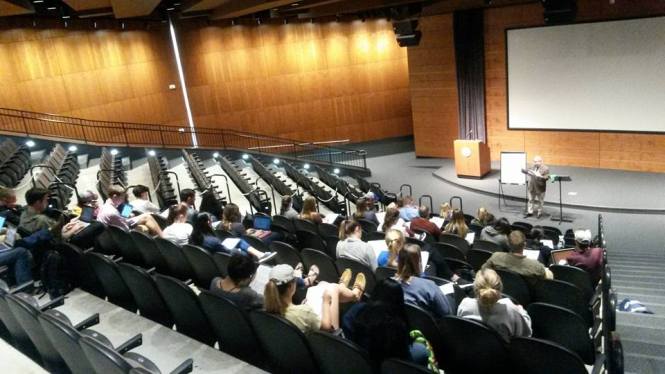
The talk was very well attended, and there were many interesting questions afterwards.  The seminar class to follow was a solid hour and a half of questions from students about Dr. Sandelands thoughts on business.  All in all it was a very successful conclusion to this year’s Business, Faith, and Common Good Speaker Series!

Andy Gustafson

sand2

“Quakers: Friends of Business” Richard Nielsen (Boston College) 10/26

Richard Nielsen came to us from Boston College Thursday evening to help us understand the history of Quaker values, businesses and education, and to make comparisons between the Quakers and Ignatian values.

Some famous Quaker businesses are: Price Waterhouse Coopers, Lloyds, Barclays, Sandy Spring Bank, Chocolate, Cadbury, Fry, Rowntree, Terry, Sony, Lever Brothers (Unilever),  Horniman’s Tea, and Wharton of Bethlehem Steel.

Most of these are no longer owned by Quakers.   Some distinctive innovations of Quaker Businesses were,  Cooperative employee relations, participative decision making, consensus decision making, profit and productivity sharing, continuing innovation with employees, job security with life-time employment with occasional layoffs, eight hour instead of twelve hour shifts, forty hour work weeks, men and women managers promoted from entry level positions, adult education, health care for employees, Home mortgage financing,  paid vacations, paid sick days and longer term leaves, subsidized nutritious meals for employees, pensions for employees, unions recognized and supported, and the concept of Servant leadership, created by Quaker Greenleaf.

The Quaker influence was substantial.   Nielsen said that this win-win social contract that began with many of the large Quaker family owned/controlled businesses later became the foundation for the 1946-1980 political-economic form often referred to as “managerial capitalism.” Nielsen pointed out that beginning around 1980, managerial capitalism was in large part replaced by the current “finance capitalism” in the U.S. and the U.K. that emphasizes maximization of shareholder wealth rather than a win-win social contract.  Many of these influences from the Quakers have been lost in the push for cost savings.

Many Quaker schools are famous: Bryn Mawr College, Cornell University, George Fox University, Haverford College, Johns Hopkins University, Swarthmore College, Wharton School of Finance and Commerce, and Whittier College.  The Quaker distinctives have faded over time for most of these schools.  Although the Quaker history is there, but its practical affects and influence is muted in most cases.  Few Quakers teach at these institutions, and there is little distinctive Quaker influence.

Dr. Nielsen drew a number of comparisons between Quaker and Jesuit values, but he raised a more disturbing concern– are Jesuit schools perhaps losing their identity gradually much like the Quaker schools did?

The history of Quakers, comparison to Jesuits, and possible parallels to decline of the distinctive values were thought provoking and very interesting for the 50+ people who attended (including some local Quakers from the Omaha community).

20171026_231805

10/12 Graham McAleer (Loyola Baltimore) Arguments in Favor of Offshore Wealth Trusts

mcaleer 3Graham McAleer, the BFCGI speaker on October 12th, spoke of the ethical issues of
wealth and offshore tax havens.  The title of his presentation was “Why does Harry’s pal Hermione keep much of her money in Panama?”: The Ethics of Wealth Management” which is a reference to the 2016 release of the Panama papers which were hacked and released to the public which led to great concern about the wealthy shielding their wealth from taxation.
Using the arguments of Edmond Burke in favor of the value of trusts, he argued that the trust is a stabilizing force in society that best benefits society while allowing high net worth individuals to maintain their wealth as well.
McAleers talk and his engaging style was very well received by students.

Born and raised in the north of England, Graham McAleer is a full professor at Loyola University Maryland, and is known for his teaching excellence and rapport with students.  He teaches for the philosophy department and the Sellinger School of Business.  Educated at universities in England, Canada, Belgium, and the United States, he is the author of three monographs: Ecstatic Morality and Sexual Politics(Fordham, 2005); To Kill Another (Transaction, 2010); and Tolkien and Lord of the Rings: A Philosophy of War (Amazon, 2014).  McAleer was Loyola’s Distinguished Teacher of the Year 2014  His most recent work is on the Ethics of Fashion.

mcaleer talk

mcaleer

“Good Goods, Good Work, Good Wealth”: The 2017 Business, Faith and Common Good Symposium

20171005_160623     20171005_121749

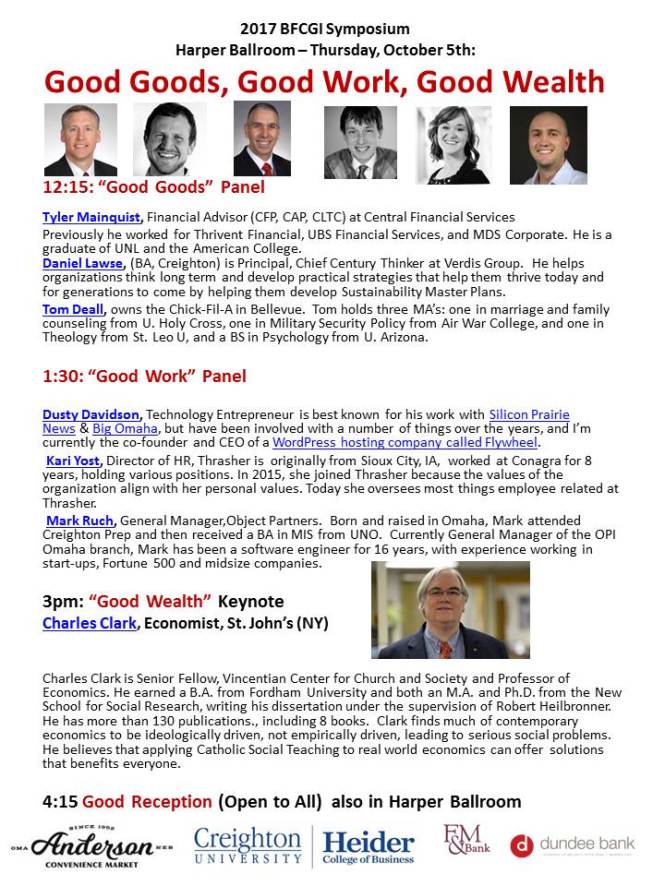
This year’s Business, Faith and Common Good Symposium was oriented around three related concepts: Good Goods, Good Work, and Good Wealth.  We had two panels of local business people talk about Good Goods, and then Good Work. Our Keynote speaker this year was Charles Clark from St. John’s University in New York.

In The Vocation of a Business Leader (2011) the concepts of “Good Goods”  “Good Work” and “Good Wealth” are highlighted, which respect human dignity and serve the common good, and look at business as a community of persons.

Good Goods: produce goods and services that meet genuine human needs and serve the common good, while taking responsibility for the social and environmental costs of production and the supply chain and distribution and watching for opportunities to serve the poor;
20171005_121804

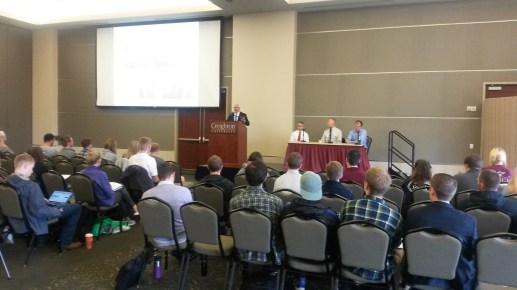
Our good goods panel was made up of Tom Deall, owner of the Bellevue Chick-fil-A, Tyler Mainquist, a financial adviser well versed in Socially Responsible Investing, and Daniel Lawse, an environmental consultant.

Good Work: organise productive and meaningful work by recognising the dignity of employees and their right and duty to flourish in their work (work is for the person rather than the other way around), and by structuring workplaces with subsidiarity that designs, equips and trusts employees to do their best work.

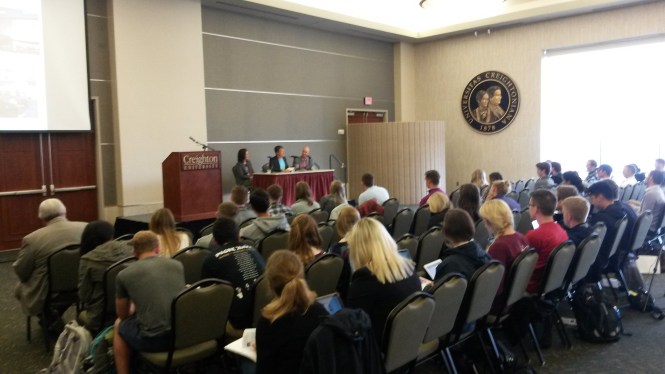
Our good work panel was made up of Kari Yost, HR Director for Thrasher, Dusty Davidson, founder of Flywheel and local entrepreneur, and Mark Ruch, of Object Partners.
20171005_134924

Good Wealth:  use resources wisely in order to create both profit and well-being, to produce sustainable wealth and to distribute it justly (a just wage for employees, just prices for customers and suppliers, just taxes for the community, and just returns for owners).”

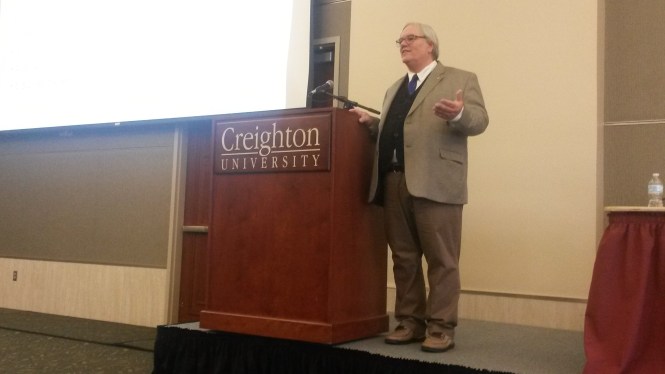
Dr. Clark discussed the ways in which a Christian anthropology (view of what it is to be human) significantly differed from the neoclassical view.  He provided a variety of views of wealth, arguing that a view of wealth which is concerned with the improved well being of society sees wealth in terms of abundance, as opposed to a scarcity view of wealth which sees wealth as possible only when you have more than others do.

Again this year’s symposium provided a great opportunity for faculty and students to engage with local business people and a renown Catholic economist.  New friendships were made, and a lot of good discussions took place.
20171005_160610

The Business, Faith and Common Good Institute could not put on the symposium or the speaker seried without the generous support of the Creighton University office of Mission and Ministry, Heider College of Business, Anderson Convenience Markets, F&M Bank, and Dundee Bank.


This year’s panelists and speaker:

Tyler Mainquist, Financial Advisor at Central Financial Services

Tyler Mainquist is a Financial Planner (CFP®, CAP®, CLTC) with a specialty in Sustainable, Responsible and Impacting (SRI) investing.  He is a registered representative (RR) and investment advisory representative (IAR) with Ameritas Investment Corp. (AIC). He is a lifelong Nebraskan, and a graduate of UNL and the American College.

Daniel Lawse, Consultant at Verdis Group.

Daniel (BA, Creighton) is Principal, Chief Century Thinker at Verdis Group.  He helps organizations think long term and develop practical strategies that help them thrive today and for generations to come by helping them develop Sustainability Master Plans and implementing sustainable strategies as well as by leading regenerative leadership workshops.

Tom Deall, Owner of Chick-Fil-A Bellevue

Tom Owns the Chick-Fil-A in Bellevue.  Tom holds three MA’s: one in marriage and family counseling from U. Holy Cross, one in Military Security Policy from Air War College, and one in Theology from St. Leo U, and a BS in Psychology from U. Arizona.

1:30: Good Work Panel

Our Panelists will discuss the good work they try to produce in their unique businesses:

Dusty Davidson, Technology Entrepreneur

Dusty is best known for his work with Silicon Prairie News & Big Omaha, but have been involved with a number of things over the years, and I’m currently the co-founder and CEO of a WordPress hosting company called Flywheel. He is very  passionate about startups, especially in Omaha.

Kari Yost, Director of HR, Thrasher

Kari,  originally from Sioux City, IA. Got her BA in Human Resources and Management from Morningside College. She worked at ConAgra for 8 years, holding various positions. In 2015, she joined Thrasher because the company’s purpose, mission and values. Kari is currently the Director of Human Resources.


Mark Ruch, General Manager,Object Partners

Born and raised in Omaha, Mark attended Creighton Prep and then received a BA in MIS from UNO.  Currently General Manager of the OPI Omaha branch, Mark has been a software engineer for 16 years, with experience working in start-ups, Fortune 500 and midsize companies.

3pm: Good Wealth Keynote
Charles Clark, Economist, St. John’s (NY)


Charles Clark is Senior Fellow, Vincentian Center for Church and Society and Professor of Economics. He earned a B.A. from Fordham University and both an M.A. and Ph.D. from the New School for Social Research, writing his dissertation under the supervision of Robert Heilbronner.  He has more than 130 publications (8 books), including Economic Theory and Natural Philosophy (1992), Pathways to a Basic Income (with John Healy) (1997); The Basic Income Guarantee: Ensuring Progress and Prosperity in the 21st Century (2002); History and Historians of Political Economy (1994); Institutional Economics and the Theory of Social Value (1995); Unemployment in Ireland (1998) and Rethinking Abundance (2005).


Clark finds much of contemporary economics to be ideologically driven, not empirically driven, leading to serious social problems.  He believes that applying Catholic Social Teaching to real world economics can offer  solutions that benefits everyone.
“Achieveing Social Justice Through Liberty” Dr. Gary Chartier 9/28

gary 2   gary

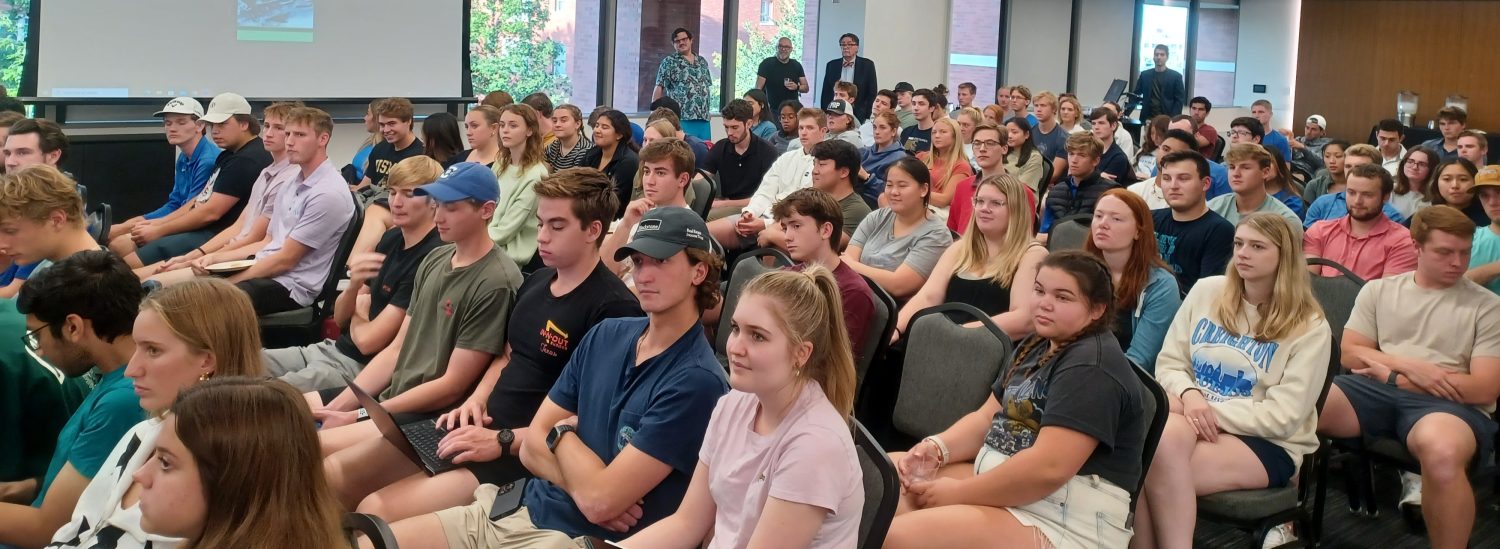
Thursday evening the business, faith and common good speaker series welcomed legal scholar and philosopher  Gary Chartier of La Sierra University to Creighton’s campus.  Dr. Chartier, identifies as a “left-wing market anarchist”, who is pro-free-market although critical of much of capitalism as it stands today.

According to Dr. Chartier, in the current market system, the state works with particular companies and interests to help dispossess people of opportunities and to maintain structures which disallow competition.  The problem is the state-sanctioned mechanisms by which those who have keep those who don’t from achieving a share of the wealth.  This can happen through monopolies, lobbied-regulations which favor established companies (often lobbied for by those companies protected), etc.  The problem, according to Dr. Chartier, is in part the state-ist control of markets and so the solution is to supplant the state governments (which are themselves area-monopolies over particular land areas) with other forms of institutions, such as mutual aid societies.

Chartier agrees with Michael Novak that we are “more sinners than saints” but state control is not the solution because state control of aspects of society merely consolidates power into the hands of a few.  What is better he thinks is a distribution to a multiplicity of institutions, but not states.  Government is no panacea to the problem of self-centeredness of individuals.  It only exacerbates it.

Justice will come from greater liberty, Chartier says, not only because people will take more responsibility for their actions (since no one will bail them out (GM, Banks in 2007)) and without state-sanctioned crony capitalism, real free markets will exist without the corporate special interest subsidies and other freedom-limiting artificial barriers to truly free markets and liberty.  As it is, real competition and real ability to enter the market are both restrained by artificial constructs of the cooperation between established corporate entities and governments who work to protect those companies.

Chartier made it clear that he is not interested in eliminating regulation in order to  allow the large corporations to allow them to do whatever they want.  He thinks the regulations in place are what sustain the corporations in many cases.   He instead advocates that the rich ‘eat themselves’ by eliminating the subsidies and special regulations which protect them and oppress competition, which would lead to actual competition which would likely undermine the companies which are presently protected.  He argues that if the state sanctioned protection of these companies was eliminated, they would collapse, and people would experience more justice through the real freedom of the market.

Dr. Chartier brought a thought provoking and challenging view of the market, and Creighton was blessed to have him come to campus!  — Andy Gustafson

Note on Dr. Chartier:  Gary Chartier (La Sierra University) is Distinguished Professor of Law and Business Ethics and Associate Dean of the Tom and Vi Zapara School of Business at La Sierra University in Riverside, California. He is the author, editor, or co-editor of thirteen other books, including Public Practice, Private Law (Cambridge, 2016), Anarchy and Legal Order (Cambridge, 2013), Economic Justice and Natural Law (Cambridge, 2009), and (with Chad Van Schoelandt) The Routledge Handbook of Anarchy and Anarchist Thought (Routledge, 2019). His byline has appeared over forty times in journals including the Oxford Journal of Legal Studies, Legal Theory, and Law and Philosophy. He is a member of the American Philosophical Association and the Alliance of the Libertarian Left and a senior fellow of the Center for a Stateless Society.

THE BFCGI SPEAKER SERIES IS GENEROUSLY SUPPORTED BY:

Anderson_Lockup

CRT_twitter

fm

2a886-1499886162590

Dr. Mary Hirschfeld’s Talk On Inequality

mary 3  mary me2 mary 2

Mary Hirschfeld, economist and theologian from Villanova, spoke to a crowded room about Christian concerns in economics, particularly economic exclusion on Thursday night at Heider College of Business.  Dr. Hirschfeld has an interesting story.  A Harvard-trained economist, she had a tenured position in Los Angeles for 15 years before going through a dramatic conversion to become a Catholic.  Shortly after, she left her tenured position as an economist and began studies in theology at Notre Dame, where she achieved her second Ph.D, this time in theology.  Eventually she landed at Villanova, where she combines her concern for faith issues with her knowledge of economics.

Dr. Hirschfeld’s talk focused on the concept of inequality, and particularly, what a Christian theologian should bring to the discussion which is unique.  While a lot of concern is focused on inequality, Dr. Hirschfeld challenged us to consider to think as Christians about economics and focus instead on how we use money to protect ourselves and exclude others and to define our status in society.  She pointed out that Aristotle said money should be considered like medicine– a certain amount is needed to fulfill a particular end.  But many times, she said, the debate about inequality is like having a debate about who has more aspirins– “I really only need two aspirins to deal with my headache, but we get into debates about I only have 10 aspirin and you have 12, or 20!”

What is it that we really need?  The quest to maximize, and to earn more and more and spend more and more is part of what undermines our happiness.  If we consider wealth as “having what we need” we make ourselves poorer by expanding our financial obligations by aquiring more and more, which then requires more of our efforts towards maintaining our own created needs, and away from concern for others and the common good.  We should instead think about what a reasonable amount is for us to live on, and to try to stay within those parameters.  When you do this, Dr. Hirschfeld said, you find a real freedom and a lack of stress because you aren’t trying to maximize your income and purchasing power and acquisitions.  But as Christians, we are especially called to own private property so that we can use it for the common good and share with those in need.  Profit is good, and making money in the free market is great, but setting limits on one’s own ‘economic requirements’ is a matter of spiritual health for us.

Drawing on Pope Francis’ concerns regarding economic exclusion and exploitation, Dr. Hirschfeld reframed the discussion on inequality, saying that the real problem in society is not so much the 1%, but the top 1/3 of us who want to protect our economic status above the other 2/3 by buying into the right school districts, getting our kids in the right colleges, getting the white collar not blue collar jobs, going to the church where aspiring people like ourselves attend, using services to help set ourselves apart in society and having expectations of retirement, vacationing and other types of behavior all which help separate us from the ‘others’ and exclude them.  As Christians, we need to overcome class and socioeconomic differences, but we create lifestyles for ourselves which create a great chasm between us and the ‘working class’ and rest of the others.  In some ways we actively want those on the ‘other side of the tracks’ to stay there– because that is how we distinguish ourselves and maintain our social standing securely.

After the public talk, Dr. Hirschfeld met with the business, faith and common good seminar class and we discussed some of these matters further, as well as St. Thomas on private property and concern for the common good.  Again, Mary challenged us to think about the human-social dimensions of economics and to seriously consider maintaining finite expectations of the amount of money we think we need to live.  It is far to easy to use up whatever we have and feel that we need a little more– no matter how much we earn.  She shared that until her conversion, she was always of the opinion that ‘if only I could get a 10% raise, then everything would be great’ (even after multiple 10% raises).   But somehow at conversion, she was able to learn to really focus on what she really wanted, and to stop spending on a lot of frivolous things which really did not bring her happiness.  This in turn allowed her to tithe more and to share generously with others, without hesitation.  An open ended maximization view of what we might earn and spend leads to a lack of definition and ironically, to a lack of satisfaction.

It was fantastic to have Dr. Hirschfeld be with us at Creighton, and we look forward to her book which will be forthcoming from Harvard University Press in 2018!  Her talk will be aired on KIOS lunch talks sometime in the winter.

Many thanks to our generous sponsors of the BFCGI talks:

Anderson_Lockup

fm2a886-1499886162590

CRT_twitter

office of mission and ministry


BFCGI Speaker: Bonnie Wilson (Economist, St Louis U.)

20170907_184644     20170907_184711

The business faith and common good Institute kicked off their speaker series for this fall with a talk by Dr. Bonnie Wilson, Economist at St Louis University. The title of Dr. Wilson’s provocative talk was “Economics: A Theology of Scarcity, Or Something More?” Drawing on the notion of Economics as human exchange, focusing on the human encounter in such scenarios, she challenged us as Christians or people of Goodwill to resist the tendency to act with fear and a mindset of scarcity wherein we look at a business exchange as a situation where I must win and the other loses, but the rather to look with eyes of faith which attempt to see business exchanges as opportunities for win-win outcomes.

In a world where economic indicators show great progress for humanity, we find that people are less satisfied, more fearful, and in fact think things are getting worse, not better, Dr. Wilson pointed out.  So it is easy for us to seek to protect ourselves, and to see the other as a threat to our well being and financial security, which then plays out in our business interactions.  But people of faith and goodwill are called by the words of Christ to “fear not” and to not lose sight of the human encounter which we participate in when we are engaged in business.  Our presence is a gift to others, their presence is a gift to us, and with faith we should practice business with a theology of abundance, not scarcity, and generosity, not fear.

This was a great start to our speaker series, and the Business, Faith and Common Good Institute is grateful that Dr. Bonnie Wilson was willing to come share her insights with us. 20170907_225724


2017 BFCG Speaker Series

Photo: Bonnie Wilson Image result for mary hirschfeld villanova Image result for gary Chartier Charles ClarkImage result for graham mcaleerImage result for richard nielsen boston college Lance Sandelands

Each year the  Business, Faith and Common Good Speaker Series brings to campus outstanding engaging thinkers who can speak to the intersection of business, faith, and the Common Good.  Coming from fields like philosophy, management, economics, thoelogy and finance, they bring various perspectives on faith and business, faith and the common good, or business and the common good.  Fall 2017 we will have an amazing speaker series lineup, with talks open to the Creighton Community and general public.

Photo: Bonnie Wilson  Bonnie Wilson (St. Louis University)

“Economics:  A Theology of Scarcity or Something More?”  (Sept. 7, 6pm Harper 4053)

Bonnie Wilson combines a strong concern for Jesuit mission with her interests in Public Choice theory, Macroeconomics, International Economics, and Financial Economics. She will kick off this year’s speaker series speaking to us about Jesuit Values, Economics, and Free Choice.  Vita


Image result for mary hirschfeld villanova Mary Hirschfeld (Villanova)   (September 21, 6pm Harper 3027)

After getting her Ph.D. in economics from Harvard, Professor Hirschfield taught economics for 15 years, but eventually was drawn to Catholicisim, quit her tenured position, and got a Ph.D in theology from Notre Dame. eventually getting a position at Villanova in Economics and Theology.   She has worked on  developing an approach to economics that is grounded in the thought of St. Thomas Aquinas. The results have applications to questions about consumption economics, economic justice, the common good, the nature of practical reason, and economic methodology.

Image result for gary Chartier  Gary Chartier (La Sierra University)

“Achieving Social Justice through Liberty”  (September 28, 6pm Harper 3023)

Gary Charier is Distinguished Professor of Law and Business Ethics and Associate dean at the business school at La Sierra University in Riverside, California, a 7th Day Adventist intstitution.  As a legal scholar and philosopher he identifies as a “left-wing market anarchist”, he is pro-free-market although critical of much of capitalism as it stands today.  As a Christian and a libertarian, he holds positions which make him a unique thinker.  Always gracious but also intense, he will provide a lively talk for our series this year.  Gary on Wikipedia

Charles Clark Charles Clark (St. John’s University, NY)

“Good Wealth”  (Thursday October 5, 3pm Harper Ballroom)

Our Keynote Speaker for the 2017 Business, Faith and Common Good Symposium on October 6th will be Charles Clark.  Dr. Clark is Senior Fellow at the Vincentian Center for Church and Society and Professor of Economics at St. John’s University in New York.   He writes frequently on the intersection of Catholic Social thought and economics, and has interests especially in the History of Economic Thought, Poverty and Income Inequality.


Image result for graham mcaleer  Graham McAleer (Loyola, Baltimore)

“Why does Harry’s pal Hermione keep much of her money in Panama?”: The Ethics of Wealth Management” (Thursday October 12, 6pm Harper Auditorium)

Born and raised in the north of England, Graham McAleer is a full professor at Loyola University Maryland, and is known for his teaching excellence and rapport with students.  He teaches for the philosophy department and the Sellinger School of Business.  Educated at universities in England, Canada, Belgium, and the United States, he is the author of three monographs: Ecstatic Morality and Sexual Politics(Fordham, 2005); To Kill Another (Transaction, 2010); and Tolkien and Lord of the Rings: A Philosophy of War (Amazon, 2014).  McAleer was Loyola’s Distinguished Teacher of the Year 2014  His most recent work is on the Ethics of Fashion.

Image result for richard nielsen boston college Richard P. Nielsen Boston College

(Oct 26, 6pm Harper 3029)  “The Quakers: Friends of Business”

Professor Nielsen comes to us from the Organization Studies Department, Carroll School of Management, Boston College, and is past president of the Society of Business Ethics. He is a member of the Religious Society of Friends (Quakers). He works in the areas of ethics engagement, communication, and leadership methods, having published more than 75 articles in journals such as Academy of Management Review, Academy of Management ExecutiveBusiness Ethics QuarterlyBusiness and Society,  and the Journal of Business Ethics. He was born in New York City and is married with two children.


Lance Sandelands  Lance Sandelands (U. Michigan)

“On the Inhumanity of Profit-Seeking”  (November 2, 6pm, Harper 3027)

Lance Sandelands has taught organizational behavior and management at the Ross School of Management for nearly three decades.  Widely published, in his recent book, Being at Workhe unites the metaphysics of Aristotle and Aquinas and the social teachings of the Catholic Church to describe how business leaders can help people in their organizations become more truly and fully human, and his previous book God and Mammon developed a comprehensive management ethic with a concern for how humans should be the focus of business when we bring God into our business practices.  (Talk on November 2, 2017, 6pm)

CJBE Conference at Creighton (Colleagues in Jesuit Business Education)

eocThe 2017 CJBE conference (Colleagues in Jesuit Business Education) was hosted at Creighton University July 6-8th.  Over 60 business faculty came from more than 20 Jesuit and other Catholic Universities, from Boston College and Fordham to San Diego and Seattle, and many in between.    The theme this year was “Using Our Work for the Common Good: The Transformative Power of Jesuit-Inspired Business Practices” and presentations were given by faculty from marketing, management, ICT(IT), accounting, economics, business ethics, theology, philosophy, and others.
170708_CU_CIJB_Nicky_Santos_SJ-1    170708_CU_CIJB_Peter_Balleis_SJ-1  lowneyporth

Fr. Nicky Santos of Marquette and also Fr. Peter Balleis, SJ of Jesuit Worldwide Learning both gave keynote presentations.  There were also keynote panels on the Creighton DBA program which incorporates Ignatian relection and pedagogy and CST principles throughout the 3 year program, as well as on the Economy of Communion (Jeanne Buckey (U St. Thomas), John Gallagher (Maryville C.), and Andy Gustafson (Creighton), and also a leadership course following the footsteps of Ignatius of Loyola in Spain by Chris Lowney and Steven Porth (SJU).

There were 30 presentations total, and each evening there were unique social events– Thursday night at the Omaha Press Club atop the old First National Bank building, Friday night at Hotshops downtown, and Saturday night at Professor Andy Gustafson’s house in Gifford Park.

The CJBE is a unique organization in that it brings together faculty within business who have a special concern to promote Jesuit and Christian thought and values and pedagogy in their classes.  There are few if any organizations like it in other disciplines, even in arts and sciences.

At the CJBE board meeting on Thursday, Creighton’s President Fr. Daniel Hendrickson joined the board of CJBE, along with Fr. Joe Koterski of Fordham University.

The Heider College of Business, Creighton University, and the Business, Faith and Common Good Institute contributed financially to help support the CJBE conference.

eatingjoan170708_CU_CIJB_Andy_Gustafson-120170707_131913