MBA 479/779 Business, Faith, and the Common Good F2016
COURSE DESCRIPTION
Faith plays a very important role in human life, and often provides a center-point for guidance in matters of behavior and practice, both personal and public. This class considers:
- the relation of faith and business
- the relation of faith and the common good
- the relation of business and the common good; and
- the relation of all three at once.
More attention will be paid to the first and last of these, but there are important concerns of all four raised in the class.
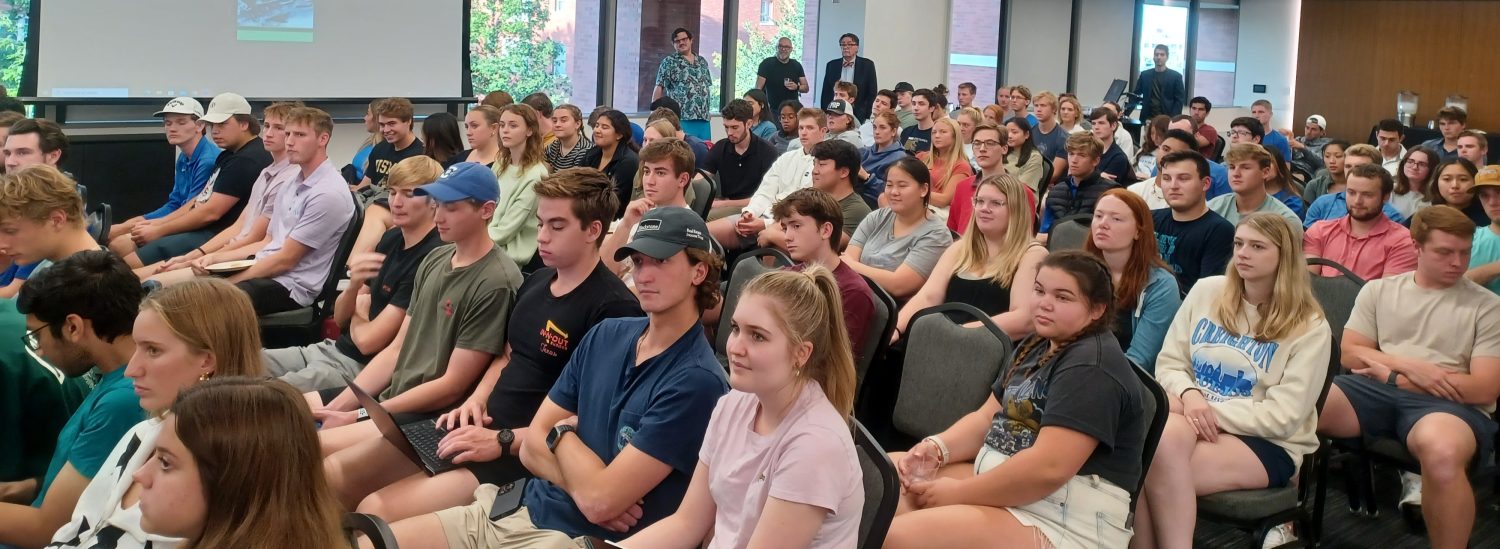
The goal of this class is to expose students to a variety of viewpoints about the ways one’s faith can or should affect one’s business practices, and to help students think through these issues for themselves. A unique aspect of this seminar style class is that we will have many nationally known guest speakers come to interact with us. See some of them here. They will come from Marquette, Loyola, Patrick Henry College, Catholic University of America, St. Joseph U., St. Louis U., as well as various departments at Creighton.
Diverse perspectives: There are a lot of differing perspectives on how faith should affect one’s business practices, from the Protestant work ethic, Catholic encyclicals on workers rights, or Puritan’s views on work as keeping us from the devil’s snare’s. While some people think of work as a means to make money to do what they really want to do, the Christian traditions have developed many thoughtful perspectives on work as vocation, on work as theological practice, and even work as worship or witness.
Business: Some think that acting ethically in transactions is the key way faith can be shown in business practice, while some see business to be an instrument to make money to do good works of faith, such as practicing charity or philanthropy, and still others see business practice itself as a work of faith or practical theological calling. Some think business contributes to the common good naturally through producing goods, services, and indirectly jobs, taxes, and infrastructure for society. Others think business has responsibility to intentionally contribute to society through, for example, environmentally conscientious decisions, paying higher wages than industry standards, considering the concerns of stakeholders in ways which sacrifice profits, or using higher cost higher quality resources in one’s products or services than might be absolutely necessary. In this class we will look at faith-informed views of business practices—learning what faith traditions (especially the Christian tradition) have said about how businesspeople of faith should conduct their business, how they frame their conceptions of business, and why.
Readings: We will consider other Catholic sources especially, including recent encyclicals, and the contemporary Catholic scholars such as Naughton, Finn, Goodpaster, Clark, Murphy and Laczniak, as well as the OEC movement (Gallagher). In addition, we will look at some other faith traditions writings on business, including some recent evangelical writings such as Rae & Hong as well as Lutheran, Jewish, Puritan and other reformed writings.
Grades: Since this class will primarily be a seminar, participation in the online and class discussions, and brief response papers (3pg each) will be a central part of the total grade (60%). Final paper (20%) and final project (20%) are also substantial.
Objectives: In this course you will integrate readings, guest lectures, and group interaction and discussion to reflect on the relationship between faith and business. It will be done seminar style. In this course you will:
- Consider both secular and religious perspectives on the relationship between business and the common good.
- Learn about various perspectives on the application of Catholic Social Thought to business.
- Learn about non-Catholic religious perspectives on the relationship between faith and business including Lutheran, Puritan/Calvinist, Amish, Jewish, Muslim, and Hindu.
- Understand concepts in this discussion such as ‘subsidiarity’, ‘common good’, ‘puritan work ethic’, ‘stakeholder theory’, etc.
Grades: A = 92-100 Remarkable Distinctive Outstanding work; B+ = 88-91 Excellent work, Very well done; B = 81-87 Above average work; C+= 77-80 Above the mean, high end of average; C = 70-76 Average, acceptable; D = Below 70 passing although needs much improvement; F = Below 60 Not passing
Requirements:
- Attend/Participate (25%) Do readings, 3 hours class time per week, 1 ‘hour’ online learning (always 4 hours per week total) brief response papers (3pg) bring to class.
- Online Participation (20%) in weekly online discussion of topic
- Final Reasearch Paper (20%) (8-12pg) On particular business ethics topic with 5+ cited sources and 10+ further research sources (where you would suggest we go to learn more about the topic).
- Term Group Project Presentation (15%): Variable content, but must be on the topic of business ethics as it relates a. the relation of faith and business, b. the relation of faith and the common good, c. the relation of business and the common good; or d. the relation of all three at once. 1-2 per group max.
- Book Review (20%): Review one book on the topic of business and faith (I will provide an extensive list of possible books, but you may find other relevant books as well) Last year 4 of the book reviews were published on our Business, Faith and Common Good website.
Readings:
Most of the readings are online.
TENTATIVE SCHEDULE Fall 2016
Note: All weeks except week 1 and 11 we will have guest speakers. Weeks 5 (Ozar), 6 (Veith) and 9 (Cloutier) our speaker will give a public talk in Harper for 45 minutes, then 20 minutes Q&A, and short reception/break. Then just our class will meet with the guest speaker from 7:30-9:00pm. On the other 6 nights, the guest speakers will come and present and we will interact with them in our seminar class for the first ½ of class (6-7:30), then we will discuss the readings further the 2nd half (7:30-9pm), etc.
| Week 1 (8/30) Business and the Common Good: Positive Externalities of Business
Overview: 1. Introduction 2. Various conceptions of business (Stockholder, Stakeholder, etc) 3. Business and the Common Good 4. Business and Faith
|
|
|
|
| Week 3 (9/13) Entrepreneurship as Vocation
Guests: Alexei Marcoux (Links to an external site.), Heider Business Read: Entrepreneurship Series Interview with Goodpaster and Naughton (Links to an external site.) “”Not Only Stakeholder Ethics” Domenec Mele “Applying CST…to Stakeholder Ethics” (Links to an external site.) By Bruno Dyck Skim: “Respect in Action: Applying Subsidiarity in Business”
1. What is Entrepreneurship? How might it be a vocation? 2. In what ways does entrepreneurship imitate God? 3. What do you think of Goodpaster’s claim that business is a spiritual activity? 4. What do you think of Naughton’s comment that “The end of business is developing products and services that enhance the common good, and developing communities of work that help people to develop. Profit is a means to achieve these ends.” 5. In light of their comments on the distinctiveness of Catholic Business Education, what do you think should be key differences at a CBS? |
|
|
Week 4 (9/20) Gregory Beabout (St. Luis U.) Gregory Beabout is professor of philosophy, and author of over 40 articles and reviews and books including The Character of the Manager: From Office Executive to Wise Steward; Freedom and Its Misuses: Kierkegaard on Anxiety and Despair; Beyond Self Interest: A Personalist Approach to Human Action; and editor of A Celebration of the Thought of Pope John Paul II: On the Occasion of the Papal Visit to St. Louis and A Handbook of Virtue Ethics in Business and Management. |
|
|
**Week 5 (9/27) David Ozar (Loyola, Chicago) ” Business and the Common Good: What Would Aristotle or J.S. Mill Do?:” 6pm, Harper Center
David Ozar was Professor and Co-Director of Graduate Studies in Health Care Ethics in the Department of Philosophy at Loyola University Chicago, and from 1993 to 2006 was Director of Loyola’s Center for Ethics. He is an applied-ethics expert who has taught and done work in the areas of Mill’s Utilitarianism and Aristotle’s virtue ethics. He was the founder and first president of the Professional Ethics in Dentistry Network and has held offices in the Society for Health and Human Values, the American Philosophical Association, and other professional organizations. His publications are wide-ranging, including articles on whistleblowing in dentistry, whether or not corporations have moral rights, and what should be done with unused frozen embryos.
|
|
| **Week 6 (10/4 ) October 4th
Gene Veith (Patrick Henry College) “Lutheran Perspectives on Vocation and Economics” 6pm Harper Center Dr. Gene Edward Veith was until recent retirement Provost and Professor of Literature at Patrick Henry College. Dr. Veith is the author of 20 books on topics involving Christianity and culture, classical education, literature, and the arts, and including books on Christian God at Work: Your Christian Vocation in All of Life and his 2016 book, Working for Our Neighbor: A Lutheran Primer on Vocation, Economics, and Ordinary Life . Read: Working for Our Neighbor: A Lutheran Primer on Vocation, Economics, and Ordinary Life |
|
| Week 7 (10/11) Economy of Communion & Catholic Social Thought and Business
Guest: Tom Kelly (Links to an external site.) Creighton University Theology Department (will speak on Guadium et spes) Read: Vatican II document Gaudium et spes selections; 1. What are the 9 ‘heresies’ Finn outlines? How are they like and unlike actual heresies? 2. What is good wealth, and what is bad wealth? 3. Is there anything that wealth should not be spent on? : Read Structures of Grace (Links to an external site.) Author John Gallagher (Links to an external site.) will join us. 1. What is EOC? 2. What aspect of EOC did you find to either be the most inspiring or problematic? 3. Which EOC company was most impressive to you & why?
October 7: BFCG symposium (Links to an external site.) all day Friday (‘required’ attendance at 2 sessions) |
|
|
Week 8 (10/25) Marketing/Consumerism Speaker: Patrick Murray (Links to an external site.) Read: “Goods that Truly Serve (Links to an external site.)” by Ken (Links to an external site.) Goodpaster (Links to an external site.) (BFCG keynote for 2015) “A Larger View of Marketing: Marketing’s Contributions to Society” Wilkie/Moore 1. What types of goods truly serve, according to Goodpaster? 2. What should Christian capitalism look like? 3. What should be the Christians response to consumerism? 4. What are the most troubling forms of commodification today, on your view? 5. What do you see to be Weber’s most powerful criticisms of capitalism for our contemporary society? 6. What do you think are the key problems with Hayeks characterization of the Open Society and social justice? |
|
|
**Week 9 (11/1) November 1st “The Ethics of Consumption” David Cloutier (Catholic U. of America) “The Vice of Luxury” 6pm, Harper Center David Cloutier teaches in the Theology department at Catholic University. He has written Love, Reason, and God’s Story: An Introduction to Catholic Sexual Ethics (2008), Walking God’s Earth: The Environment and Catholic Faith (2014) and The Vice of Luxury: Economic Excess in a Consumer Age (2015), in which he gives a historical account of the concept of luxury, shows why luxury is a problem, explains how to identify what counts as the vice of luxury today, and develops an ethic of consumption that is grounded in Christian moral convictions. Read: The Vice of Luxury |
|
| Week 10 (11/8) Marketing Ethics and Catholic Social Thought
Gene Laczniak (Marquette U.) In 2012, Gene Laczniak received a lifetime achievement award from the American Marketing Association for his contributions to marketing ethics, corporate social responsibility and public policy scholarship. Laczniak currently serves as President of the Macromarketing Society, and from 1998 to 2002, he was the Associate Vice-President/Associate Provost for Academic Affairs at the Marquette. Laczniak was a member of the editorial review board of the Journal of Marketing for 15 years and continues to serve on two academic journal review boards. He is co-author of five books on business ethics with his most recent being Ethics in Marketing: International Cases and Perspectives (Routledge, 2012).” He has been a member of the board of directors of four non-profit organizations with 18 years of aggregate service. He has taught executive development classes in the U.S., Europe and Asia winning several teaching awards. Laczniak has published over 150 journal articles and papers. Read: Laczniak and Klein “Applying CST to Marketing” Lazniak, Klein, Murphy “Caritas In Veritate: Updating Catholic Social Teaching…” Laczniak“On the Nature of ‘good’ goods, and the ethical role of marketing” (Links to an external site.) |
|
| Week 11 (11/15) Business, Faith and the Common Good (Presentations of Projects at a restaurant—either Mark’s in Dundee or Johnny’s in South Omaha) |
A Bibliography on Business Faith and the Common Good resources
The Creighton University Business Faith and Common Good Institute Website
 Business, Faith, and the Common Good Institute