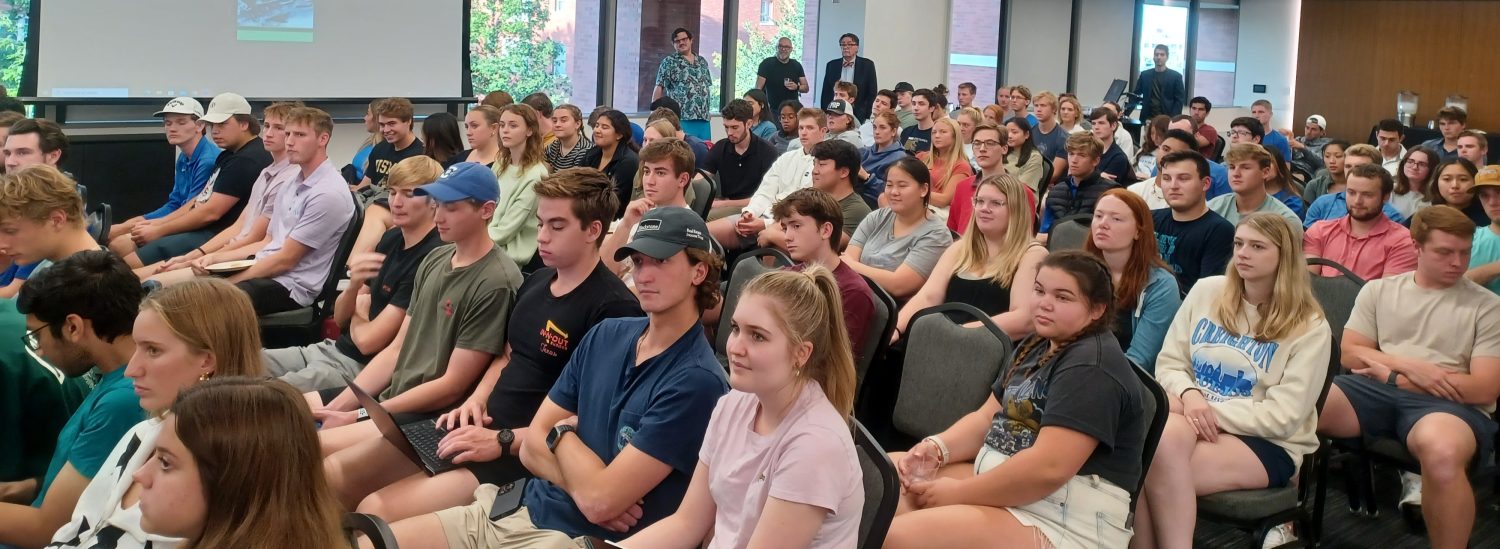
The Business, Faith and Common Good Seminar Class was started in 2015 to provide a class to help students learn more about how business, faith, and the common good are interrelated. MBA and undergrad students (in liberal arts as well as business) may take the class. We look at a variety of traditions and perspectives. Unique to this class is the fact that we bring in faculty from across the country to speak to interact with our seminar. See the 2016 speakers here, and the 2017 speakers here.
This semester we will have guest expert faculty speak to our seminar group in person coming from Loyola-Baltimore, St. Johns (NY), St. Louis U., Villanova, La Sierra U., and Boston College, and other departments from Creighton. When we have guest speakers, we will typically attend their public talk in Harper 6-7pm, and then our seminar group will get to talk with them in our seminar 715-845. Other students and faculty are welcome to join our seminar group as guests. Our tentative list of speakers this year will be:
Bonnie Wilson St. Louis U “Economics from a Catholic Jesuit Perspective”
Mary Hirschfield , Villanova: “St. Thomas Aquinas and Adam Smith”
Charles Clark St. John’s (NY): What Economics Can Learn From Catholic Thought
Richard Nielsen, Boston College: A Quaker View of Business
Graham Macaleer, Loyola-Baltimore: Ethics of Fashion
Lance Sandelands , U. Michigan : “How Work Forms and Shapes Us Spiritually”
Gary Chartier, La Sierra U (CA) “Economic Justice and Natural Law”
Each week there will be online discussion assignments, as well as some readings related to class and the guest speakers. In addition to weekly assignments, there are no tests or quizzes, but a final paper and final presentation project which you will present on the last day of class when we meet at Johnny’s Steakhouse for our last class (Gustafson’s treat!)
Many readings will be online, but assigned books from which we will read include: Business for the Common Good (Rae & Wong), Working for Our Neighbor: A Lutheran Primer on Vocation, Economics and Ordinary Life (Veith); Being at Work (Sandelands); Respect In Action: Applying Subsidiarity in Business (Naughton et al); and Vocation of the Business Leader
If you have any questions, please contact Andy Gustafson (andrewgustafson@creighton.edu)
TENTATIVE Fall 2017 SCHEDULE:
|
Week 1 (8/24) Business and the Common Good, Business and Faith, and Faith and the Common Good Overview: 1. Introduction 2.Various conceptions of business (Stockholder, Stakeholder, etc) 3. Business and the Common Good; 4. Business and Faith Read: What ever Happened to the Common Good? (Time) Business, the Economy, and the Poor (Gustafson) *Business for the Common Good Ch 1 Reading (Online Discussion) |
|
|
|
| Week 3 (9/7) Bonnie Wilson, Economist, St. Louis University
“Economics from a Catholic Jesuit Perspective” Questions TBA |
|
| Week 4 (9/14) Catholic Social Thought and Business Practices
Read: “The Distinctive Vocation of Business Education in Catholic Universities” Vocation of the Business Leader Interview with Goodpaster and Naughton Example Study Question: 1. In light of the Goodpaster article on distinctiveness of BusEd at Catholic Universities, what are three things you could imagine Creighton doing to be ‘more distinctively Catholic/Christian’? 2. What are gift and reciprocity from VoBL? 3. What do you think of Goodpaster’s claim that business is a spiritual activity? 4. What do you think of Naughton’s comment that “The end of business is developing products and services that enhance the common good, and developing communities of work that help people to develop. Profit is a means to achieve these ends.” |
|
|
Week 5 (9/21) Mary Hirschfield , Economist/Theologian, Villanova: “St. Thomas Aquinas and Adam Smith” Read: “How a Thomistic Moral Framework Can Take Social Causality Seriously” List the questions and simple answer to each question of Aquinas (9 Qs) Other Questions TBA |
|
|
Week 6 (9/28) Luther on Vocation: Working for Our Neighbor: A Lutheran Primer on Vocation, Economics and Ordinary Life Questions: 1.How did Max Weber go wrong? 2. How does Luther’s view of vocation see God working through Humans? 3. How is vocation the ‘locus of the Christian life?” 4. What was Luther’s critique of monasticism? 5. How does the Lutheran concept of vocation arise from or differ from a medeival social order? 6. How is the division of labor (seen in Adam Smith, etc) related to the notion of vocation? 7. How does looking at the economic order in terms of vocation change how you view it, for a Lutheran? 8. How does sin affect vocation and the economic order? 9. How is Justification (Lutheran Style) different than the work ethic? 10. What’s the difference between how a Christian and a non-Christian might do the very same job?
|
|
| Week 7 Read: Charles Clark on CST and Economics
“Challenges Bringing CST to Catholic Business Schools” (Charles Clark) 1. What are 2 of the most remarkable or even radical ways CST should affect one’s economic outlook, according to Clark? 2. Which of Clark’s three barriers are the most difficult, in your opinion, and why? ***October 6: Charles Clark BFCG symposium (Links to an external site.) (Links to an external site.) all day Friday (required attendance at 2 sessions) |
|
|
Week 8 (10/12) Graham Macaleer, Loyola-Baltimore: Ethics of Fashion Read: “Introduction: Fashion: Rhetoric or Death?” “Fashion & Justice: Benedict XVI and feel-good fashion” Questions TBA |
|
|
Week (10/19) No class (Fall Break!!) |
|
|
Week 9 (10/26) A Quaker View of Business —Richard Nielsen, Boston College
“Doing Business The Quaker Way” (Forbes) “An Introduction to Quaker Business Practices”
|
|
|
Week 10 (11/2) Lance Sandelands , Management & Psych., U. Michigan : “How Work Forms and Shapes Us Spiritually” Read: Being at Work (Sandelands, 2014) Questions TBA Week 11 (11/9) Business, Faith and the Common Good (Presentations of Projects to be held at Johnny’s Cafe and Steakhouse in South Omaha) Examples of 2015 presentations: Advertising for the Common Good G |


 “What can an Economist Learn from Catholic Social Thought?”
  Read:
Read:  Business, Faith, and the Common Good Institute