Economy of Communion

EOCI

The Economy of Communion is a group made up of laypeople, entrepreneurs and business owners, and academics committed to promoting and practicing an economic culture which is oriented around people, and communion together.  The concepts of gratuity and reciprocity are key to them in thinking about business practices, and they see themselves to be offering an alternative to typical business practices that we find in the world around us.  They sometimes refer to their way of thinking as a “culture of giving”.

Those who participate in the Economy of Communion are committed to run their businesses in ways which demonstrate the values of EoC.  While financial poverty is a concern, there is also the significant poverty of isolation and being disconnected from society which EoC sees as a key problem.  They seek to encourage engagement with anyone who are willing to “conceive and live their activity as a vocation and service for the common good, aiming at the excluded in every part of the world and every social context…” (from their website).

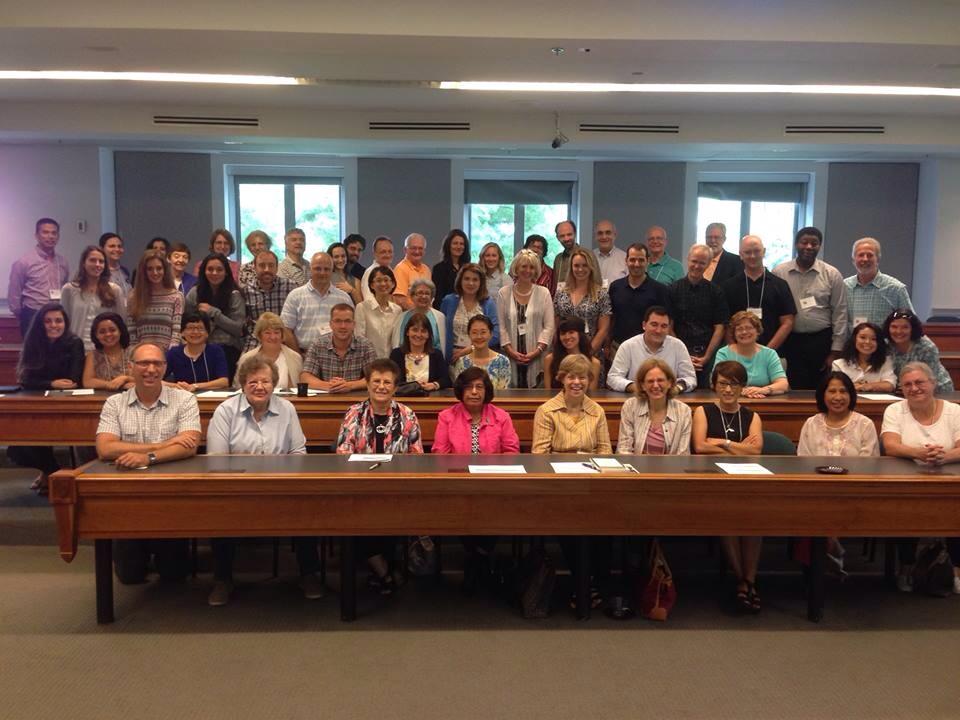
I had the wonderful opportunity to go to the 2015 meeting held in Washington D.C. this weekend.  There I got to meet a lot of interesting and committed people who see in business a means to transform the lives of others, and to bring them into communion with others.   There were many varied stories about how that was practically lived out.  One filmmaker shared his experience in upstate New York of finding himself developing a community of artists and people involved in film, and helping establish a common space for them to work– even though some of them are his competition.  One construction business owner shared his experience of being involved in very difficult negotiations with the lawyers of a company suing him, but taking time to discuss a personal concern of one of the opposing lawyers, and soon they were all sharing problems together and sympathizing across the table.  That (obviously) changed the whole nature of the meeting, and in the end, the opposing company ended up being much more gracious than they would have otherwise.  Another company owner involved in information technology services shared an opportunity he had had to collude with another minority company to get some government money for a large project, and turning it down because of his commitment to the EoC values.

These were business people firmly committed to doing business in a way which looks beyond the bottom line.

There is more to it than just ‘doing the right thing’ though.  There are ways that these business owners spend their money– not just on themselves, but in ways which are beneficial to others.  There is a strong commitment to bring what some might consider overly-generous benefit to employees and customers above and beyond what is necessary or expected normally.  But that is the generosity and culture of reciprocity which they want to live out.

The EoC, while its origins are from the Focolare movement of a group of Catholics, is open to all, not just Catholics, and not just Christians– there was one Muslim at the meeting as well.  What the EoC does well is try to bring faith and spirituality to bear on how someone conducts their business– the values we often profess are hard to live out concretely because we get so focused on the tasks at hand, but there is a great deal of satisfaction living out your values through your work practices and how you run your business.

If you have an interest in being a part of the EoC, let me know.  After doing a brief presentation for them about my rental projects, they welcomed me in as one of them! 🙂

October 9, 2015: Symposium on Business, Faith, and the Common Good

       IMG_1672

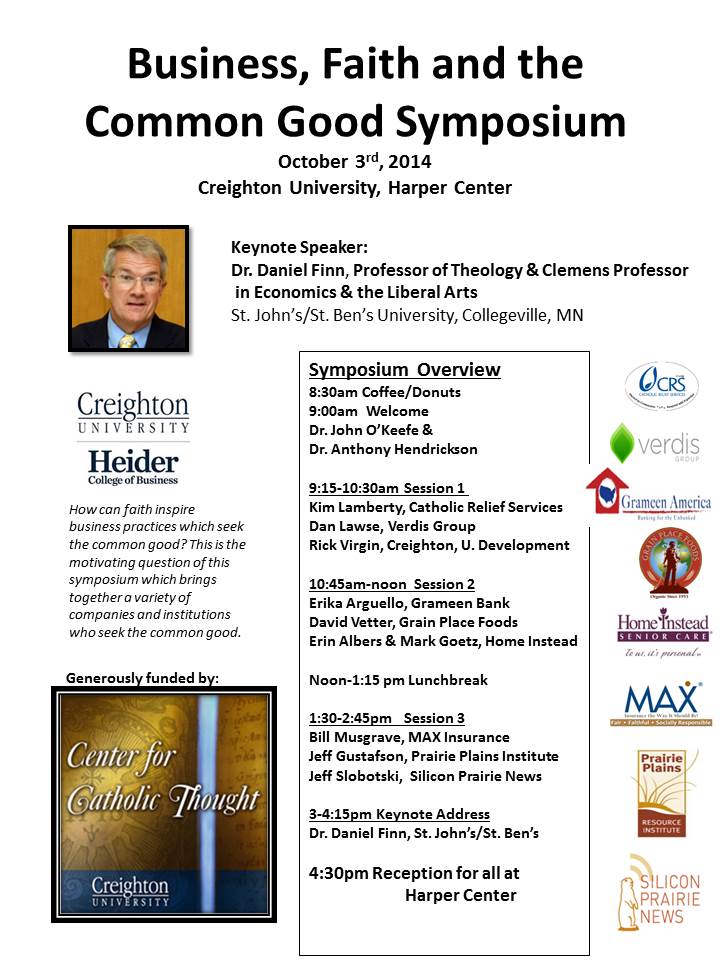
This year’s 2015 Business, Faith and the Common Good symposium will be held at the Harper Center in the Heider College of business.   Our keynote speaker will be Kenneth Goodpaster, who has taught at Notre Dame, Harvard, and held a Chair in Business Ethics at St. Thomas University for many years, and has written extensively on how faith should affect our business practices.

The symposium is an all day event on Friday, October 9th, and like our 2014 symposium, we hope to bring in business leaders from the local community who own or manage companies with a mindset directed by their faith and their concern for the common good.  Typically we’ve had 3 breakout sessions at a time, each with different business owner who intentionally seeks to do business with a special concern for the common good or with faith-rooted principles and values, or both.  We are looking for suggestions for presenters, so if you have any ideas, please don’t hesitate to contact Andy Gustafson at andrewgustafson@creighton.edu  If you want to be get notices of events, email us or join our facebook page.

Here is last year’s flyer:

BFCG Symposium

The Poor and the Common Good in the Philippines: Enchanted Farm

a poverty        th_20150228_133106 –Andy Gustafson

Helping the poor to establish a baseline of human dignity for themselves through work is something that is essential.  I just returned from a great conference in the Philippines put on by the Ryan Institute at St. Thomas University, De Lasalle University of the Philippines, and Ateneo University, a Jesuit University in the Philippines.  There were so many great takeaways from the conference having to do with Catholic Social Teaching, but a few were:

1. Philanthropy needs to be directed towards creating possibilities for the poor to have sustainable means of taking care of themselves.  Handouts to the poor are not a long term strategy.

2. In the Philippines, as in many countries, those who gain education are educated to go ‘work for other people’– nursing, maids, laborers, etc.  Usually they are not encouraged to think entrepreneurially– the truly sustainable means by which they might support themselves.

3. One very important insight from Catholic Social Thought– which any Christian can accept I believe– is that of subsidiarity– that grassroots localized projects are better than centralized ones at empowering individuals.  Church, labor unions, and other localized organizations should be used to help people have the means to support themselves.

4. Solidarity: While it is important to help each person to be able to break the cycle of poverty, it is also important to recognize that we are all in this together– and that my actions affect others, and visa-versa.  To act as though we are isolated atomistic beings separate and independent from all others is not only not in line with Christian thought, it is simply false.

th_20150228_170146      th_20150228_143755

Subsidiarity and Solidarity are two of the basic “Catholic Social Teachings” which are, in my mind, acceptable to any Christian.  The fact that they arose from Catholic thinkers is ultimately irrelevant to their truth.

th_20150228_125154th_20150228_133233

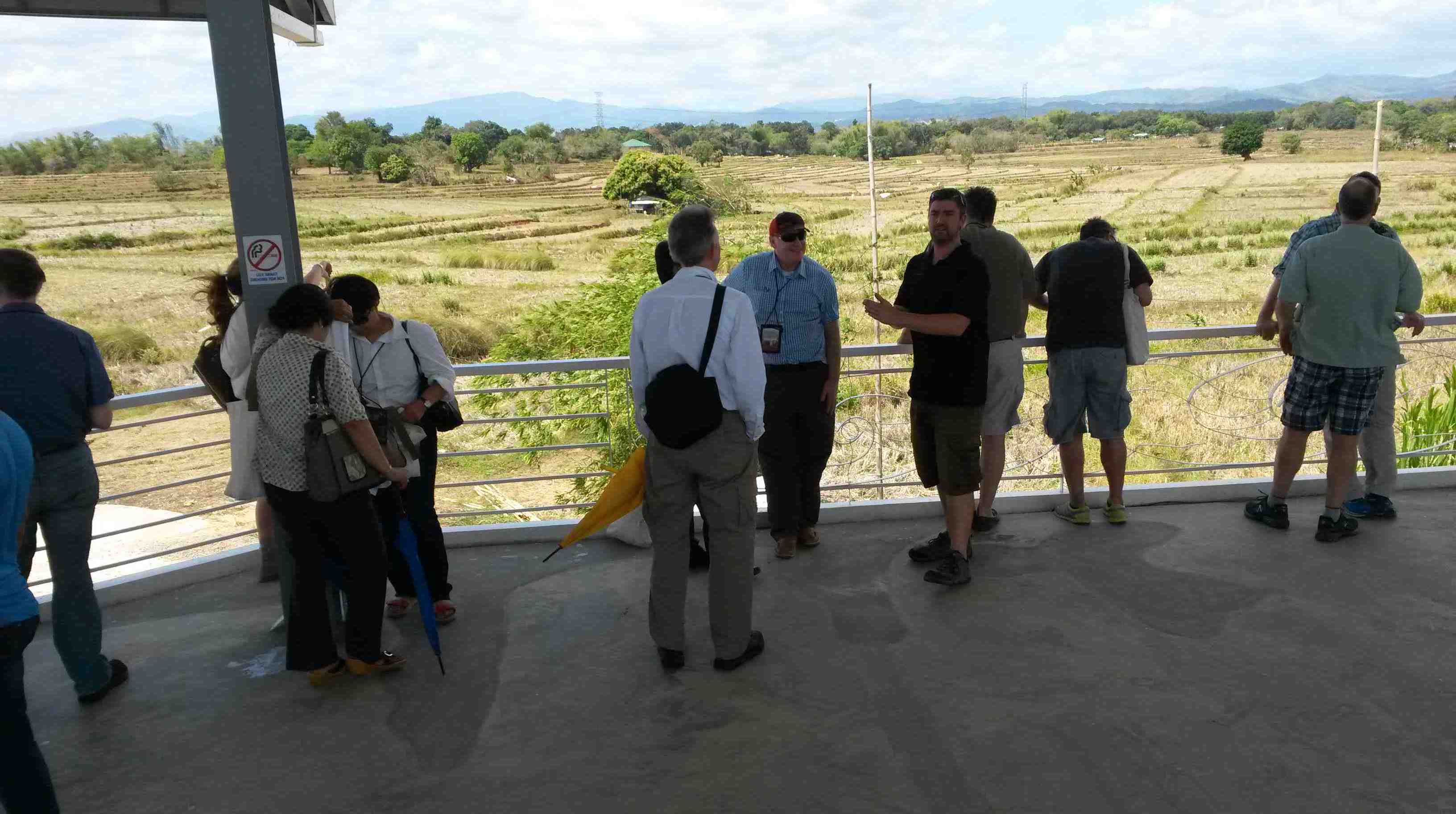
So the Enchanted Farm, which we visited on Saturday, is a project of Gawad Kalinga, which is a national movement in the Philippines to empower the poor and help them out of poverty.  In the remainder of this post, I will simply post what their website says– it is a powerful understanding of poverty, the causes of poverty, and their attempt to overcome it:

From their website:

The problem of poverty is not about a lack of money as much as it is a loss of human dignity.

The poor may not have steady financial resources to support their basic needs but what permanently cripples them the most, disabling them from rising from poverty, is the loss of human dignity. Once stripped of their dignity — forced to live in conditions quite close to that of a pig pen, people start to live like pigs. It is then that standards of living decline, value systems crumble and chaos rules. Moreover, they lose their capacity to dream and work towards achieving their dreams.

Poverty is most debilitating to the men who are reduced to living like animals (becoming predators) when they are de-humanized and stripped of their natural male nobility.

Men, by their very nature, are meant to be hunters and protectors of their families and, most especially in the Philippines, men are expected by society to be the providers. Caught in the cycle of poverty and being unable to deliver as he is expected to, Filipino men lose motivation to be productive members of society and instead turn towards vices of drinking, gambling, mendicancy and some, even turn to a life of violence to regain their primacy over society.

The cycle of poverty is rooted in the divisiveness of our nation.

The Filipinos are an intelligent and talented people but most have been pursuing the path of individual gain and achievement without a conscious effort to work for the common good. For decades now politics, religion, socio-economic class and ideology have divided the country.  Further, driven by ambition, self-interest, pride and the need to provide for their children and their family beyond their need, those who have material wealth have turned a blind eye to a great many others who are in need. The Filipino has lost his inherent culture of bayanihan, its culture of working together as a community for the greater good.

That is why GK’s attack to poverty is quite revolutionary. It does not address poverty through a purely financial solution. It addresses poverty through environmental and social engineering. And more than being a non-profit or charity organization,

Gawad Kalinga is a movement of nation-building.

GK focuses on the restoration of the dignity of the poor by building colorful GK homes in beautiful communities.

From flimsy shanties of bleak grey rusted iron sheets, motley brown used plyboards and tattered tarpaulins and plastic, GK builds for the poor sturdy structures painted in bright colors of hope. From unsanitary surroundings, GK brings them to clean, beautifully landscaped communities. From bare survival in structures akin to pig pens and chicken coops the poor now turn to a quality of life equal to upscale subdivisions. By providing them with a middle-class environment the poor start to have middle-class dreams and aspirations to work for.
Where most interventions target women and children, for GK the initial intervention is through the men. 

GK raises the men to their inherent nobility and productivity by getting them to build homes for their family and for their community.  GK puts man’s natural brawn to good use – turning him away from destructive activities in society and instead leading him towards building for his neighbor.


The success of a GK community is hinged on the improved quality of life of the entire community rather than the economic or material standards of living of an individual.

Through its various programs, GK aims to renew the culture of bayanihan in its communities. GK breaks the current culture of individual gain and instead envisions a strong united community that builds together, plants together, harvests together and rises together – believing that no one will be left behind.

Through GK, Filipinos and people of all faiths and races are transcending differences to come together for nation-building. GK unites by not discriminating in terms of politics, religion or ideology. In Mindanao, GK has forged friendships and partnerships in various communities where Christians, Muslims and lumads build together, live together and rise together.

Breaking out of the usual fund-raising mentality, GK focuses on building strong partnerships.  In GK, everyone is welcomed not as a donor but as a key stakeholder… a committed and passionate partner in re-building the nation.  Through a creative formula of counterparting, GK has been able to forge strong multi-sectoral partnerships that bring together individual resources (financial, human and extraordinary) to effectively fill in gaps. In the model of Kalinga Luzon, the national government through National Disaster Coordinating Council and the Department of Social Welfare and Development provided a 50/50 share of the funds with GK for the construction of homes. The local government secured the land, provided site development and the use of heavy equipment.  Other groups come in to drive the programs on-ground.

I was so grateful for the opportunity to learn about the work of Gawad Kalinga and the Enchanted Farm.

th_20150228_155238 th_20150228_133244

The Divide Between Colleges of Business and Colleges of Arts and Sciences

The above slide, about typical distrust of business– is probably typical of many Arts and Science colleagues at most colleges and universities.  Business does not have a great reputation, and the business schools often have the same bad reputation.  

Michael Naughton (St. Thomas University, MN) is a well known scholar who does work in Catholic Social Thought (CST) as it relates to business.  In a 2009 article, he articulates well the ‘disconnect’ between colleges of business and arts and science colleges at Catholic universities.  There are some practical reasons why business faculty have a difficult time seeing how to bring CST to bear on business.  As Naughton puts it (his quotes in italics**)

The Catholic social tradition is not always portrayed in the most accessible and useful manner by its proponents, especially as it relates to business. One needs to be sympathetic with deans and business faculty who find little help to envision the role of this tradition, especially the articulation of its social principles within business education. Too often the content of this tradition is perceived in terms of extrinsic moral constraints, rather than an understanding of the intrinsic character of between CST and CSR on the ‘Good Company’” 

The process of this extrinsicism with faculty, especially as it relatesto Catholic social principles, usually goes something like this:
Theologians and philosophers articulate a list of principles, such as human dignity, common good, subsidiarity, and solidarity, which are described universally as having no explicit connection to business

Business faculty look at the principles with a certain sense of good will, but are unclear about their relationship to business. As one faculty member responded, “The principles look innocuous enough, who can be against them?”

Theologians and philosophers, however, see more difficulty between the principles and business practice than do their business colleagues. They insinuate that businesses, as presently constituted, are not living up to these principles. Their critiques verge on prophetic denunciations, yet often fail to apply the principles to the specific technical complications of business.
Business faculty get defensive and respond that such theologians and philosophers, and the church in general, do not understand business and the way markets work. Yet business faculty continue to
describe their discipline only in empirical, quantitative, and technical terms, failing to engage their discipline with the demands of justice.

• The unproductive impasse continues where theologians and philosophers fail to understand the demands of business, and business faculty fail to take seriously the social vision of Catholicism.

Naughton points out:

There are many exceptions to this scenario, but it is difficult for disciplines such as theology, philosophy, and business to communicate with each other. The lack of a common understanding of the Catholic social tradition, however, is more serious than just specialized disciplines talking past each other. Such misunderstandings result in the failure of the Catholic university to fulfill its mission as future business leaders are denied a moral and spiritual vision of organizational life. If a business education in a Catholic university is to be mission-driven, it is imperative that the faculty understand the significance of Catholic social tradition for business.

I think that this impasse is very common at Catholic colleges and universities, including at my own.  There is some degree of distrust and defensiveness at work.

But Naughton is positive about Business Faculty in many respects– he says they do a better job of understanding how business and the mission of a Catholic university go together, for example, (while many A&S might feel that the practice of business is antithetical to Catholic social thought.  

Naughton asks,

Do Catholic universities and their business programs have the faculty to offer a distinctive kind of mission-driven business education, informed and animated by the Catholic social tradition? There are many positive reasons to answer affirmatively. Let me identify four of them:

• Interdisciplinary: Because most Catholic universities are not research universities there tends to be more openness to inter disciplinary engagement within their business schools. Catholic  universities have strong departments in philosophy, theology, and literature, which provide the conditions for fruitful conversations between business and liberal education.
• Business Ethics: Catholic business schools have been leaders in developing the discipline of business ethics and in helping the business community to see ethics as integral to running a business.
• Spirituality: The language of vocation, calling, and spirituality has become increasingly incorporated into the curriculum and research of business faculty. The recent series of Lilly grants on vocation has
contributed in this area. Many faculty of Catholic universities have participated in the Management, Spirituality, and Religion interest groups within the Academy of Management as well.
• Institutional Mission: Faculty within Catholic business schools understand the importance of institutional mission and identity better than some of their liberal education colleagues. There is a strong belief that students should engage the Catholic social tradition with business issues.

But Naughton says that, despite these strengths, there are often some problems in many business programs as well:

There are several underlying problems within Catholic universities and their business programs. These concern hiring patterns and the lack of faculty development programs on mission. The majority of
business faculty, Catholic or otherwise, come to Catholic business schools with the little formation in literature, history, philosophy, and theology required to give them a distinctively disciplined perspective on their own scholarly pursuits. A growing number of faculty members have no experience in Catholic education. They often lack knowledge of the Catholic social tradition and, increasingly, many have no experience of any kind of liberal education. More and more faculty in Catholic business schools have a purely technical education, embark on a Ph.D. program that ignores moral and spiritual questions, and reduce their research interests to empirical, quantitative, and so-called nonnormative questions.  Once they arrive at Catholic business schools, little progress is made in understanding the meaning of a mission-driven Catholic business education.

Because of this, leaders within Catholic business schools have not recognized the full dimension of mission drift within their schools. While often optimistic and confident about their schools, if leaders fail adequately to grasp the gap between operation and aspiration, it is doubtful whether the religious mission of Catholic business schools will survive, let alone thrive. This doubt stems both from the understated  character of Catholic mission and leaders’ lack of understanding of the
Catholic intellectual and social tradition.
Despite these obstacles, faculty from Catholic business schools and programs can make a significant contribution to the fulfillment of a robust, differentiated business education. If Catholic business schools can keep themselves from being hijacked by an instrumental rationality that attempts to escape moral agency, and resist abdicating their custodial role of mission to theology and philosophy, then they can play an important role in advancing the mission and identity of Catholic universities.

But its not just the Business School side who have some issues to deal with.  Naughton points out some problems with the A&S side as well:

Faculty within liberal education departments, especially theology and philosophy, play a crucial role in how they interact with business faculty and how they engage questions of work and business. Unfortunately, there is a divide in many Catholic universities between liberal and business faculty that makes it difficult to provide a more integrated education for business students. Philosophy and theology faculty often operate with a Platonic/Aristotelian bias against work and, in particular,
business.15 They also have little interest in understanding the work of their business colleagues. While philosophy faculty have engaged with business ethics, although the relationship has been an uneasy one, theologians have tended to ignore the question of business, either focusing on the question of Catholic social thought abstractly and theoretically or focusing on its socio-political implications.

Perhaps the greatest harm from all this is a schizophrenic education for students: 

This strained relationship creates a fragmented education for students. When a gulf between liberal and business education occurs, students get the impression that they are receiving two types of education: one that makes them more human and one that makes them more money. They are uncertain about how the two fit together. Challenges between the Catholic Social Tradition and
Business Theory and Practice: The Importance of Practical Wisdom The Catholic social tradition and its ability to foster practical wisdom is key to overcoming this kind of fragmentation in a student’s education. It is a religious and moral tradition that seeks the integration of the person: contemplative and active, body and soul, individual and social, and physical and spiritual. 

Living the life of a faculty member, I know that it is difficult already to get all the things done which are immediately pressing, much less attempt to build bridges to colleagues in other colleges at our university.  There are natural factors which lead to the disconnect, and in fact I would argue that many times there are parallel movements going on in the different colleges, which are unknown to the other colleges.  This can even be true from one department to the next within a college.  But what is often difficult is a cross-uni-versity awareness of how to communicate with or learn from each other.  The potential fragmentation of our faculties, as well as a disparate fragmentation of our students education, are the result.

**All quotes are from Michael Naughton, “A Complex Mission: Integration of Catholic
Social Tradition with Business Education” in The Journal of Catholic Higher Education” 28:1 (2009)
Bibliography of Koch Brothers Controversy with regard to supporting Catholic Colleges and Universities

koch_brothers   by Andy Gustafson

David and Charles Koch are controversial figures.  They have been criticized by many for influencing politics and policies with their billions of dollars.  Being two of the wealthiest citizens in the United States, they wield a lot of financial power, and one way that they have chosen to use their wealth is to support various libertarian-leaning educational institutes at colleges and universities.  Click here to see the list of universities and colleges who have received money from the Charles Koch foundation.

This has become especially controversial as they have begun to support research and education initiatives at Catholic Colleges and Universities.  Many Catholic theologians and other thinkers feel that the Koch Brothers business practices and political views are at odds with Catholic Social teaching.   Some others disagree with that assessment, and feel that if sufficient oversight is given to the use of these funds by the standard university procedures to keep the donations from simply producing propaganda without academic merit, and if the funds can instead actually be used to enhance the education of students and academic advancement of the university, then its all for the greater good.

Here is a random list of some of the recent articles surrounding this controversy.  (Click on the link to go to the article):

“Controversial, Capitalist Koch Brothers Pledge Millions To Catholic University Business School” Hugginton Post (Feb, 2015)

“Koched Up” Commonweal Magazine, Grant Gallicho (Jan, 2015) 

“Tim Busch, the Koch Brothers, Capitalism and Catholicism”  Michael Winters in National Catholic Reporter (Jan, 2015)

The Catholic Universityof America accepts more money from Charles Koch Foundation”  

“Of two minds on economics: Does teaching at Creighton institute contradict Catholic social thought?” Steve Jordan, Omaha World Herald (Dec, 2014)

“Take Take Koch money & run your charity. Does their cash truly smell?”  New York Daily News  (June 25, 2014)

“United Negro College Fund Accepts $25 Million from Koch” Inside Higher Ed (June, 2014)

“Koch Brothers Money Hasn’t Bought as Much as You Think” by Matthew Cooper,  Newsweek, (April 24, 2014)

“Dirty Money: From Rockefeller to Koch” in The Atlantic (Mar, 2014)

“Can Koch Money Come To Campus Without a Fight? Ask Catholic University” Jack Grauer, Inside Philanthropy (Mar, 2014)

“Scholars Protest David Koch’s Donation to Catholic University” Mother Jones (Dec, 2013)

“Educators Criticize Catholic University for Accepting Money From Conservative Koch Brothers” Morgan Lee, Christian Post Reporter (Dec, 2013)

Vocation of the Business Leader

“Faith enables Christian business leaders to see a much larger world, a world in which God is at work, and where their individual interests and desires are not the sole driving force…to promote human dignity and the common good and not merely the narrow interest of any particular stakeholder.” (from Vocation of the Business Leader)

Vocation of the Business Leader: A Reflection (2012) is a work which resulted out of a workshop symposium on Pope Benedict’s encyclical, Caritas En Veritate, arranged by the Pontifical Council for Justice and Peace.  It is, in short, a business-friendly set of takeaways from the encyclical for today’s business leaders.